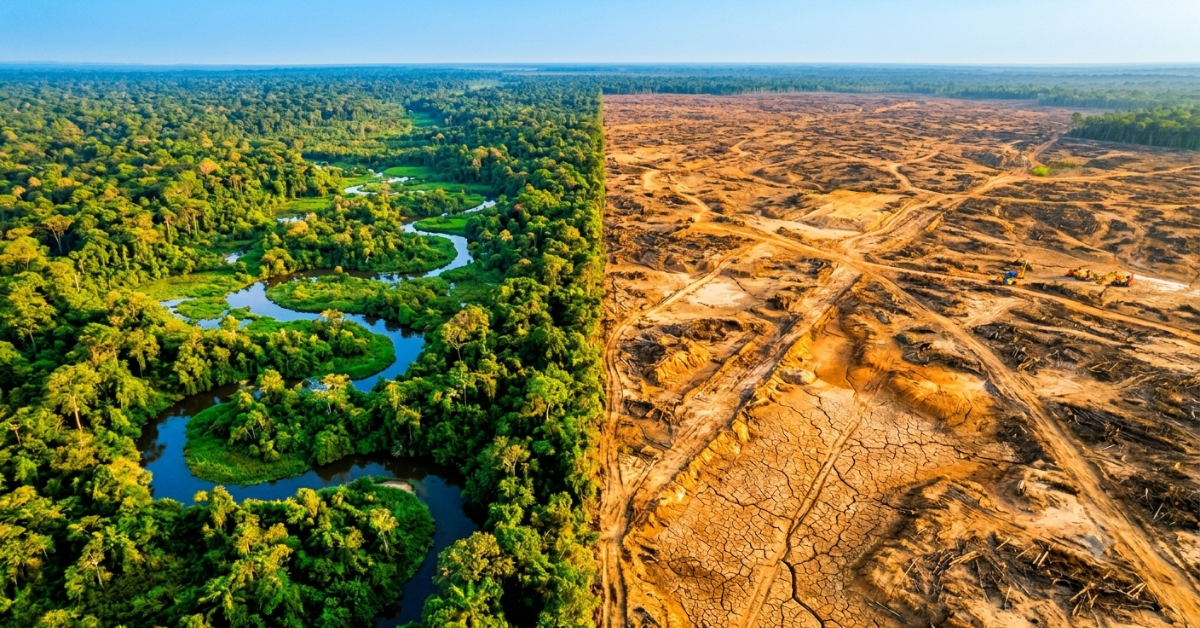
| Conservation of natural resources means protecting and managing forests, water, soil, minerals, air, and biodiversity so they remain available for future generations. It matters because natural resource depletion is accelerating due to deforestation, climate change, pollution, intensive agriculture, and unsustainable consumption. |
The conservation of natural resources is no longer a distant concept. For billions of people, it’s a matter of survival, and for millions of species, it’s a matter of life and death. Forests the size of countries disappear every year. Rivers run dry. Species disappear even before we can call their names. And our soil, which gives us life, is eroding more quickly. People are consuming the Earth’s resources at 1.7 times the rate at which they can replenish them. This implies that we rely on a future that may not be able to repay us.
However, the best shared articles on this matter rarely tell you the right solutions. The instruments to turn the tide of the crisis are available today through forest monitoring. This monitoring ranges from space-based monitoring to smart AI applications for water use and precision agriculture. The question is only whether they will be deployed in time.
This piece presents actual figures, deficits, and solutions that are helping us conserve what’s left of the natural world.
Key Facts at a Glance
| Topic | Key Fact |
|---|---|
| Forest Loss | 8.1 million hectares of forest were lost globally in 2024 — a rate 63% higher than needed to halt deforestation by 2030. |
| Biodiversity | Up to 1 million species are threatened with extinction, according to the United Nations. |
| Soil Degradation | Global degraded land rose from 11.3% to 15.5% between 2015 and 2019, affecting the well-being of 3.2 billion people. |
| Wetlands | 85% of the world’s wetlands have been lost since 1700, with 35% lost since 1970 alone. |
| Carbon Emissions | Fossil fuel CO₂ emissions are projected to reach 38.1 billion tonnes in 2025, a record high. |
What Is Conservation of Natural Resources and Why Does It Matter More Than Ever?
Conservation of natural resources involves the careful, responsible, and sustainable utilization and management of the natural systems of the Earth. These include forests, water, soil, minerals, air, and biodiversity to ensure they are available.
Give it a bit of thought. All clean air, fresh water, food, and all medicines are natural resources. These are not background amenities. They are the operating system of human civilization.
Renewable vs. Non-Renewable Resources: The Critical Difference

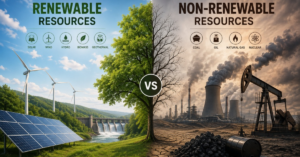
Some resources are treated more equally than others in their treatment. Renewable resources (e.g., solar energy, wind, sustainably managed forests, freshwater cycles) can be naturally replenished. We cannot replace non-renewable resources on a human time-scale once used, like fossil fuels, minerals, and some groundwater reserves.
Resources at the frontier- soils, forests, and biodiversity raise the greatest challenge to the conservation of natural resources. These can potentially regenerate, but only if we allow them time, space, and protection. If they’re stripped too quickly, they exceed tipping points that can’t be overcome. Understanding how climate change accelerates resource loss and what climate resilience strategies can slow it is essential. Currently, we measure timelines for the conservation of natural resources in years, not decades.
Ecosystem Services: The $125 Trillion Value We Take for Granted
This is a number that turns the discussion. The economic value of ecosystem services, such as pollination, water purification, climate regulation, and nutrient cycling, is noteworthy. They provide benefits to humans and more than $125 trillion annually, a figure that exceeds the GDP of most nations on Earth.
However, these services don’t show up on any national balance sheet. We use forests for timber, rivers for draining, and soil for farming. These are unreplaceable systems which create trillions of dollars every year. The resulting consequences when they go wrong are devastating, and recovery is inter-generational. This is exactly why the conservation of natural resources is treated as an economic priority, not just an environmental one, in national planning today.
The Alarming Data: How Fast Are We Losing Earth’s Natural Resources?
Humanity is consuming natural resources at a rate faster than the Earth can replenish them. The overuse of natural resources threatens environmental sustainability and economic stability. Sustainable resource management is crucial for future generations, and the conservation of natural resources is the single clearest lens for tracking whether we are moving in the right direction.
Forests: 8.1 Million Hectares Lost in 2024 Alone
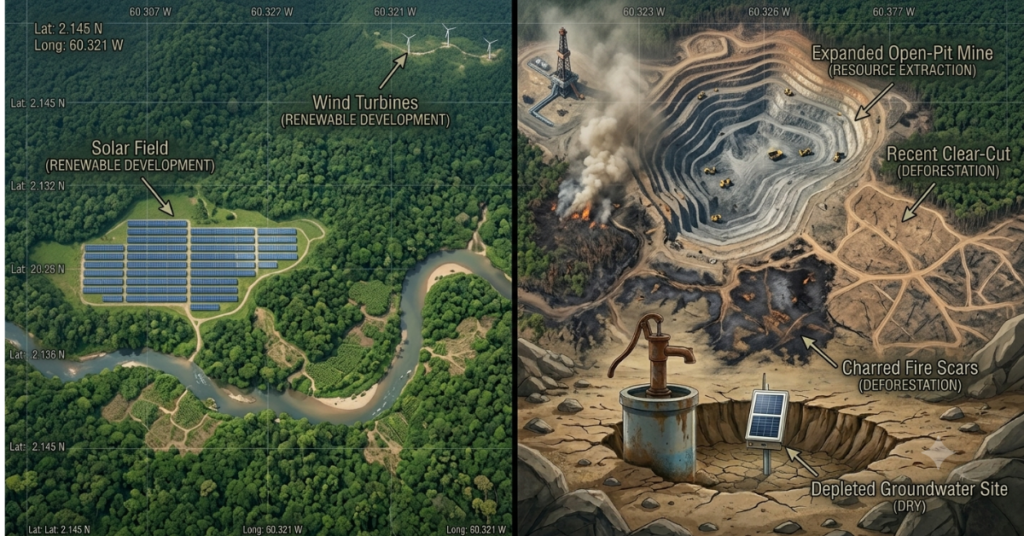
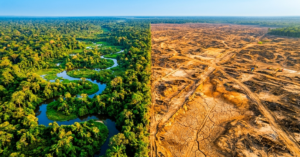
The 2025 Forest Declaration Assessment resulted in a harsh assessment: 8.1 million hectares of forest were lost in 2024. A level of destruction 63% greater than the level required to stop deforestation by 2030. Between 2001 and 2024, 34% of all global tree cover loss is likely permanent, meaning these forests are unlikely to regrow naturally. Sixty-one percent of forest loss is attributed to permanent land use change in tropical primary rainforests.
Forests cover 4.14 billion hectares, which is about one-third of the Earth’s land surface, as stated in the FAO Global Forest Resources Assessment 2025. The annual rate of deforestation, however, is slowing. It has decreased from 17.6 million hectares during the 1990s to 10.9 million hectares per year between 2015 and 2025. It is very alarming. In 2024, an additional 8.8 million hectares were degraded, further compromising the conservation value of the ecosystem.
Remote sensing techniques using the world’s most advanced satellite systems now monitor forest loss globally in real time at 1-kilometer resolution, giving conservationists, governments, and communities the precise data they need to act before loss becomes permanent.
Biodiversity: One Million Species Facing Extinction
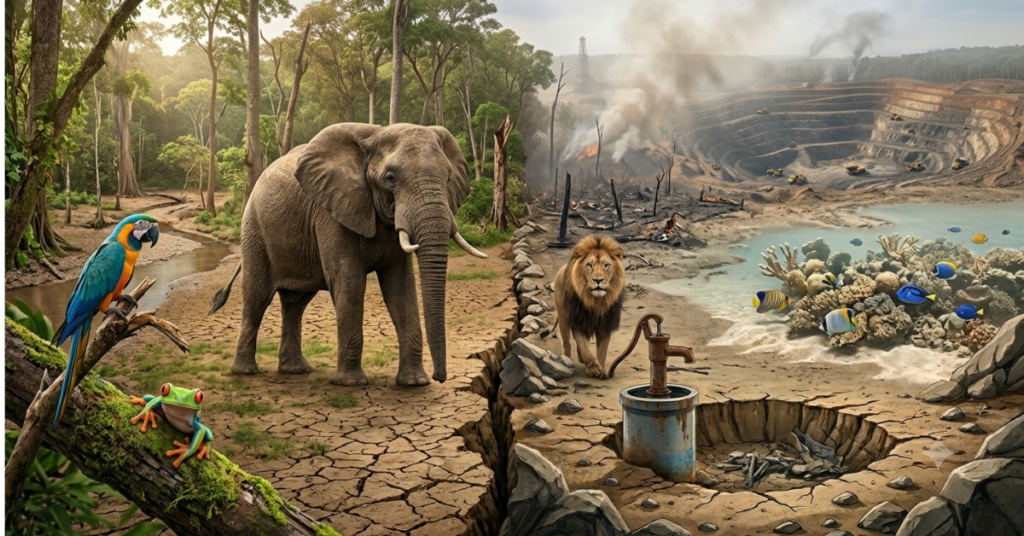
The United Nations has issued its starkest warning. As many as a million species are at risk of extinction, with many in the near future. Primarily due to habitat loss, deforestation, land-use changes and climate change, extinctions are happening at 10-100 times the background rate of species loss.
The effects are reverberating. Pollination, soil fertility, water purification, disease regulation, climate stability and human life all depend on biodiversity. These services are lost when biodiversity declines. Amazon Rainforest, one of the strongest carbon sinks, is now emitting more carbon than it is sequestering. This is due to climate change, as well as deforestation.
Furthermore, since 1700, 85% of the world’s wetlands have been lost, with an average loss of 35% since 1970. This has decreased the water purification capacity of more than 2 billion people and has wiped out irreplaceable habitats for thousands of species.
Water: The Invisible Crisis Threatening 2 Billion People
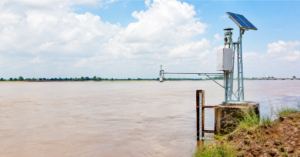
When people realize they need fresh water, but don’t have it. Today, more than 2 billion people reside in countries experiencing water stress. The aquifers that formed over thousands of years are being depleted in a matter of decades. Once water filters and stores in wetlands for entire regions have been drained for agriculture and development.
Climate change worsens all facets of water problems: melting glaciers provide freshwater to billions, erratic monsoons, longer and more intense droughts, and more devastating floods occur when they do. The use of natural resources, especially water, by protecting watersheds, restoring wetlands, and adopting smart irrigation systems is not a luxury. It is the foundation of food security and public health for the new generation. How GIS mapping services transform raw water data into conservation decisions that planners and policymakers use is one of the most critical and most underreported conservation stories of our era.
Soil: The Foundation of Food Security Is Crumbling
Between 2015 and 2019, the global proportion of degraded land increased from 11.3% to 15.5%, undermining the well-being of 3.2 billion people, according to UN SDG data. Soil erosion, nutrient depletion from intensive agriculture, salinization from over-irrigation, and compaction from heavy machinery are quietly destroying the resource that produces 95% of the world’s food.
It takes an average of 1,000 years to form 1 centimetre of topsoil naturally. We are losing it 100 times faster than that in some regions. This is the conservation crisis that receives the least media coverage, and it may be the most consequential of all. Soil health is where the conservation of natural resources meets food security most directly.
The Top Causes of Natural Resource Depletion You Need to Understand
There are some causes of natural resource depletion, which are discussed below. Understanding these drivers is the first step toward effective conservation of natural resources, since each cause demands a different policy response
Agricultural Expansion: The Biggest Driver of Deforestation
Agricultural expansion accounts for nearly 90% of global deforestation, according to UN data. The demand for beef, soy, and palm oil is the single greatest force of forest destruction. About 80% of deforestation in the Amazon is linked to cattle pasture expansion. Soy farming contributes roughly 10% of global deforestation, most of it to produce animal feed. Palm oil production is responsible for approximately 5% of tropical deforestation.
Crucially, these are not inevitable trade-offs between food security and the conservation of natural resources. Smart agriculture technology, which utilizes precision data, satellite monitoring, and AI-driven yield optimization, makes it possible to produce significantly more food on existing agricultural land, reducing the pressure to clear new forest. The technology exists. Scaling it is the challenge.
Fossil Fuel Dependency and Carbon Overload
The 2025 Global Carbon Budget estimates fossil fuel CO₂ emissions will reach 38.1 billion tonnes this year, a figure that continues to drive temperature rises, accelerate glacier melt, destabilize rainfall patterns, and increase the frequency of extreme weather events that destroy natural ecosystems. Between 2015 and 2024, emissions from permanent deforestation alone ran at approximately 4 billion tonnes of CO₂ per year.
Transitioning to clean energy solutions that reduce fossil fuel dependency is not simply an energy policy issue. It is one of the most powerful conservation actions available because, without decarbonization, every other conservation effort fights against an accelerating headwind.
Urbanization and Land Use Change
Urban areas are expanding rapidly, converting natural land at unprecedented rates. Between 2015 and 2019, the global proportion of degraded land increased by more than 4 percentage points. Poorly planned urban growth destroys green space, fragments wildlife habitats, increases impervious surfaces that prevent groundwater recharge, and generates pollution that damages surrounding ecosystems.
Smart real estate development and zoning optimization tools that use geospatial analysis to guide urban expansion into already degraded land rather than into productive ecosystems and habitats are one of the most underutilized conservation tools for the conservation of natural resources available to municipal planners today.
Powerful Benefits of Conservation of Natural Resources: What We Stand to Gain?
The conservation of natural resources protects the environment, supports economic growth, and ensures a sustainable future for generations to come.
Climate Stability and Carbon Sequestration
Forests absorb over 2.6 billion tonnes of CO₂ annually, making them the largest terrestrial carbon sink on Earth after the oceans. Protecting existing forests and restoring degraded ones could provide approximately one-third of the greenhouse gas emissions reductions needed by 2030, according to UN climate scientists.
The economics are compelling. Financial flows for harmful subsidies currently outweigh green subsidies by over 200:1, according to the Forest Declaration Assessment 2025. Reversing this ratio, redirecting agricultural subsidies toward sustainable land management and rewarding forest protection, is one of the highest-return climate investments available, and a clear demonstration of how the conservation of natural resources pays for itself. Understanding the role of ESG and sustainability intelligence in redirecting capital toward conservation-positive outcomes is increasingly critical for governments, investors, and corporations alike.
Food and Water Security for Future Generations
Healthy soils produce healthful meals. Intact forests regulate rainfall and save you from the flooding and drought cycles that smash harvests. Functional wetlands purify the water and buffer against floods. These are not summary environmental benefits; they’re the infrastructure of world food and water security.
Conservation of natural resources is therefore inseparable from the dreams of feeding ten billion people by 2050, ensuring time-honoured access to easy water, and protecting public health.
Economic Value: Conservation Pays More Than Extraction
The economic case for conservation of natural resources is now unambiguous. Intact ecosystems generate a much greater long-term financial value than the assets extracted from them. Sustainable fisheries outperform collapsed ones. Intact forests generate more value through water law, tourism, and carbon credits than through wood by themselves. Healthy coral reefs contribute an estimated $375 billion yearly to coastal economies via fisheries, tourism, and coastal protection.
In contrast, environmental sustainability frameworks that help organizations move beyond resource extraction toward regenerative business models are increasingly the basis for long-term commercial competitiveness, not just regulatory compliance.
Proven Methods of Natural Resource Conservation That Actually Work
Effective resource conservation methods that need to be considered.
Sustainable Land Use and Precision Agriculture
The single most powerful lever for reducing deforestation pressure is making existing agricultural land more productive. Precision agriculture, which uses satellite data, soil sensors, AI-driven irrigation, and GPS-guided planting, can increase yields dramatically while reducing water use, chemical inputs, and land area required.
Data-driven high-yield agricultural solutions that guide farmers toward more efficient, sustainable practices are not just an agronomic tool. They are a conservation instrument. A farmer who produces 40% more from the same land has no incentive to clear the forest at the field edge. Combine this with decision support systems built on applied GIS solutions that help planners identify where agricultural intensification is most viable and where land should be left wild, and you have a powerful framework for reducing conversion pressure on natural ecosystems.
Reforestation, Afforestation, and Ecosystem Restoration
Restoration is gaining momentum. At least 10.6 million hectares now host active forest restoration projects worldwide, according to the Forest Declaration Assessment 2025. But global data remain too fragmented to determine whether the world is recovering forests at the scale required, a critical gap that geospatial data production and satellite-based forest monitoring are uniquely positioned to fill.
Effective restoration requires more than planting trees. It demands the right species in the right place, based on local soil, climate, and biodiversity data, a reminder that the conservation of natural resources is a science, not just a good intention. Mapping, cartography, and spatial visualization tools that model optimal restoration sites accounting for connectivity with existing forest, hydrological function, and carbon sequestration potential are transforming reforestation from a blunt instrument into a precision conservation strategy.
What Water Conservation and Smart Resource Management Are Necessary?
Protecting watersheds, restoring wetlands, reducing agricultural water waste through drip irrigation and precision scheduling, and implementing integrated river basin control are the best water conservation strategies to be had. Collectively, they address the total water cycle from precipitation to groundwater recharge to river flow to coastal freshwater shipping.
Indigenous peoples play a crucial role and frequently overlooked function here. Managing over 38 million square kilometres of land globally, including nearly 40 % of all included regions. Indigenous groups are among the world’s most skilled natural resource stewards.
Their traditional ecological knowledge, combined with modern remote sensing and image analytics that can verify land cover changes and detect early signs of degradation, creates a powerful partnership between ancient wisdom and cutting-edge technology.
Protected Areas, Wildlife Corridors, and Biodiversity Zones
Around 20% of the world’s forests are currently located in protected areas, approximately 813 million hectares. Nearly every country has pledged to protect 30% of Earth’s land and sea by 2030 under the Kunming-Montreal Global Biodiversity Framework. However, less than half of the countries have formally committed to this target at the national level.
Protected areas are only as effective as the data underpinning their management. GIS specialists who use geospatial data to monitor protected area integrity, detect encroachment in real-time, model wildlife corridor connectivity, and track species distribution across fragmented habitats are now indispensable to effective conservation governance. Without spatial data, protected areas are lines on a map. With it, they become managed, adaptive, living conservation systems.
How AI and Geospatial Technology Are Revolutionizing Conservation?
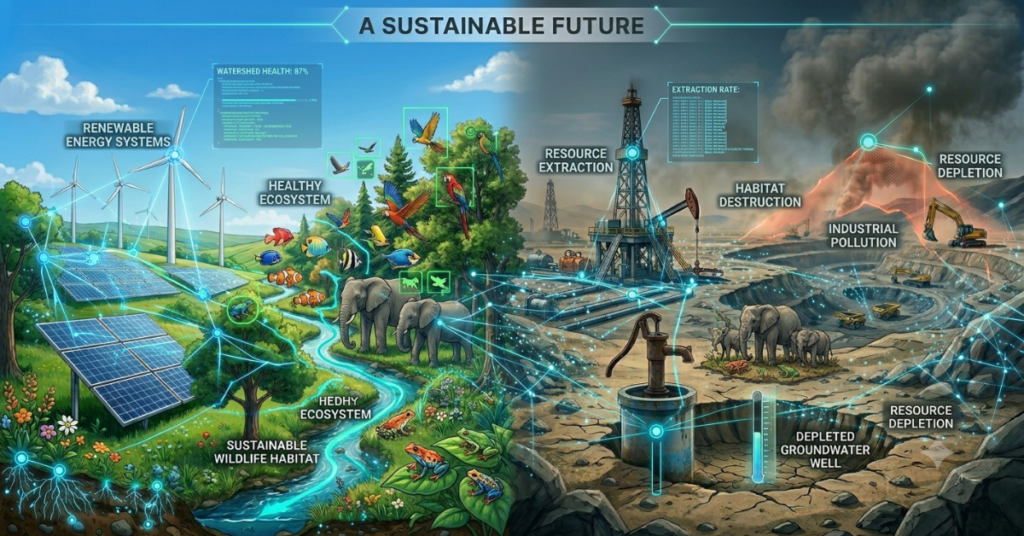
The use of AI and Geospatial technology provides valuable results that can be characterized as follows, each one advancing the conservation of natural resources measurably. The use of AI and Geospatial technology provides valuable results that can be characterized as follows.
Satellite Monitoring and Remote Sensing for Real-Time Tracking
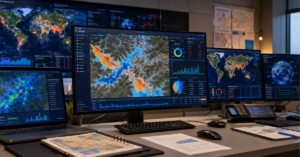
Conservation of natural resources at the planetary scale is only possible with planetary-scale monitoring. Satellite-based remote sensing services now deliver continuous, high-resolution coverage of forest cover, wetland extent, glacial retreat, soil moisture, land degradation, and biodiversity habitat, providing the ground truth that conservation decisions depend on.
WRI and Google DeepMind’s collaboration to map forest loss drivers at 1-kilometre resolution across the entire planet from 2001 to 2024 demonstrates exactly what becomes possible when AI is combined with satellite data at scale. The result: for the first time, conservationists can know not just that forest is being lost, but why, enabling targeted, driver-specific interventions rather than blanket policy responses.
Predictive Modelling and Risk Analytics for Smarter Decisions
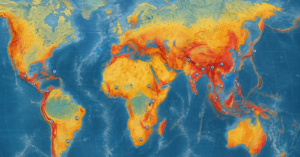
Climate intelligence, the synthesis of AI, environmental data, and geospatial analysis, is now being applied to conservation challenges that were previously impossible to address systematically. Predictive models can identify forests most likely to experience wildfires, which watersheds face the best groundwater depletion strain, which agricultural areas are most likely to encroach on covered land, and which coastal ecosystems are most prone to sea level rise.
Furthermore, risk analytics and decision intelligence platforms allow conservation organizations, government agencies, and NGOs to prioritize where limited financial and human resources should be deployed for the greatest impact. In a world where budgets for the conservation of natural resources are often insufficient, this kind of prioritization intelligence can make the difference between an ecosystem saved and one lost.
Digital Twins and Decision Support Systems for Ecosystem Management
AI GIS mapping services are enabling a new generation of conservation tools: digital twins of entire ecosystems that allow planners to model the impact of different interventions before committing resources, test the resilience of restoration plans against future climate scenarios, and monitor outcomes in real time as they unfold.
The AI-powered geospatial products platform brings these capabilities together in an integrated, accessible format combining climate dashboards, carbon tracking, geospatial analytics, parcel mapping, and risk assessment into tools that decision-makers at every level can actually use. From a district forest officer monitoring tree cover on a tablet to a national planning ministry tracking ecosystem service delivery against SDG targets, the same underlying spatial intelligence infrastructure serves every scale of conservation decision.
These tools are not theoretical. Completed real-world conservation projects, including mangrove conservation and rehabilitation in the Indus Delta in Sindh, cadastral mapping of 41,368 parcels across 60 mouzas, and multi-hazard vulnerability assessments in disaster-exposed northern regions, demonstrate what operationalized geospatial conservation intelligence looks like when it is built, deployed, and maintained at project scale.
Additionally, spatial databases and Web GIS infrastructure ensure that conservation data is not siloed in individual projects but integrated into shared, updatable systems that every relevant stakeholder can access, interrogate, and build on, creating the institutional memory that long-term conservation of natural resources requires.
What You Can Do: From Individual Actions to Institutional Change
Conservation of natural resources is not the exclusive responsibility of governments and large organizations. Every level of society has a role and a material impact. Here is how to make yours count:
As an Individual
- Cut paper and plastic waste; demand for these products drives deforestation and ocean pollution.
- Support products certified by FSC (forest), MSC (marine), or Rainforest Alliance, since your purchasing decisions directly fund sustainable resource management.
- Stay informed through the latest geospatial and climate insights to understand what is actually happening and what solutions are gaining traction
As a Business or Organization
- Commission an ESG consulting review to understand your organization’s impact on natural resources across the full value chain and to identify where conservation-positive changes are most achievable
- Use remote sensing and image analytics services to monitor the environmental footprint of your operations or supply chains, and to verify the conservation of natural resources claims of suppliers
- Invest in nature-based solutions, such as wetland restoration, reforestation, and sustainable agriculture, in your supply chain to generate measurable carbon and biodiversity co-benefits alongside commercial returns
As a Policymaker or Government Official
- Use predictive modelling and AI development tools to identify which ecosystems in your jurisdiction are at the highest risk, and where protective investment will have the greatest return
- Mandate environmental sustainability reporting for major land users and extractive industries, with third-party verification using satellite data
- Follow the latest conservation news and policy developments to stay ahead of the international frameworks that will shape national obligations over the next decade
Conclusion
Conservation of natural resources is the most consequential mission of our era. The forests are shrinking. The rivers are drying. The soil is eroding. The species are disappearing. And the window for reversing these trends is measurable in years, not decades.
But this isn’t always a tale of inevitable disintegration. It is a tale of alternatives. We have the records, the era, and the knowledge to make better ones. Satellite monitoring can detect woodland loss in real time. AI can predict which ecosystems are at maximum risk before they reach tipping points. Precision agriculture can feed the sector without clearing some other forest. Climate intelligence can manually allocate every rupee, dollar, and euro of conservation investment to where it’s going to do the most good.
The question is not whether we’ve got the tools for the conservation of natural resources. The question is whether or not we can use them urgently, at scale, and with the seriousness this disaster needs.
Act today. Explore how AI-powered geospatial and climate intelligence is being applied to the conservation challenges that threaten the planet. Additionally, find out how your corporation may be a part of defending the natural assets of the planet. Contact us to begin the conversation.
FAQs
What are the most alarming current statistics on natural resource loss?
In 2024 alone, the world lost 8.1 million hectares of forest. To meet the global goal of halting deforestation by 2030, the current rate of forest loss reduction must improve by 63% compared to the present trajectory. Up to one million species face extinction. Global wetland coverage has declined 35% since 1970. The proportion of degraded land globally rose from 11.3% to 15.5% between 2015 and 2019. And fossil fuel CO₂ emissions are projected to reach 38.1 billion tonnes in 2025. Remote sensing services and satellite monitoring are now the primary tools for tracking these losses in real time.
What are the most effective methods of conservation of natural resources?
The most effective methods combine land, water, and technology strategies rather than relying on any single approach. Precision agriculture increases yields on existing farmland, reducing pressure to clear new forest. Reforestation and ecosystem restoration, when guided by soil, climate, and biodiversity data, rebuild degraded land more reliably than tree-planting alone. Expanding and actively managing protected areas, currently around 20% of the world’s forests, safeguards biodiversity at scale. Watershed protection and wetland restoration secure water supplies for the long term. Increasingly, AI and geospatial technology tie these methods together, using satellite monitoring, predictive risk modelling, and digital twins to target conservation investment where it will have the greatest impact
How does conservation of natural resources connect to climate change?
The connections are direct and bidirectional. Deforestation releases carbon stored in trees and soil, accelerating climate change. Protecting forests could provide approximately one-third of the emissions reductions needed by 2030, while climate resilience strategies help ecosystems and communities adapt to the climate impacts that are now unavoidable.
What role do AI and geospatial technology play in natural resource conservation?
AI and geospatial technology are transforming conservation from a reactive to a predictive discipline. Climate intelligence platforms can model which ecosystems are at the highest risk. Geospatial data production provides the high-resolution baseline maps that restoration projects and protected area managers need.