| Quick answerClimate intelligence is the process of turning climate and environmental data into decisions about risk, resilience, mitigation, and adaptation. It draws on satellite imagery, sensor readings, and climate model outputs.GeoAI (geospatial artificial intelligence) is one of its main engines. It applies machine learning to maps and satellite data to locate, measure, and monitor hazards, exposure, and vulnerability. |
Climate intelligence is the use of climate observations, historical datasets, projections, analytics, and decision-support tools to understand climate risks and guide mitigation and adaptation decisions. It differs from a weather forecast because it links hazards to specific places, assets, and people, and it works across time horizons from days to decades. GIS, remote sensing, and GeoAI are some of the technologies behind it, but climate intelligence itself is the wider process of turning climate information into action.
This guide explains what climate intelligence is, how it works, and how it supports climate risk management. Moreover, it covers practical applications, real limits, and the situation in Pakistan, where floods, glacial lake outburst floods (GLOFs), and drought make the topic especially urgent. For a wider view of how geospatial work protects ecosystems and communities, see our guide to GIS-based environmental monitoring.
What Is Climate Intelligence?
Climate intelligence is the collection, analysis, and use of historical, current, and predictive climate data to support decisions on mitigation and adaptation. In simple terms, it answers a practical question: what do climate conditions mean for this place, this asset, or this community? The World Economic Forum has described it as business intelligence for managing climate risk.
Public institutions use the term too. The Copernicus Climate Change Service presents climate intelligence within its climate information services, which include monthly climate bulletins and climate indicators. Its users include governments, insurers, infrastructure operators, farmers, researchers, and businesses exposed to physical or transition risks.
GeoAI is one of the technologies that can enable climate intelligence. Climate intelligence itself is the broader process of converting climate information into actionable risk and adaptation insights.
Climate Intelligence vs Climate Analytics
Climate analytics is the analysis of climate data. Climate intelligence goes further. It adds interpretation, risk context, and decision support, so the output is something a planner, an insurer, or a district officer can act on.
What Data Does Climate Intelligence Use?
In practice, climate intelligence combines four ingredients.
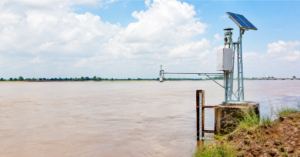
• Observation data: satellite imagery, drones, weather stations, river gauges, and IoT sensors.
• Climate and reanalysis datasets: ERA5 from ECMWF and NASA’s MERRA-2 provide long-term historical and recent climate information, while CMIP6 climate-model simulations and SSP-based scenarios support analysis of possible future climate conditions.
• Analytics: GIS spatial analysis, remote sensing indices such as NDVI, and machine learning models.
• Delivery: dashboards, maps, alerts, and reports that non-technical users can act on.
It helps to know how these sources relate to each other. ERA5 is a global reanalysis produced by ECMWF for the Copernicus Climate Change Service. It combines historical observations with numerical modeling through data assimilation. MERRA-2 is NASA’s global reanalysis, which begins in 1980. CMIP6 is a coordinated framework for comparing climate model simulations, and the SSPs are socioeconomic scenario pathways used alongside those projections, including in IPCC assessments. They are related, but they are not the same thing.
The table below summarizes the main data types and what each one is used for.
| Data type | Examples | Use |
| Satellite | Sentinel, Landsat, MODIS | Land, water, and vegetation monitoring |
| Weather | Temperature, rainfall, wind | Hazard monitoring |
| Hydrological | River discharge, water level | Flood and drought analysis |
| Reanalysis | ERA5, MERRA-2 | Historical climate |
| Climate models | CMIP6 | Future projections |
| Socioeconomic | Population, assets | Exposure |
| GIS | Roads, buildings, land use | Risk mapping |
Satellite and aerial data need careful handling before they become useful. These remote sensing techniques give a closer look at how imagery is turned into usable information.
Climate Intelligence vs Weather Forecasting
A weather forecast describes what the atmosphere may do over the coming days. Climate intelligence uses climate information, spatial context, and risk and exposure data to support decisions. It is not only a long-term tool. It can support near-real-time monitoring, seasonal outlooks, and planning over years or decades.
| Weather forecast | Climate intelligence |
| Short-term atmospheric conditions | Multiple time horizons |
| Temperature, rain, and wind | Hazard, exposure, and vulnerability |
| Asks “what may happen?” | Asks “what does it mean for this place or asset?” |
| Forecast output | Decision-support output |
Why Climate Intelligence Matters for Climate Risk
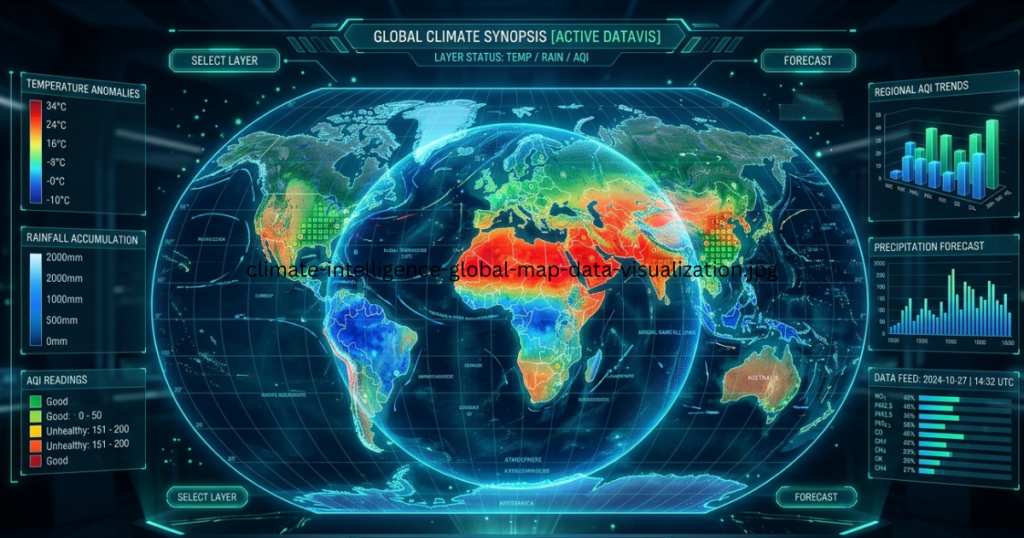
Weather-, climate-, and water-related disasters have increased substantially over recent decades, while deaths have fallen as early warning and disaster risk reduction have improved. According to the World Meteorological Organization (WMO) 1970–2019 Atlas, the number of reported disasters rose by a factor of five between 1970 and 2019. The WMO linked that increase to climate change, more extreme weather, and improved reporting.
The same WMO Atlas found more than 11,000 reported disasters in that period, with just over 2 million deaths and US$3.64 trillion in losses. Deaths fell almost threefold. The WMO links that decline to improved early warning and disaster management, which shows the life-saving value of better early warning and disaster risk reduction. Even so, the Atlas noted that only about half of the WMO’s 193 Members had multi-hazard early warning systems at the time of publication.
This is the core problem climate intelligence addresses. Data exists in abundance. Yet decision-makers still struggle to turn it into action fast enough, particularly in regions where monitoring networks, data access, and technical capacity remain limited. Manual analysis is slow, and climate systems are deeply interconnected. A drought in one basin, for instance, can affect food prices far away.
How Climate Intelligence Works
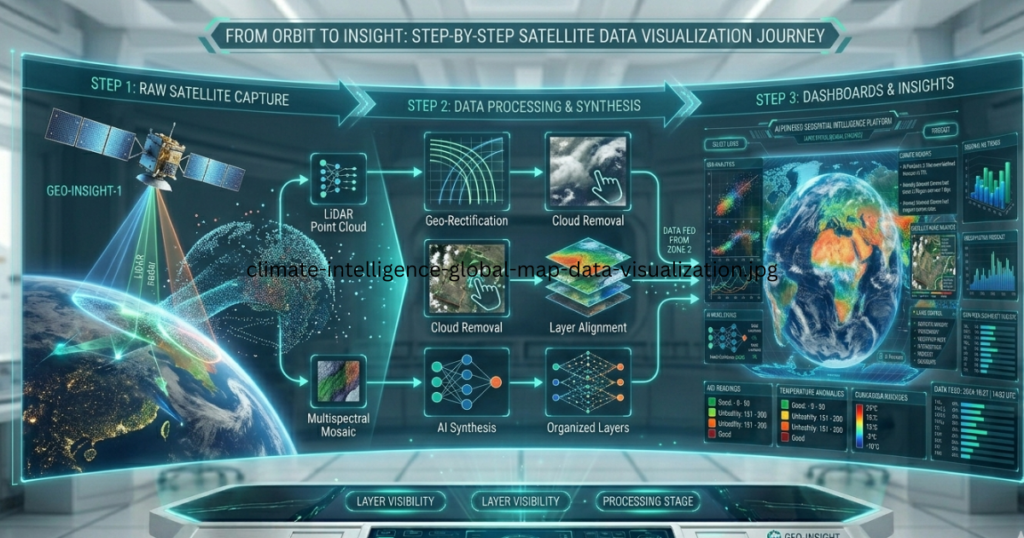
The workflow moves from raw data to a decision in five stages. Validation and uncertainty are built into the process rather than added at the end.
1. Collect: satellite imagery from sources such as Sentinel-1, Sentinel-2, Landsat, and MODIS, plus meteorological data, hydrological records, ground sensors, and field observations.
2. Process: georeference, correct, quality-check, and harmonize datasets in space and time within a GIS environment. This preparation work is usually handled by GIS specialists using tools such as ArcGIS, QGIS, and Google Earth Engine.
3. Model: apply machine learning, deep learning, and physical models to detect change, classify land cover, and estimate hazard likelihood.
4. Map risk: overlay hazard layers with population, infrastructure, and land use to show exposure and vulnerability.
5. Validate and deliver: test results against ground observations, quantify uncertainty, then publish dashboards, alerts, and decision briefs.
Time-series models such as LSTM (Long Short-Term Memory) networks can be used for hydrological, drought, and other sequential forecasting tasks because they can learn temporal patterns in data. Their performance depends on training data, model design, validation methods, and the characteristics of the study area, so results should be presented with uncertainty ranges.
A Simple Example
In practice, a GIS-based climate risk workflow follows a clear chain: hazard layer, exposure layer, vulnerability layer, risk map, decision. For flooding, the hazard layer might come from radar imagery and rainfall records. The exposure layer adds buildings, roads, and population. The vulnerability layer adds factors such as housing quality or distance to health facilities. The resulting risk map shows which neighborhoods face the highest combined risk, and planners can use it to decide where to improve drainage or extend early warning coverage.
GIS vs Remote Sensing vs AI vs GeoAI vs Climate Intelligence
These terms overlap, so a comparison helps. The table shows what each one does and how it contributes to climate intelligence.
| Term | What it is | Role in climate intelligence |
| Remote sensing | Collecting information about the Earth from satellites, aircraft, or drones | Provides repeated, large-scale observation of land, water, vegetation, and heat |
| GIS | Software and methods for storing, layering, and analyzing spatial data | Combines hazard, population, and infrastructure layers to map exposure |
| AI / machine learning | Algorithms that learn patterns from data | Detects patterns, classifies features, and produces predictions |
| GeoAI | AI applied to geospatial data | Automates feature extraction, change detection, and spatial prediction at scale |
| Climate intelligence | The use of climate data, analysis, modeling, and decision-support tools to understand and manage climate-related risks and opportunities | The decision-support framework that draws on all of the above |
Put simply, remote sensing supplies data, GIS integrates it spatially, AI and machine learning detect patterns and make predictions, and GeoAI joins AI with geospatial analysis. Climate intelligence brings these technologies and data sources together within a broader decision-support process. For a deeper technical walk-through, read our complete GeoAI guide.
Climate Risk Management: What Decision-Makers Need
Climate Intelligence for Climate Risk Management
Climate risk management is the process of identifying, measuring, and reducing the impact of climate hazards on people, assets, and operations. A common conceptual framework describes climate risk in terms of hazard, exposure, and vulnerability, and climate intelligence supplies evidence for each one.
Physical Climate Risks
Physical risks come from hazards such as floods, heat, drought, and sea-level rise. Climate intelligence maps where these hazards occur and which assets and communities sit in their path.
Transition Risks
Transition risks arise from policy, technology, and market shifts as economies decarbonize. Standards and reporting requirements such as IFRS S2 and the EU’s Corporate Sustainability Reporting Directive (CSRD) have increased the importance of assessing and disclosing climate-related risks. IFRS S2 distinguishes between physical and transition risks. Not every organization is subject to both frameworks, since scope depends on jurisdiction and on the size and type of the organization. Where disclosure does apply, it creates demand for asset-level analysis.
What Governments Need
Governments need something slightly different. They need district-level hazard maps, early warning systems, and adaptation plans that fit local capacity. An insurer, a district officer, and a farmer each need a different output from the same data, so good analysis is tailored to the user. Our risk analytics and decision intelligence work follows this principle by building scenario analysis and early-warning logic into existing workflows.
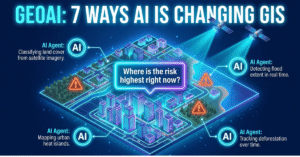
6 Ways GeoAI Supports Climate Intelligence
GeoAI is one of the methods that can enable climate intelligence, while climate intelligence is the broader process of turning climate information into decisions.
1. Flood Forecasting and Early Warning
GeoAI can help map flood extent quickly and, when combined with hydrological models, support flood forecasting. Google’s Flood Hub is a well-known example. Google describes AI-based riverine flood forecasts up to seven days ahead, covering more than 2 billion people across more than 150 countries, along with urban flash-flood forecasts up to 24 hours ahead. That is a global system built by Google and should not be confused with any single local project.
Locally, the synthetic aperture radar (SAR) on Sentinel-1 can acquire imagery through cloud cover and at night, which makes it useful for flood monitoring during cloudy or monsoon conditions. For the Pakistan context, see our review of flood forecasting in Pakistan.
2. Climate Risk Mapping
GeoAI can combine hazard layers with building footprints, road networks, land use, and population data to estimate which assets and communities may be most exposed. Esri, for example, describes how AT&T used climate data and geospatial analysis to map potential flood risks to its US infrastructure through 2050. See our guide to disaster risk management with GeoAI and early warning; it shows how layered hazard maps support planners.
3. Precision Agriculture
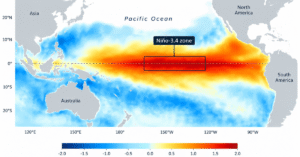
By analyzing satellite imagery, drone data, and weather forecasts together, models can help detect vegetation stress, estimate water requirements, and identify patterns associated with crop health and soil degradation. Predictive analytics can also help farmers plan irrigation and planting. Drought indicators derived from vegetation indices such as NDVI support district-level food security planning. Our articles on smart agriculture technology, El Niño impacts, and preparedness show how this connects to seasonal risk.
4. Urban Heat and Planning
Cities can use land-use and land-cover (LULC) change detection, land surface temperature, and flood modeling to identify heat islands and drainage weak points. Together, these layers support urban climate risk mapping, so planners can direct green infrastructure and drainage upgrades to the areas that need them most.
5. Forest, Glacier, and Land-Change Monitoring
Time series from Landsat and Sentinel satellites let analysts track how land surfaces change over many years. Forest loss, shifting land cover, and expanding settlements can be detected through changes in spectral and temporal patterns across satellite imagery, and indices such as NDVI (vegetation), NDWI (water), and NDSI (snow) help separate one surface type from another. GeoAI can automate this detection across large areas that would take far too long to review by hand. Our articles on why protection forests matter more than ever and why GIS-based environmental monitoring has become essential cover this in more detail.
In mountain regions, the same approach supports glacier area monitoring and the mapping of glacial lakes, which feeds into assessments of glacial lake outburst flood (GLOF) risk. Steep terrain, snow, and cloud shadows can limit optical imagery, so analysts often combine it with radar data and field validation.
6. Climate Adaptation and Disaster Planning
Adaptation planning needs to know where to act first. Risk maps that combine hazard, population, and infrastructure data can help governments decide where to extend early warning coverage, which evacuation routes need upgrading, and where to invest in drainage, water storage, or resilient housing. Scenario analysis shows how those priorities may change under different future conditions. Our guide to climate resilience solutions looks at these options in more detail.
Climate Intelligence in Pakistan
Pakistan is a useful case because several climate hazards overlap in one country. Monsoon flooding, glacier-fed rivers, heat, drought, and water stress all matter, and monitoring capacity varies from region to region. Our overview of climate change in Pakistan covers the wider picture, including glacier melt, floods, and heat waves. Climate intelligence applies to this setting in several ways.
- Monsoon flood monitoring: SAR imagery and river-gauge data can support inundation mapping, flood assessment, and early-warning workflows along the Indus system.
- GLOF risk in Gilgit-Baltistan: glacier and glacial lake mapping helps identify downstream communities that may need warning systems.
- Drought monitoring: vegetation indices and rainfall records show where water stress is building.
- Urban heat: land surface temperature maps show which parts of large cities heat up the most.
- Agricultural water stress: in rainfed areas, water capture and storage are critical, as our piece on rainwater harvesting for agriculture in Pakistan explains.
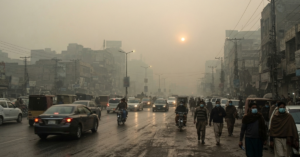
- Smog and air quality: Satellite aerosol observations combined with ground-based monitoring can help identify the spatial and temporal distribution of air pollution.
- Indus Basin water risk: snowmelt, rainfall, and demand data together support basin-scale water planning.
Seasonal signals matter as well. Our article on the El Niño crisis in Pakistan shows how a seasonal climate outlook can be linked to local risk.
Challenges and Limitations of Climate Intelligence
Climate intelligence is only as reliable as the data and methods behind it. GeoAI does not always produce accurate answers, and results need careful interpretation. The main limitations are listed below.
- Data gaps: ground stations and river gauges are sparse in some regions.
- Inconsistent resolution and interoperability: datasets differ in spatial and temporal resolution and in format, which makes integration harder.
- Cloud cover and sensor limits: optical sensors cannot see through clouds, and every sensor has limits on what it can measure.
- Model uncertainty and downscaling: coarse global models must be downscaled for local use, which adds uncertainty.
- Bias in training data: a model trained in one region may perform poorly in another.
- Limited ground validation: without field data, accuracy is difficult to confirm.
- Computing needs: large datasets and complex models require substantial computing resources and skilled staff.
- Interpretation: a map or risk score can be misread by non-technical users unless uncertainty is explained clearly.
The Future of Climate Intelligence
Several trends are likely to shape the field. Satellite coverage continues to improve, which gives more frequent observations. Open datasets from agencies such as ECMWF and NASA make high-quality climate information easier to access. AI methods are getting better at working with large Earth-observation archives. The field is also moving toward AI-assisted Earth observation, higher-frequency monitoring, and integrated geospatial systems that can connect observations, forecasts, scenarios, and decision support in near real time. At the same time, disclosure requirements and early warning programs are pushing organizations and governments to use this information in routine decisions.
The harder work is likely to be local. It includes validating models against ground data, building technical capacity, and presenting uncertainty clearly so decision-makers can use results with confidence.
Conclusion
Climate intelligence connects climate data to decisions. Remote sensing supplies observations, GIS adds spatial context, AI and GeoAI detect patterns, and the decision-support layer turns the results into maps, alerts, and plans that people can act on. Its value comes from being specific to a place and a user, honest about uncertainty, and checked against what is happening on the ground. Used that way, it helps governments, businesses, and communities understand climate risk early enough to reduce it.
FAQs
What is climate intelligence?
Climate intelligence is the process of collecting, analyzing, and interpreting climate and environmental data, using tools such as AI, GIS, and remote sensing, to support decisions on climate risk and adaptation.
How does AI support climate intelligence?
AI detects patterns in large datasets, classifies satellite imagery, and produces predictions. It can speed up analysis that would take analysts far longer, although results should be validated against ground data.
What is GeoAI?
GeoAI is the application of artificial intelligence to geospatial data such as satellite imagery, maps, GPS data, and spatial databases. It is designed to learn relationships in physical space.
What is the difference between GIS and GeoAI?
GIS stores, layers, and analyzes spatial data. GeoAI adds machine learning so that features can be extracted and predictions made automatically at scale. Most modern workflows use both.
How can GeoAI support flood forecasting?
GeoAI can map flood extent from satellite imagery and feed hydrological models with land-cover and terrain information. Global systems such as Google’s Flood Hub offer riverine forecasts up to seven days ahead and urban flash-flood forecasts up to 24 hours ahead, while local systems add district-level detail.
How is GIS used in climate risk assessment?
GIS overlays hazard layers, such as flood depth or heat, with population, infrastructure, and land-use data. This shows which places and assets are most exposed.
How does AI analyze satellite data?
Models learn to recognize patterns in pixels, such as water, vegetation, built-up areas, or burn scars. Once trained, they can classify new imagery and detect change over time.
How can climate intelligence help Pakistan?
It supports flood early warning, GLOF risk screening, drought monitoring, agricultural planning, and safer land-use decisions. Pakistan’s mix of monsoon floods, glaciers, and dry regions makes this especially relevant.
Who can benefit from climate intelligence?
Government and disaster management agencies, farmers and food security programs, urban planners, insurers and financial institutions, NGOs, and researchers can all benefit.
Is climate intelligence accessible for developing countries?
Access is improving. Open satellite data from NASA, ESA, and Copernicus, together with cloud-based tools, has lowered costs. Still, gaps in data, connectivity, and trained staff remain.