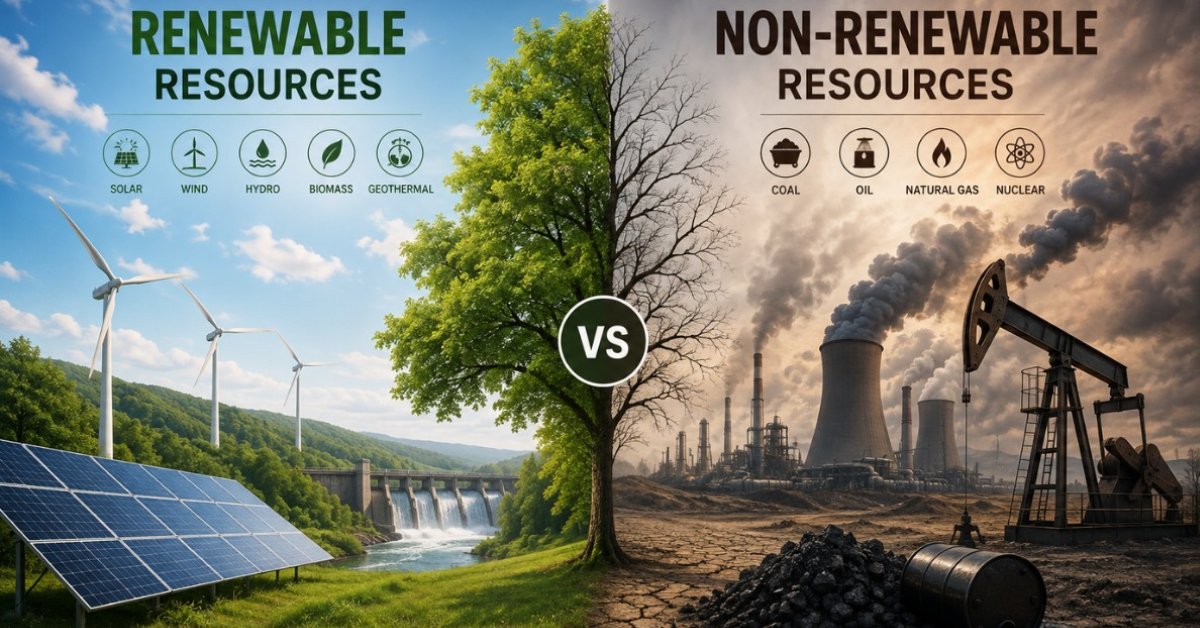
| Quick Answer: Renewable resources vs nonrenewable resources differ mainly in supply and formation time. Renewable resources, such as solar, wind, and hydropower, replenish naturally within a short timeframe and produce little to no emissions during use. Nonrenewable resources, such as coal, oil, and natural gas, take millions of years to form, exist in fixed quantities, and release significant emissions when burned. Both play a role in today’s energy mix, but the balance between them is shifting as renewable technology costs fall and climate policy accelerates the transition. |
Understanding renewable resources vs nonrenewable resources is the starting point for almost every energy decision, from national power planning to a household choosing between grid electricity and solar panels. The core distinction comes down to supply: renewable resources regenerate naturally within a human timeframe, while nonrenewable resources exist in fixed amounts that shrink every time they are used. This guide breaks down how the two compare on emissions, cost, reliability, and real-world application, including where Pakistan’s own energy mix currently stands. For a broader look at how these choices affect investment decisions, see our Clean Energy Investment guide.
What is the difference between renewable resources vs nonrenewable resources?
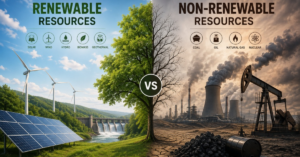
Renewable resources replenish within a human lifetime. Nonrenewable resources take millions of years to form, and once they’re used up, they’re gone. Almost every other difference between them, including cost, emissions, and reliability, traces back to that one fact.
Renewable vs nonrenewable resources: 5 differences in one look
| Supply: Renewable resources refill naturally. Nonrenewable resources do not refill in our lifetime. Time: Renewable resources renew in days, months, or years. Nonrenewable resources take millions of years to form. Pollution: Renewable sources release little during use. Burning fossil fuels releases carbon dioxide and other pollutants. Cost: Renewable projects often cost more to set up but little to run. Nonrenewable fuels often cost less at the start, but their prices swing with global markets. Reliability: Solar and wind depend on weather and time of day. Coal, oil, and gas can supply power on demand. |
What Are Renewable Resources?
Renewable resources include sunlight, wind, moving water, geothermal heat, and biomass. They replenish naturally through ongoing processes such as the water cycle, atmospheric circulation, and plant growth. When managed responsibly, using these resources today does not permanently reduce their availability tomorrow.
What Are Nonrenewable Resources?
Nonrenewable resources include coal, crude oil, natural gas, and uranium. They form far more slowly than humans consume them, often over millions of years. Once extracted and used, they cannot be replaced on a human timescale. Fossil fuels, for example, formed from ancient organic matter under heat and pressure over extremely long periods.
How renewable resources regenerate naturally
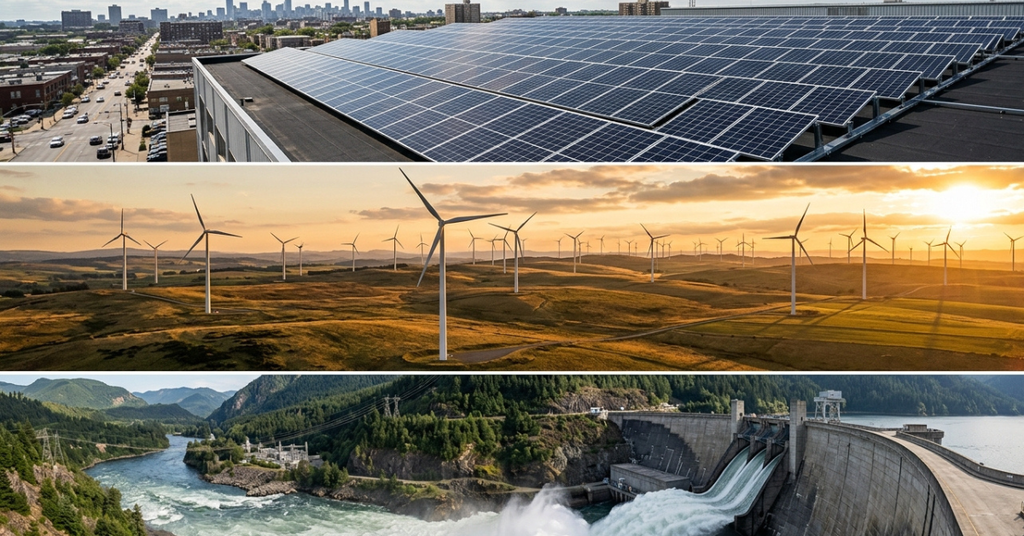
Renewable resources work on a human timescale. Sunlight shows up every clear day, and wind patterns repeat because the Earth’s surface heats unevenly. Hydropower depends on rainfall and snowmelt refilling rivers and reservoirs. Biomass regrows when crops, algae, or forest matter are replanted and managed well. The energy from these sources is captured rather than a finite fuel being burned; engineers are just capturing energy that’s already moving through the system.
The renewable resources vs nonrenewable comparison becomes clearer when you look at how quickly each type can replenish. Renewable resources can continue supplying energy when natural cycles are protected, while nonrenewable resources depend on finite reserves.
Why nonrenewable resources cannot be replaced quickly
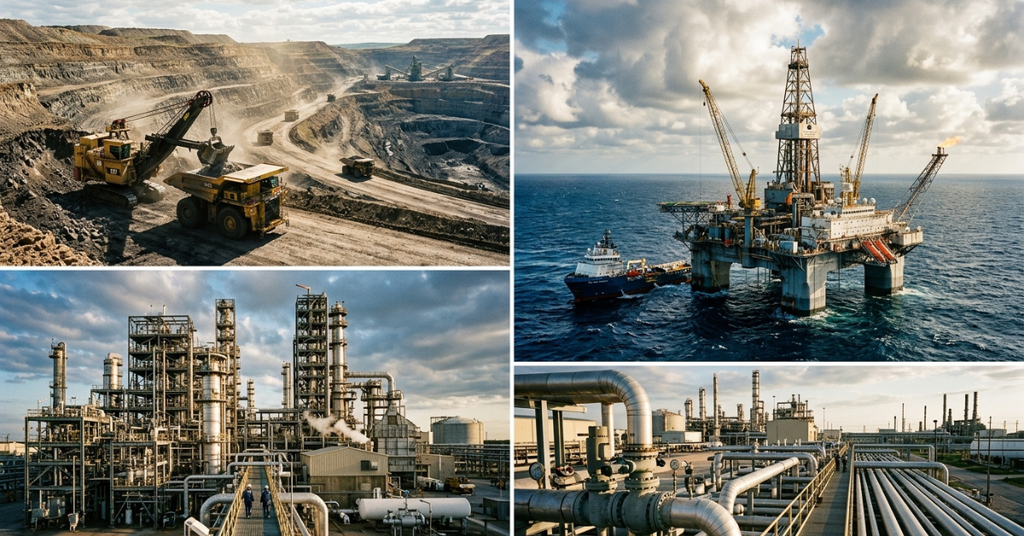
Nonrenewable resources exist in a fixed, finite quantity within the Earth’s crust. Coal, oil, and natural gas are fossil fuels because they formed from long-dead organic material. Uranium, the fuel behind nuclear energy, is also a mined, finite mineral rather than something that regenerates. Once fossil fuels are extracted and burned, the fuel is consumed and cannot be quickly replaced, which is part of why nonrenewable resources keep getting scarcer and more expensive to reach.
Are renewable resources vs nonrenewable resources only about energy?
No. Resources are more than fuel. Water, soil, forests, and fish are renewable when people manage them well. Metals and minerals are nonrenewable.
Iron, aluminum, and copper come from ore deposits that take millions of years to form. Recycling helps us use them longer, but it does not make the ore renewable.
Some renewable resources can turn nonrenewable in practice. A forest cut faster than it regrows will shrink. An aquifer pumped faster than rain refills it will run dry. Soil forms very slowly, so heavy erosion can erase it for generations.
Renewable vs Nonrenewable Resources: Full Comparison Table (10 Factors)
The clearest way to compare renewable resources vs nonrenewable is side by side. The table below covers formation time, cost, emissions, and reliability, the four factors that matter most when a household, a business, or a government is planning its energy mix.
| Factor | Renewable resources | Nonrenewable resources |
| Formation time | Continuous to years, depending on the resource | Hundreds of millions of years |
| Availability | Effectively unlimited if managed well | Fixed and depleting |
| Common examples | Solar, wind, hydro, geothermal, biomass | Coal, oil, natural gas, uranium |
| Carbon emissions during use | Very low operational emissions | Fossil fuels: high CO₂ and pollutants; nuclear: very low operational emissions |
| Cost trend (2010 to 2024) | Utility-scale solar LCOE fell about 90% | Fuel costs remain exposed to global price volatility |
| Reliability | Weather and time-of-day-dependent | Available on demand today |
| Storage needs | Higher for variable sources such as solar and wind | Low; fuel is stockpiled directly |
| Infrastructure age | New, still expanding rapidly | Mature, decades-old in most regions |
| Environmental risk | Land use, mining for materials | Air, water, and soil pollution |
| Long-term sustainability | Sustainable if not overharvested | Unsustainable by definition |
Nuclear energy is nonrenewable because uranium is finite, but nuclear power has very low operational carbon emissions compared with fossil-fuel generation, which is why it’s broken out separately from the rest of the nonrenewable category in the emissions row above.
What are examples of renewable and nonrenewable resources?
Real-world examples make the renewable resources vs nonrenewable comparison easier to understand, from the fuel in a car tank to the panels on a rooftop.
Examples of nonrenewable resources
Not all nonrenewable resources are energy sources. Minerals such as copper, iron, and phosphate rock are nonrenewable resources, but they are not fuels.
- Coal, used mainly for electricity generation and industrial heat
- Crude oil, refined into gasoline, diesel, and jet fuel
- Natural gas, used for heating, cooking, and power generation
- Uranium, the mineral fuel for nuclear power plants
- Gasoline and diesel, refined petroleum products for transport
- Propane, a fossil-derived fuel for heating and cooking
- Peat, a slow-forming fuel source still used in some regions
- Natural gas liquids, byproducts used in petrochemicals
- Metallic ores such as copper and iron, mined in finite deposits
- Phosphate rock, a finite mineral used in fertilizer production
Common examples of renewable resources
- Solar energy, captured through photovoltaic panels or solar thermal systems
- Wind energy, harnessed through onshore and offshore turbines
- Hydropower, generated from flowing or falling water
- Geothermal energy, drawn from the earth’s internal heat
- Biomass, organic material such as crop waste or wood pellets
- Tidal and wave energy, captured from ocean movement
- Sustainably managed timber, regrown through replanting programs
- Biofuels, produced from crops, algae, or organic waste
Renewable Resources vs Nonrenewable in Everyday Life
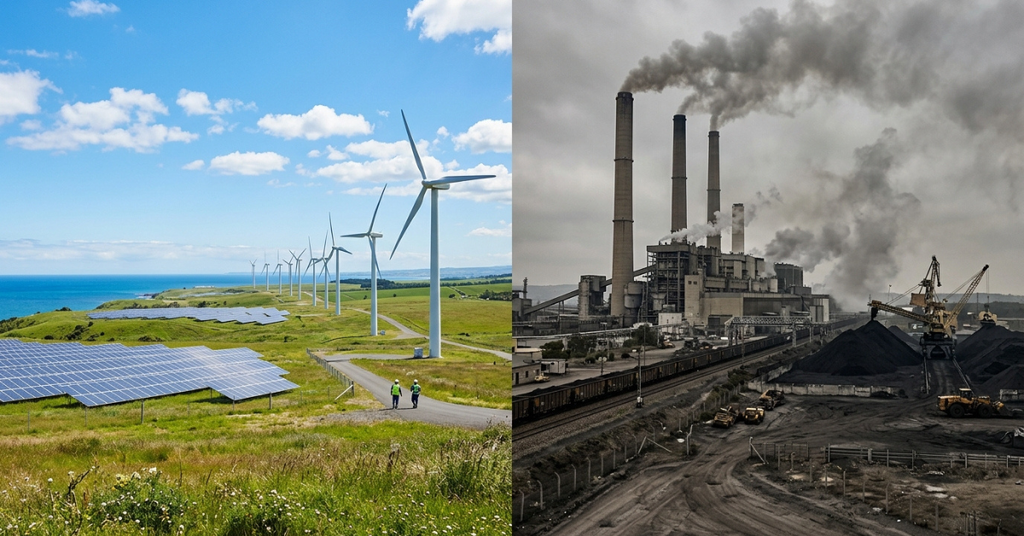
The difference between renewable and nonrenewable resources becomes easier to see in everyday life. Solar panels, wind turbines, and hydropower rely on naturally replenished sources, while cars, gas heating systems, and many industrial processes still depend heavily on finite fuels. Understanding these examples helps explain why countries are gradually diversifying their energy systems.
What are the environmental benefits of switching to renewable energy?
Switching to renewable energy cuts greenhouse gas emissions, improves local air quality, and uses less water than fossil fuel extraction and cooling require, a gap that shows up clearly whenever you weigh renewable resources vs nonrenewable resources on environmental footprint alone. Renewable technologies don’t burn fuel to generate power, so they skip most of the direct air pollutants tied to respiratory illness near power plants. In the renewable resources vs nonrenewable resources comparison, these operational differences are what drive most of the environmental case for renewables.
The data behind the shift
- Global renewable power capacity reached 5,149 gigawatts by the end of 2025, the largest single-year jump on record, according to IRENA’s Renewable Capacity Statistics 2026.
- Renewables made up 85.6 percent of all new power capacity added worldwide that year. Every gigawatt that replaces a coal plant instead of adding to one compounds the emissions saved.
- Utility-scale solar cost 90 percent less in 2024 than it did in 2010, down to 4.3 cents per kilowatt-hour.
- IRENA’s analysis found utility-scale solar was about 41 percent cheaper than the average fossil-fuel-based electricity option in its comparison.
That’s the part that changes minds faster than any emissions chart: price and pollution are now pulling in the same direction.
What this means for businesses
Businesses that need to quantify these environmental and financial trade-offs, whether for a renewable energy site, a corporate sustainability report, or a climate risk assessment, can explore how AI Geo Navigators’ environmental sustainability and ESG consulting services turn spatial and environmental data into actionable decisions.
Renewable Energy Limitations: A Fair Comparison
Renewable energy still has real limits, and the difference between renewable resources vs nonrenewable resources has to do with that. Solar panels don’t generate power at night. Wind turbines slow down when the air is still. Both sources depend on weather and time of day in a way coal and gas plants don’t.
Storage and grid readiness
Storage is the biggest technical hurdle. Battery costs fell 93 percent between 2010 and 2024, but grid-scale storage still adds cost and complexity to a fully renewable system, according to IRENA’s cost data. Most national grids were also built decades ago around large, centralized fossil fuel plants, so fitting in distributed solar and wind means real transmission upgrades, not just more panels.
Uneven access and extreme weather
Access isn’t even, either. According to IRENA’s Renewable Capacity Statistics 2026, Africa added just 1.6 percent of the world’s new renewable capacity in 2025, despite having some of the best solar potential on the planet, mostly because of financing gaps and weak grids. Extreme weather threatens renewable and nonrenewable infrastructure alike, which is a big part of why resilient planning matters as much as the choice of energy source itself, a point covered in more depth in Effective Disaster Risk Management: GeoAI & Early Warning. Most energy planners expect renewable and nonrenewable sources to run side by side for years, yet the balance keeps tilting toward clean power.
Advantages and Disadvantages of Nonrenewable Resources
Nonrenewable resources still power much of the world. Here is a fair look at both sides.
Advantages
- They supply power on demand, day or night.
- Fossil fuels pack a lot of energy into a small amount of fuel.
- Mines, pipelines, and power plants already exist in most regions.
- Setup costs are often lower than for new renewable projects.
Disadvantages
- Supply is fixed, so reserves shrink with every use.
- Burning fossil fuels releases greenhouse gases and air pollutants.
- Mining and drilling can harm land, water, and wildlife.
- Fuel prices swing with global events, which leaves importing countries exposed. This risk is a big part of energy security.
How can you switch from nonrenewable to renewable energy at home?
Making the switch doesn’t require an all-or-nothing decision; it’s one part of the renewable resources vs nonrenewable resources decision most households can act on directly. Most households move through it in a series of practical, manageable steps.
- Start with a home energy audit to see where electricity and heat are actually being wasted
- Install rooftop solar panels with a net metering agreement, so excess power sold back to the grid offsets your bill
- Add a solar water heater, since water heating is one of the biggest energy loads in most homes
- Upgrade to electric or hybrid appliances that pair well with a renewable power source
- Improve insulation and sealing, which cuts how much energy your home needs in the first place
- Join a community solar program if rooftop installation isn’t an option at your property
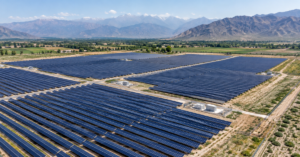
Pakistan is a good example of how fast this can move once the economics line up. According to REN21’s 2025 Global Status Report, net-metered rooftop solar capacity in Pakistan grew from 583 megawatts in the 2022 to 2023 fiscal year to 5.3 gigawatts by April 2025, nearly a tenfold jump in two years. Rising grid electricity prices did as much for that growth as falling panel costs.
Renewable energy around the world: current developments and future outlook
Renewables now make up 49 percent of the world’s installed power capacity, though they generate a smaller 32 percent share of actual electricity. Because different power technologies operate at different capacity factors, their share of installed capacity does not directly match their share of electricity generation. Investment tells a similar story. Global energy investment topped 3 trillion dollars for the first time in 2025, with around 2 trillion of that going to clean energy technologies and infrastructure, including renewables, grids, storage, and electrification, according to the International Energy Agency, meaning spending on clean energy now outpaces total spending on oil, gas, and coal combined. We go deeper into what that shift means for businesses and investors in Clean energy: reshaping investment in the global economy
Renewable energy in Pakistan: a quick snapshot

Pakistan’s experience also shows why the renewable resources vs nonrenewable debate is becoming increasingly important for energy security and household electricity costs. Pakistan’s energy mix is shifting fast, and the renewable resources vs nonrenewable resources balance is tipping quickly toward solar. According to Global Energy Monitor’s Boom and Bust 2026 report, solar alone accounted for an estimated 25 percent of the country’s electricity consumption in 2025, most of it from off-grid and rooftop installations, and hydropower added another 29 percent to the generation mix in fiscal year 2024, according to national industry data. That shift is happening against a backdrop of intensifying climate pressure across the country, covered in more detail in Climate Change in Pakistan: Data & Realities. For a closer look at the country’s solar and hydropower rollout, read Renewable Energy in Pakistan: Opportunities, Challenges & Future.
How AI Geo Navigators supports the renewable energy transition
A lot of renewable energy pitches stop at national totals, but the real work happens at the site level. AI Geo Navigators handles that part: checking solar irradiance and wind speed against a specific plot of land, confirming it isn’t sitting in a floodplain or protected area, and working out how far it is from the nearest grid connection. That groundwork is often what separates a project that gets financed from one that stays a spreadsheet. Given how fast Pakistan’s rooftop and utility-scale solar capacity has grown in just the past two years, this kind of site-level checking matters more than it used to.
Why the renewable energy shift matters for a sustainable future
The renewable resources vs nonrenewable comparison goes beyond emissions and energy costs; it is also about long-term energy security. Countries generating their own solar and wind power are less exposed to volatile fuel imports. It also creates jobs in installation, manufacturing, and maintenance, and it keeps communities further from the air and water pollution tied to fossil fuel extraction. We cover this broader case in more depth in Why Renewable Energy Matters for a Sustainable Future.
Key takeaways
Here are the main lessons from this renewable resources vs nonrenewable comparison:
- Renewable resources like solar, wind, hydro, and geothermal replenish naturally; nonrenewable resources like coal, oil, natural gas, and uranium exist in fixed, depleting supplies.
- Global renewable capacity hit a record 5,149 gigawatts by the end of 2025, with solar and wind driving most of that growth, according to IRENA’s Renewable Capacity Statistics 2026.
- Utility-scale solar costs have fallen about 90 percent since 2010, strengthening the cost advantage of renewables for many new power projects.
- Renewable energy still runs into real limits around storage, grid readiness, and regional financing gaps, so a mixed energy system isn’t going away soon.
- Practical, incremental steps, from a home energy audit to rooftop solar and net metering, make the switch achievable for most households.
Conclusion
When it comes to renewable resources vs nonrenewable resources, the two will keep sharing the global energy mix for years, but the direction isn’t really in question anymore. Renewable resources bring lower emissions, falling costs, and more energy security. Nonrenewable resources are finite, and extracting harder-to-reach reserves can increase costs over time. Knowing where the two actually differ, not just assuming, is what helps households, businesses, and policymakers make better calls today. The choice between renewable and nonrenewable resources will remain important as countries balance affordability, reliability, emissions, and long-term energy security.
If your organization needs to size up renewable energy site potential, climate risk exposure, or ESG performance as part of an energy transition strategy, AI Geo Navigators combines GIS, remote sensing, and AI-driven analytics to turn that into a workable plan. Contact the AI Geo Navigators team to see how climate intelligence can support your next renewable energy or sustainability decision.
Quick Quiz: Renewable vs Nonrenewable Resources
1. Which is a renewable resource: coal, crude oil, plants, or soil?
Plants. They regrow when people replant them. Soil forms too slowly to count as renewable.
2. Which is renewable: petroleum, wood, iron, or coal?
Wood, as long as trees are replanted.
3. Gasoline is a ______ resource, so its supply is limited. Is it renewable or nonrenewable?
Nonrenewable. It comes from crude oil.
4. Which is an advantage of nonrenewable resources?
They can be cheaper, especially at the start. They also supply power on demand.
5. What can turn a renewable resource into a nonrenewable one?
Using it faster than nature can replenish it. Overfishing, cutting forests too fast, and over-pumping groundwater are common examples.
6. Which type replenishes within our lifetime?
Renewable resources.
FAQs
Is nuclear energy renewable or nonrenewable?
Nuclear energy counts as nonrenewable because it runs on uranium, a finite mined mineral, even though it produces very low direct carbon emissions during operation.
Will renewable energy fully replace fossil fuels?
Not in the near term. Renewables supplied roughly a third of global electricity generation in 2024, and a full transition will likely take decades more of storage and grid investment, according to IRENA.
Can a renewable resource become nonrenewable?
Yes. Overharvest a forest faster than it can regrow, or drain an aquifer faster than rainfall can refill it, and a naturally renewable resource starts behaving like a nonrenewable one.
What is the main difference between renewable resources vs nonrenewable resources?
Replenishment speed. Renewable resources, like sunlight, wind, and water, regenerate within a human lifetime. Nonrenewable resources, like coal, oil, and natural gas, take millions of years to form and don’t come back once they’re used up.
Is renewable energy cheaper than nonrenewable energy long term?
Increasingly, yes. Utility-scale solar costs have fallen 90 percent since 2010 to about 4.3 cents per kilowatt-hour, already 41 percent cheaper than the average fossil fuel option, according to IRENA. On cost alone, renewable resources vs nonrenewable resources keeps tilting toward clean power for new projects.
Is uranium renewable or nonrenewable?
Uranium is a nonrenewable resource. It is a mined mineral found in fixed amounts in the Earth’s crust, and it does not regenerate on a human timescale. Nuclear plants release very little carbon while they run, but they still depend on a finite fuel.
Is iron a nonrenewable resource?
Yes, iron is a nonrenewable resource. It comes from ore deposits that took millions of years to form. Recycling steel reduces mining, but it does not create new ore. That is why metals like iron, copper, and aluminum count as nonrenewable resources.
Can nonrenewable resources be replenished?
No, not within a human lifetime. Coal, oil, and natural gas take millions of years to form. People use them much faster than nature makes them, so supply stays limited. This is the core gap in renewable resources vs nonrenewable resources.
Are renewable resources unlimited?
Not always. Sunlight and wind will not run out from human use. But forests, fish, soil, and groundwater can run low if people use them faster than they replenish. Careful management keeps these resources renewable.