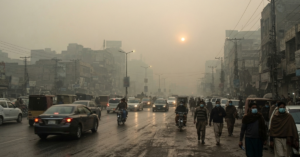
| Quick answer: Smog in Pakistan is a winter haze of fine PM2.5 particles and harmful gases. Vehicles, factories, brick kilns, crop fires, waste burning, and dust contribute to it, while cold, still air can trap pollution near the ground. Smog can shorten life expectancy and harm respiratory health. Punjab’s 2023 smog rules fine polluters, while cleaner fuel, better transport, and stronger enforcement can help reduce pollution. |
Smog in Pakistan is a serious public-health concern. Pakistan ranked as the world’s most polluted country in 2025 by annual average PM2.5, according to IQAir. Its average was 67.3 µg/m³, which is 13.5 times the WHO yearly guideline. The high pollution levels help explain why smog is a major concern, especially during Punjab’s winter smog season.
Smog is severe air pollution in which fine particles and gases build up in the air, often when the weather is still. It stings your eyes, strains your lungs, and disrupts school and work. Air pollution affects all of Pakistan. This guide focuses on Punjab, where winter smog is most visible. Punjab notified the Smog Prevention and Control Rules on 6 June 2023, and they came into force immediately.
In this guide, you’ll learn:
- the 7 major causes of smog in Pakistan
- how smog harms health, life expectancy, and daily life
- what the Smog Rules 2023 say, with a fines table
- how the Smog Policy 2017 compares with the Smog Policy 2023
- practical measures that help control smog
Key Takeaways
- Smog in Pakistan is a haze of fine particles (PM2.5) and gases that builds up in still winter air.
- Pakistan recorded 67.3 µg/m³ of annual PM2.5 in 2025, according to IQAir.
- Punjab’s pollution comes from many sectors: homes, transport, industry, farms, and waste.
- The Punjab Smog Prevention and Control Rules 2023 set penalties for specific polluting activities.
- Lasting progress needs fewer emissions, cleaner transport, better waste and crop-residue management, and strong monitoring.
What Is Smog in Pakistan?
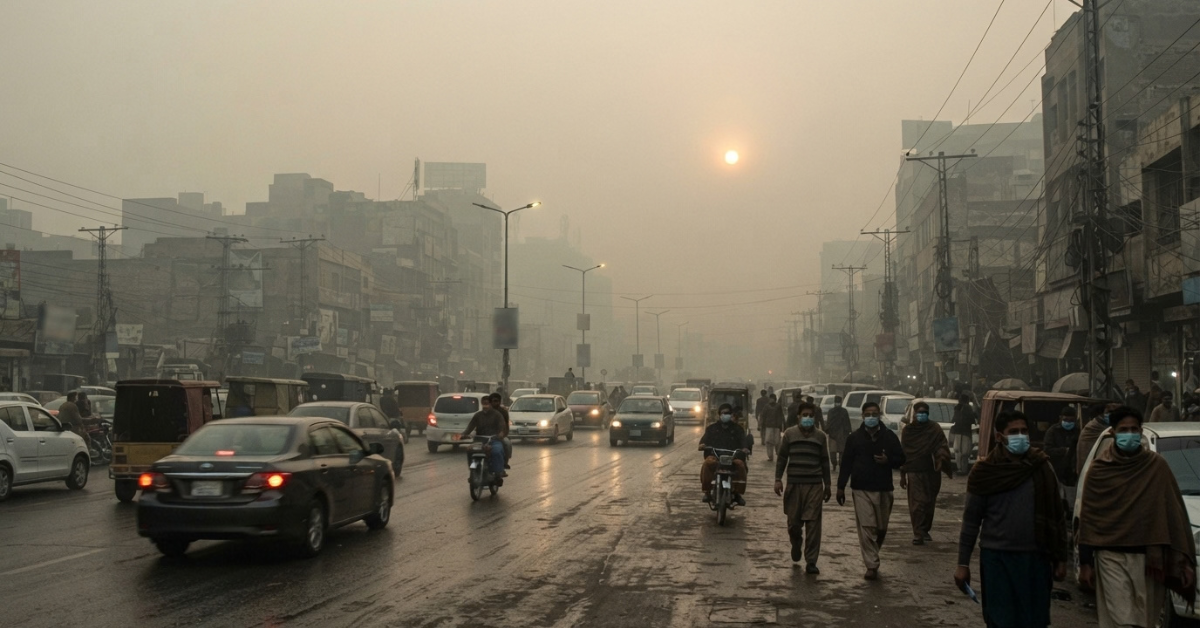
Smog in Pakistan is polluted air containing fine particles such as PM2.5 and gases from vehicles, homes, industries, agriculture, and waste burning. It becomes worse in winter when weak winds and temperature inversions trap pollutants near the ground, especially across Punjab and Lahore.
What Is Smog, and What Is PM2.5?
The word smog began as “smoke plus fog.” Today it describes severe air pollution in which particles and gases accumulate in the atmosphere, often under stagnant weather. The most harmful part is PM2.5. These particles are about 30 times thinner than a human hair. They can reach deep into the lungs, and some of their parts are linked to inflammation and heart problems.
Smog in Pakistan: The 2025 PM2.5 Numbers
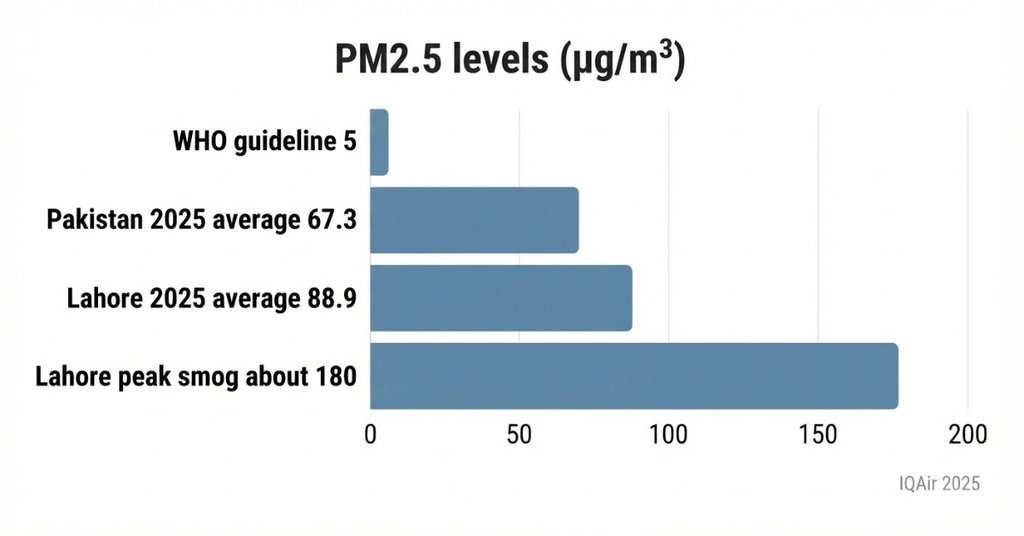
The IQAir 2025 World Air Quality Report, released in March 2026, ranked Pakistan first among 143 countries and territories. Here are the key numbers:
- Pakistan: 67.3 µg/m³ in 2025, down from 73.7 in 2024.
- Lahore: 88.9 µg/m³ in 2025, or 17.8 times the WHO guideline.
- Acute episodes: a World Bank program document reports 24-hour averages above 300 to 400 µg/m³ in Lahore.
| Measure | Annual PM2.5 |
|---|---|
| WHO annual guideline | 5 µg/m³ |
| Pakistan, 2025 average | 67.3 µg/m³ |
| Lahore, 2025 average | 88.9 µg/m³ |
Pakistan’s average fell from 73.7 µg/m³ in 2024 to 67.3 µg/m³ in 2025. It still stayed far above the WHO guideline.
PM2.5 and AQI are different measures. PM2.5 is a concentration. AQI is an index built from it, so the two numbers are not directly comparable. For example, The Express Tribune reported an AQI of 442 in Lahore in November 2023.
Why Winter Smog Gets Worse
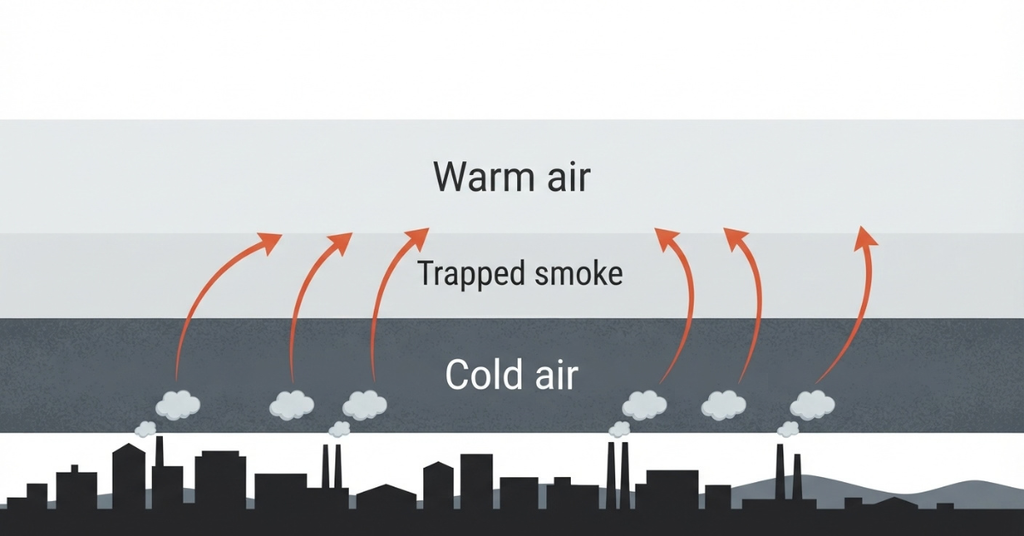
Nights get cold, and winds slow down. A layer of warm air then sits above cold air and blocks it from rising. Smoke and exhaust pile up near the ground. Experts call this a temperature inversion.
Punjab’s Environment Protection Agency treats October to January as the main smog window, as Dawn reported in September 2026.
7 Major Causes and Factors Behind Smog in Pakistan
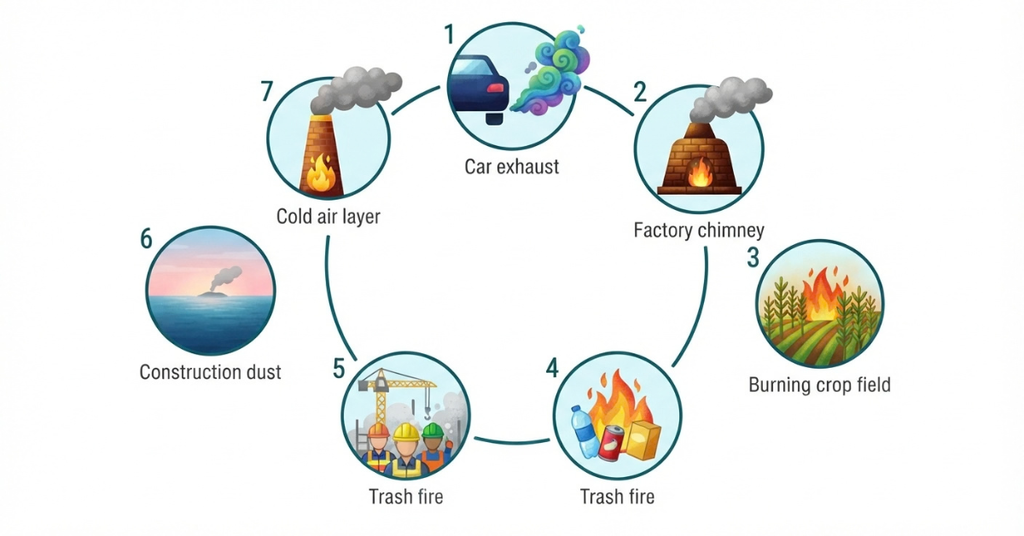
A World Bank analysis found five human sources account for about 75 percent of PM2.5 in Punjab. Natural dust and sea salt make up about one quarter. The first five categories below follow the World Bank’s Punjab-wide PM2.5 source breakdown. Road and construction dust is discussed separately because it matters locally, while winter weather is a trapping condition rather than an emission source.
| Factor | Share of Punjab PM2.5 | Main period | Main control |
|---|---|---|---|
| Residential fuel burning | 23% | Year-round | Cleaner cooking fuels and stoves |
| Transport emissions | 16% (World Bank category; includes road dust) | Year-round, worse in winter | Emission tests, cleaner vehicles, public transport |
| Industry and brick kilns | 16% | Year-round | Cleaner fuels, filters, kiln upgrades |
| Agriculture, including crop residue burning | 13% | Post-harvest peaks | Super seeders, balers, residue management |
| Waste burning | 7% | Year-round | Waste collection and enforcement |
| Road and construction dust | Road dust counted in transport | Dry periods | Dust suppression and site controls |
| Winter weather and inversion (a condition, not a source) | Not applicable | Autumn and winter | Forecasting and early warnings |
Transport and Industry
Factor 1: Vehicle and transport emissions. Trucks, buses, and two- and three-wheelers drive most of the problem. A World Bank assessment says Lahore’s private vehicles doubled in a decade to 7.4 million, and 82 percent of them are two-wheelers. The World Bank’s program document adds that Pakistan has no vehicle retirement age and still uses an old Euro II emission standard.
Factor 2: Industrial emissions and brick kilns. Heavy industry and old kilns burn dirty fuel and release thick smoke. Stronger pollution control regulations, filters, and kiln upgrades can cut this load.
Homes, Farms, and Waste
Factor 3: Residential fuel burning. The World Bank ranks this as Punjab’s largest source at 23 percent, mostly from cooking on solid fuels. The smoke adds to both indoor and outdoor pollution.
Factor 4: Crop residue burning. After the rice harvest, many farmers burn leftover stalks to clear fields for wheat. It is cheap and fast. It is also banned under Rule 7 of the 2023 rules.
Factor 5: Open waste burning. People burn trash, leaves, and tyres in streets and dumps. Weak waste collection makes this worse.
Dust and Winter Weather
Factor 6: Road and construction dust. Punjab’s EPA wants dust-control steps to become a condition for approving building projects.
Factor 7: Winter weather and temperature inversion. Cold, still air does not create pollution. It traps and concentrates what other sources release. That makes it the amplifier behind every smog episode.
Transboundary Pollution: What Role Does It Play?
Punjab sits in the Indo-Gangetic Plain, a shared airshed. The World Bank says that in 2021 about 53 percent of PM2.5 came from Punjab itself, 9 percent from other Pakistani provinces, and 13 percent from neighbouring countries. Transboundary pollution may add to some episodes. Its size changes with place, weather, and season, and it does not replace local action.
Effects of Smog in Pakistan
Smog in Pakistan affects human health, visibility, agriculture, and the environment, with the most serious impacts occurring during prolonged periods of poor air quality.
Health Effects
Smog irritates eyes, throats, and noses. Over time, it raises the risk of asthma, heart disease, stroke, and lung cancer. The World Bank says the poor, women, older adults, and children under five carry a heavier burden.
Estimates of deaths vary widely by method and year. Fair Finance Pakistan cites at least 128,000 deaths a year, as noted by AQLI. The Centre for Research on Energy and Clean Air (CREA) estimates up to 235,000, as summarized by Global South Hub.
How Much Life Expectancy Does Smog Reduce in Pakistan?
The Air Quality Life Index (AQLI) Pakistan fact sheet estimates that the average Pakistani could gain 3.3 years of life if PM2.5 fell to the WHO guideline. Lahore residents could gain 5.8 years. Between 1998 and 2023, yearly particle levels in Pakistan rose 55.7 percent.
Schools, Transport, and the Economy
Smog cuts visibility, raises accident risk, and can cancel flights. The World Bank estimates the health cost of PM2.5 exposure at about 9 percent of Pakistan’s GDP, based on 2019 data. Courts have also stepped in. In November 2024, a Lahore High Court judge called for a 10-year smog policy, Dawn reported.
Punjab Environmental Protection Smog Prevention and Control Rules 2023 Explained
These rules provide a legal framework for controlling major sources of smog and set penalties for activities that contribute to air pollution in Punjab.
What the Smog Prevention Rules Cover
Punjab notified the rules on 6 June 2023 under Section 31 of the Punjab Environmental Protection Act 1997. They apply across Punjab. The smog prevention rules cover brick kilns, industrial units, resource recovery units, tyre pyrolysis plants, stubble burning, waste burning, and vehicle smoke.
The rules set enforceable requirements and penalties for these activities. Environmental officers can inspect sites and issue fines. Rule 12 provides preventive measures, while Rule 14 deals with appeals. A penalised person can appeal to the Environmental Tribunal within 30 days.
Smog Rules 2023: Fines at a Glance
The amounts below are summarized from the notified 2023 rules, as reported by Pakistan Era from the Gazette copy. Amounts are in Pakistani rupees (Rs).
| Offence | First offence | Repeat offence | Rule |
|---|---|---|---|
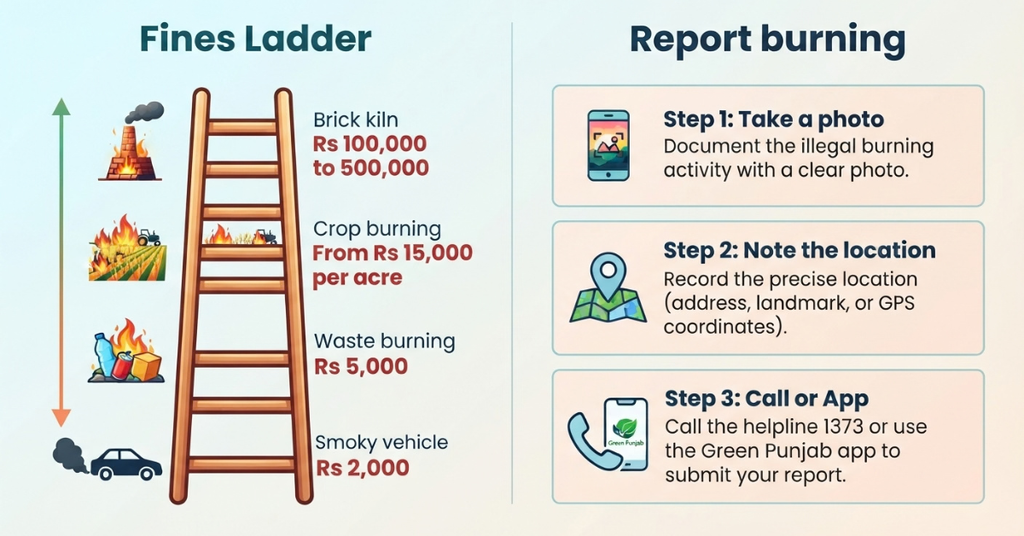
| Stubble or agricultural waste burning | Rs 15,000 for 0–1 acre; higher penalties apply as acreage increases | Double the first-offence penalty | Rule 7 and schedule |
| Open waste burning | Rs 5,000 | Rs 10,000 | Schedule |
| Smoky vehicle | Rs 2,000 | Rs 4,000 | Schedule |
| Brick kiln without zigzag | Rs 100,000 to 500,000 | Kiln demolition | Schedule |
| Smoky factory or business | Rs 100,000 to 500,000 | Rs 600,000 to 1,000,000 | Schedule |
| Tyre pyrolysis plant | Rs 100,000 to 500,000 (plants banned) | Rs 600,000 to 1,000,000 | Schedule |
Legal update: The EPD website also lists a Punjab Environmental Protection (Amendment) Act, 2026. Check penalties and enforcement steps against the latest Punjab legislation and notifications.
Where to Find the Smog Prevention and Control Rules 2023 PDF
The Punjab Environment Protection Department publishes the rules on its official rules and regulations page. Open the Smog Prevention and Control Rules 2023 PDF from there. It is a scanned copy, so you cannot search its text. Look for notification No. SO(T)/EPD/1-215/2023. That is the Punjab Environmental Protection Smog Prevention and Control Rules 2023 PDF.
How to Report Smog Violations
Call the EPA Punjab helpline at 1373 or use the Green Punjab app. Note the place and time, and take a photo if you can do so safely.
Smog Policy 2017 vs Smog Policy 2023 and Beyond
Many people mix up Punjab’s pollution control policy and its rules. Keep these three terms apart:
Policy: goals, strategy, and planned actions.
Rules: enforceable requirements, offences, and penalties.
Action plan: implementation steps, budgets, and timelines.
Punjab’s Smog Policies, 2017 to 2026
| Year | Instrument | What it does |
|---|---|---|
| 2017 | Policy on Controlling Smog (smog policy 2017) | Response plan and AQI system after a Lahore High Court petition |
| 2023 | Punjab Clean Air Policy (with phased action plan) (smog policy 2023) | Long-term plan through 2030 across key sectors |
| 2023 | Smog Prevention and Control Rules (smog rules 2023) | Legal rules and fines for named activities |
| 2024 | Smog Mitigation Action Plan | Short-term, budgeted plan, meant to be updated each year |
| 2025 | Punjab Clean Air Program | World Bank-backed program that supports the 2024 plan |
The World Bank says these plans show Punjab’s commitment, but enforcement is held back by limited staff, money, and systems. Critics also said the 2017 AQI was too lax.
Punjab Clean Air Program: What Is Being Funded?
In March 2025, the World Bank approved a USD 300 million loan for the program. Its goal is to cut PM2.5 by 35 percent over the next decade for 13 million people in Lahore Division. Key steps include:
- 5,000 super seeders to reduce crop residue burning
- 600 electric buses
- more regulatory-grade air quality monitors across Punjab
- two new fuel testing laboratories
Air Pollution Rules in Pakistan vs India: A Common Search Mix-Up
Many searchers find the Air (Prevention and Control of Pollution) Rules. Those belong to India. In Pakistan, pollution control regulations sit mainly in the 1997 Environmental Protection Acts, federal and Punjab, and in the rules made under them. Always confirm which country’s Air (Prevention and Control of Pollution) Rules you are reading.
How to Control Smog in Pakistan
Government Measures
A strong pollution control policy attacks every source at once. Priorities include:
- enforcing the smog prevention rules all year, not only in winter
- setting newer fuel and vehicle standards, and retiring old, smoky vehicles
- expanding public transport and air quality monitors
- helping families switch to cleaner cooking
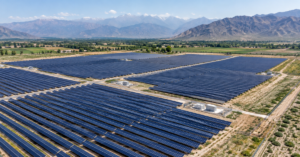
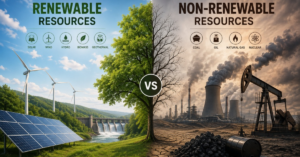
- moving power toward renewable energy in Pakistan
Money matters too. Global clean energy investment hit a record $2.3 trillion in 2025. Pakistan can tap that trend.
Sector-Specific Measures
Transport: inspect trucks and buses, test fuel quality, and add electric buses. Agriculture: use super seeders and balers instead of fire. Industry: upgrade kilns to zigzag designs and add filters. Waste: collect it on time so nobody burns it. Construction: cover loads and spray water on dust.
10 Ways to Reduce Air Pollution
- Use public transport.
- Carpool.
- Walk or cycle short trips.
- Service your vehicle.
- Choose an electric or cleaner vehicle when you can.
- Avoid idling your engine.
- Never burn trash or leaves.
- Compost garden waste.
- Switch to cleaner cooking fuel or an improved stove.
- Save electricity or install solar power.
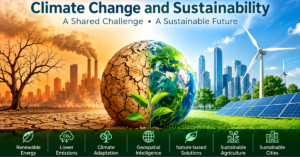
Also report open burning, and protect and plant urban greenery as a support, not a substitute for cutting emissions. These steps also support wider climate change solutions.
10 Ways to Reduce Exposure to Smog
- Check the AQI before you go out.
- Limit time outdoors during bad episodes.
- Avoid hard exercise outdoors on bad days.
- Close windows during severe episodes.
- Consider a well-fitting N95 or KN95 respirator when outdoor PM2.5 is high.
- Run a properly sized HEPA air cleaner indoors.
- Keep children, older adults, and people with heart or lung disease indoors on bad days.
- Follow official health advisories.
- Do not burn wood, trash, or incense indoors on smoggy days.
- Ask your school or workplace about smog-day plans.
Masks and purifiers lower your exposure, but they do not make polluted air safe.
How AI, GIS and Remote Sensing Help Fight Smog
AI, GIS, and remote sensing help identify pollution hotspots, monitor emission sources, map air-quality patterns, and support faster, data-driven action against smog.
Satellite Monitoring and GIS Hotspot Mapping
Satellites can spot fires, and ground sensors can map PM2.5. GIS can overlay traffic, industrial clusters, and crop-burning hot spots on one map. The same GIS and remote sensing methods that track floods can track smoke plumes. Officers can then reach the right field or kiln fast.
[Image 6: AI and GIS smog monitoring workflow. Place here.]
AI Forecasting and Early Warnings
AI models can combine weather, traffic, and sensor data to forecast high-PM episodes. They can also flag odd pollution patterns, rank places for enforcement, and support early-warning alerts. This works like AI in disaster management and flood forecasting in Pakistan. These tools need dense sensor data, and Punjab is still expanding its monitoring network.
Smog in Pakistan: October 2026 Update
October 2026 marks the start of Pakistan’s high-risk smog season, with Punjab stepping up monitoring, enforcement, and air-quality forecasting as pollution levels begin to rise.
October 1: Drones and Night Squads
Dawn reported on 1 October 2026 that Punjab’s EPA deployed night squads and drones to track violators and stubble-burning hot spots along motorway corridors. In one 24-hour period, teams inspected 431 brick kilns, demolished 5, sealed 9, registered 9 FIRs, and imposed Rs 1.4 million in fines. They also inspected 269 industrial units, sealing 11 and imposing Rs 1.23 million in fines.
September: The Pre-Smog Crackdown
In September 2026, Punjab’s EPA launched a “pre-smog crackdown” on waste burning and vehicle smoke. The agency said open waste burning is banned under the 2023 rules. It also proposed making dust-control rules a condition for approving building projects. The EPD website also lists a Pre-Smog Action Plan 2026 for July to September 2026.
The 2026 Farm Season
As of 23 September 2026, Pakistan Era reported that the Agriculture Department had counted 21 burning incidents on 24 acres, Rs 330,000 in fines, and one FIR. The rice harvest runs into October and November, so these numbers may climb. Farmers can call the department’s helpline at 0800-17000 to ask about machines and support.
Conclusion
Smog in Pakistan is a public health problem, not only a winter nuisance. It has multiple sources, including household activities, transport, industry, agriculture, and waste burning, while winter weather can trap pollutants near the ground. Pakistan’s Smog Rules 2023 provide penalties for violations, but their effectiveness depends on consistent, year-round enforcement. Long-term improvement also requires cleaner energy, better public transport, stronger pollution controls, and reliable air-quality data. Pakistan’s annual PM2.5 concentration fell from 73.7 µg/m³ in 2024 to 67.3 µg/m³ in 2025, but it remained far above the WHO guideline. Check the rules, report open burning, and share this guide. Need air-quality maps or monitoring for your project? Explore GIS environmental monitoring by AI Geo Navigators.
FAQs
What is smog in Pakistan?
Smog in Pakistan is polluted air full of PM2.5 and gases. It builds up in still winter weather, especially across Punjab and Lahore. Vehicles, homes, industry, farm fires, waste burning, and dust feed it. In 2025, Lahore averaged 88.9 µg/m³, about 17.8 times the WHO guideline.
Is smog only a winter problem in Pakistan?
No. Pollution sources operate throughout the year. Winter conditions, such as low wind and temperature inversions, trap pollutants near the ground and make smog episodes more severe. That is why Punjab treats October to January as the main smog window, but cleaner transport, homes, and industry matter in every season.
What are the main causes of smog in Pakistan?
The main causes of smog in Pakistan include vehicle emissions, industrial pollution, crop-residue and waste burning, household fuel use, and construction dust. During winter, stagnant air, low temperatures, and reduced wind can trap these pollutants close to the ground, worsening smog in major cities.
Why is Lahore affected so badly by smog?
Lahore combines heavy traffic, industry, home cooking smoke, and nearby crop burning. In Greater Lahore, the World Bank puts residential sources at 28 percent and transport at 24 percent. Its position in the Indo-Gangetic airshed, close to the border, and cold winter weather make the effect stronger.
What are the specific measures to control smog?
Enforcement comes first. Governments should retire old vehicles, expand public transport, clean up kilns and factories, collect waste, and help farmers use machines instead of fire. Families can switch to cleaner cooking fuel. Cities need more air monitors. Homes can also cut car trips and stop trash fires.
What are the environmental protection rules and regulations in Punjab?
Punjab follows the Punjab Environmental Protection Act 1997 and the rules made under it. Key rules include the Smog Prevention and Control Rules 2023, the Administrative Penalty Rules 2013, and the Motor Vehicles Rules 2013. The Punjab EPA enforces them through inspections, fines, and sealing polluting sites.
Which environmental laws and policies matter for smog in Pakistan?
People often ask, “What are the 7 environmental laws?” No official list of seven exists. Acts: the Punjab Environmental Protection Act 1997 and its 2026 amendment. Rules: the Smog Prevention and Control Rules 2023, Motor Vehicles Rules 2013, and Administrative Penalty Rules 2013. Policies: the Policy on Controlling Smog 2017 and the Punjab Clean Air Policy.
Where can I find the Smog Prevention and Control Rules 2023 PDF?
Visit the Punjab Environment Protection Department’s rules and regulations page. The Punjab Environmental Protection Smog Prevention and Control Rules 2023 PDF is the official text, notified on 6 June 2023 under notification No. SO(T)/EPD/1-215/2023. It is a scanned copy, so download it and save a copy.
Sources and Further Reading
- IQAir: 2025 World Air Quality Report (March 2026)
- World Bank: Punjab Clean Air Program – Program Information Document (December 2024)
- Punjab Environment Protection Department: Smog Prevention and Control Rules 2023, Policy on Controlling Smog 2017, and Punjab Clean Air Policy
- World Bank: Environmental and Social Systems Assessment – Punjab Clean Air Program (March 2025)
- World Bank: Press release on the Punjab Clean Air Program (28 March 2025)
- Air Quality Life Index: Pakistan Fact Sheet 2025
- Dawn: Reports on Punjab’s pre-smog operations (September–October 2026) and Lahore High Court proceedings (November 2024)
- The Express Tribune: Report on Lahore AQI (November 2023)
- Pakistan Era: Crop Burning in Punjab, the Fine, the Rules and How to Report It (25 September 2026)
- Fair Finance Pakistan & CREA: Research and estimates on air-pollution-related deaths