| Quick Answer: The Indus Water Treaty main points cover six key areas: allocation of six rivers between India and Pakistan; permitted water uses; storage and pondage limits on the western rivers; data sharing through the Permanent Indus Commission; a three-tier dispute resolution process; and rules for treaty modification and continuity. Together, these provisions define each country’s rights and responsibilities over the Indus River system. |
Most guides list the Indus Water Treaty main points and stop there. This guide shows what each point means in real life. It also shows what has changed in 2026.
The treaty’s official name is the Indus Waters Treaty 1960. Many people search for it as the Indus Water Treaty, so this page uses both. In Pakistan, it is also called the Sindh Taas Agreement, or Sindh Tas (سندھ طاس معاہدہ). The name means Indus Basin Agreement. Our Indus Water Treaty guide tells the story behind it.
This page covers only the rules. For the signing story, read the 1960 treaty history. For what happened after the Pahalgam attack, read the 2025 suspension.
Key takeaways
- India gets the Ravi, Beas and Sutlej. Pakistan gets the Indus, Jhelum and Chenab, after India’s permitted uses.
- India must let the western rivers flow, except for four uses: domestic, non-consumptive, agricultural and hydroelectric.
- Article VI covers data sharing. Article VII covers notice of planned works.
- Disputes start at the Permanent Indus Commission. Technical differences go to a Neutral Expert. Disputes go to a Court of Arbitration.
- The treaty has no exit clause. The Court says India’s abeyance is not allowed. A Neutral Expert decision is expected around July 2027.
What are the Indus Water Treaty main points?
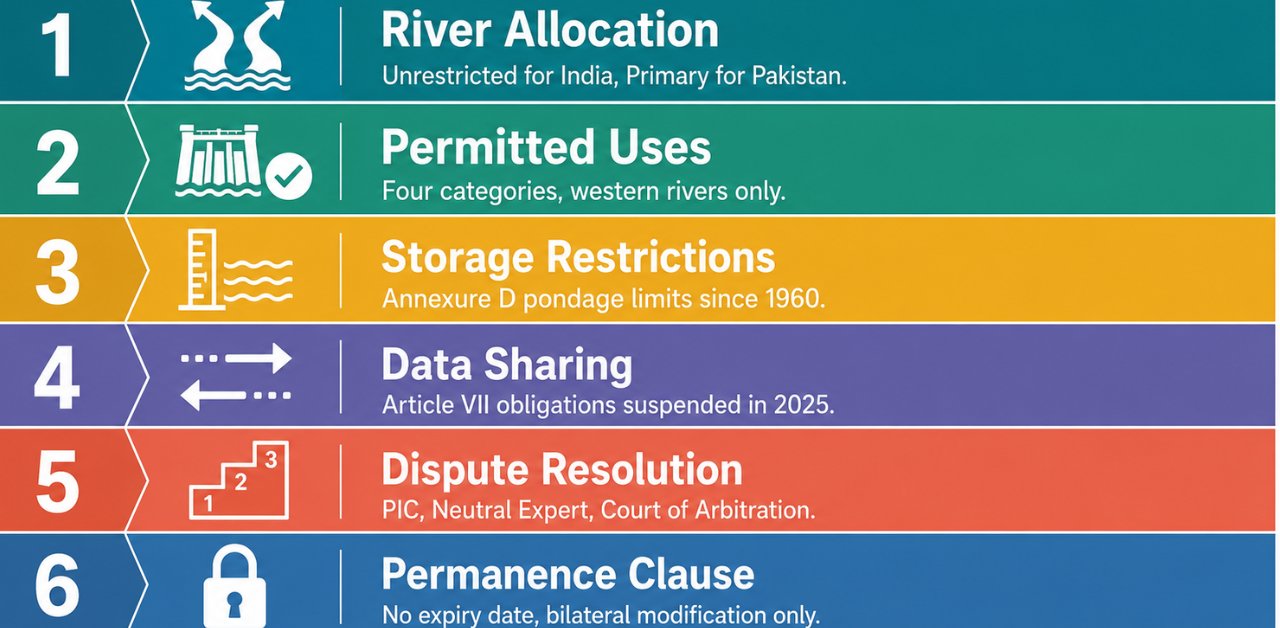
The Indus Waters Treaty has six main points. Here they are in order:
- River split. India uses the three eastern rivers. Pakistan has the three western rivers, after India’s permitted uses.
- Permitted uses. India may use the western rivers only for set purposes.
- Storage and pondage limits. India may hold only limited amounts of water on the western rivers.
- Data sharing. Both countries must share river data and give notice of planned works.
- Dispute process. Disagreements go to one of three mechanisms.
- Permanence. The treaty has no end date. Only a new, ratified treaty can end or change it.
The table shows where each point sits in the treaty and where it stands today.
| Main point | Where it sits | Plain rule | Status in 2026 |
| 1. River split | Articles II and III | India: Ravi, Beas, Sutlej. Pakistan: Indus, Jhelum, Chenab | Rivers unchanged. India says the treaty is in abeyance. The Court says it is in force |
| 2. Permitted uses | Article III(2), Annexures C and D | India must let the western rivers flow, except for domestic, non-consumptive, agricultural and hydroelectric use | Disputed at Kishenganga and Ratle |
| 3. Storage and pondage | Article III(4), Annexures D and E | India may not store water on the western rivers except as these annexures allow | A May 2026 pondage award and an August 2026 order limit work at Ratle |
| 4. Data sharing | Articles VI and VII | Monthly river data and notice of planned works | Treated as paused by India since April 2025 |
| 5. Dispute process | Article IX, Annexures F and G | Commission first, then a Neutral Expert or a Court of Arbitration | India does not take part in the Court. The Neutral Expert’s decision is expected around July 2027 |
| 6. Permanence | Article XII | No end date. Only a ratified treaty can change or end it | The Court says abeyance is not allowed |
1. How are the rivers divided?
Article II gives India the Ravi, Beas, and Sutlej. Article III gives Pakistan the Indus, Jhelum, and Chenab, after India’s permitted uses. India can use the eastern rivers for almost any purpose.
The western rivers carry roughly 80% of the Indus Basin’s average annual flow. The eastern rivers carry about 20%. These are approximate flow shares. The treaty divides the rivers. It does not write a fixed 80/20 share of water into its text.
Our Indus Water Treaty guide explains why this split favors Pakistan and shows the full river table.
2. What can India do with the western rivers?
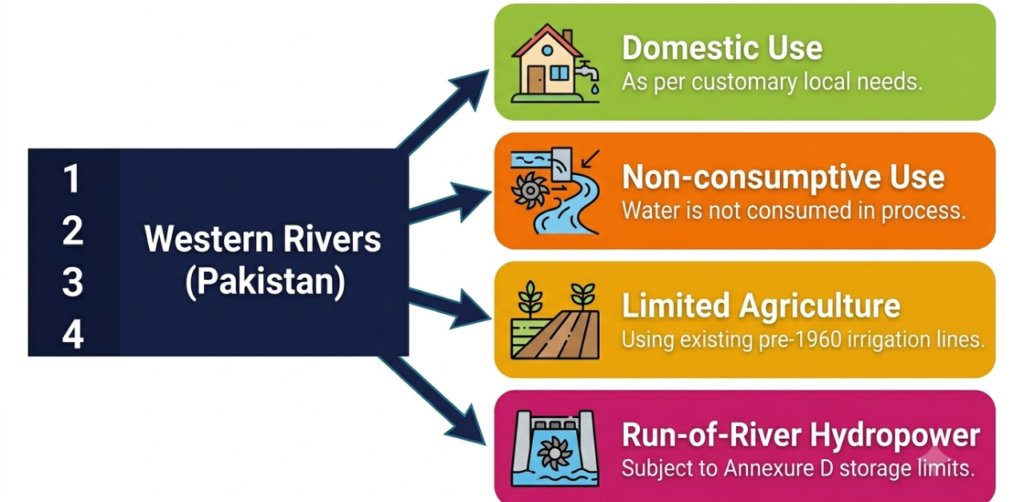
Article III(2) says India must let all the western rivers’ water flow, with four exceptions. India may use the water for:
- Domestic use. Drinking, washing, household, municipal and industrial use. It does not include farming or power.
- Non-consumptive use. Navigation, floating timber, flood control, fishing and wildlife.
- Agricultural use. Irrigation, as set out in Annexure C.
- Hydroelectric power. Generation, as set out in Annexure D.
India may not use the water in other ways. In August 2025, a Court of Arbitration issued an award on how to read the treaty. Pakistan welcomed it as backing its view that India must let the western rivers flow.
What is the difference between consumptive and non-consumptive use?
Non-consumptive use leaves the water in the river. Consumptive use takes it out. Under Article I, non-consumptive use means uses like navigation and fishing, where the water stays in or returns to the same river. Seepage and evaporation do not count against it.
Irrigation and hydropower are not counted as non-consumptive. The treaty gives each its own rules. Large reservoirs make the line harder to draw. They lose water to evaporation and hold back flow for a time. That is why modern dams cause so many disputes.
3. What do the storage and pondage limits mean?
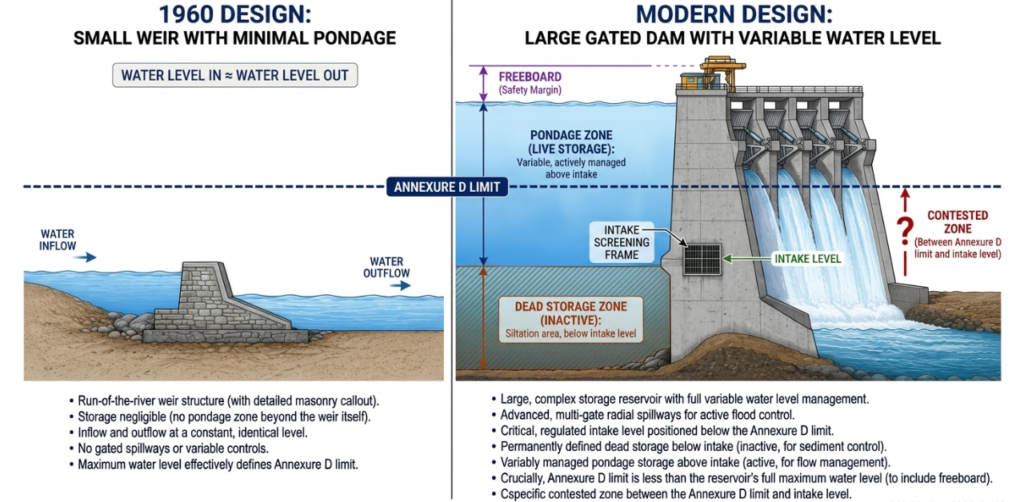
Pondage is the small amount of water a run-of-the-river plant may hold to meet daily or weekly changes in power demand. Annexure D sets how much each plant may hold. Article III(4) bars India from storing water or building storage works on the western rivers, except as Annexures D and E allow. Annexure E sets the storage caps. They add up to about 3.6 million acre-feet, a small share of what the rivers carry each year.
These rules were written for 1960 dams. Modern plants are bigger and use gates and spillways in new ways. So the same question keeps coming back: does this design fit the limit?
- Baglihar (2005 to 2007): The Neutral Expert mostly backed India. He still required some design changes.
- Ratle (850 MW, Chenab River): The Ratle and Kishenganga projects are involved in parallel proceedings before the Court of Arbitration and the Neutral Expert. The Court has addressed treaty interpretation and maximum pondage, while the Neutral Expert is examining specific technical design questions, including whether the projects comply with the treaty. On May 15, 2026, it issued an award on maximum pondage. Reports say the award favored Pakistan. On August 31, 2026, the Court unanimously barred India from concreting the Ratle dam wall and power intake above set levels until 90 days after the Neutral Expert’s final decision. India must also report any change to the construction schedule. India rejected the ruling. See the PCA case record for the Court’s decisions.
Storage limits also protect the timing of flows. A canal manager in Punjab or Sindh plans water weeks ahead. If upstream releases swing, planning breaks, even when the yearly total stays the same.
Monitoring river flows, reservoir levels, and upstream releases takes reliable hydrological data. Satellite remote sensing and GIS can help analysts watch changes across the river basin. See how AI-powered GIS supports this kind of monitoring.
Pakistan also depends on these rivers for power. See how hydropower fits into renewable energy in Pakistan and energy security.
4. What does the data-sharing rule require?
Article VI requires both countries to exchange river data. Article VII requires notice of certain engineering works. The treaty text sets these duties out clearly.
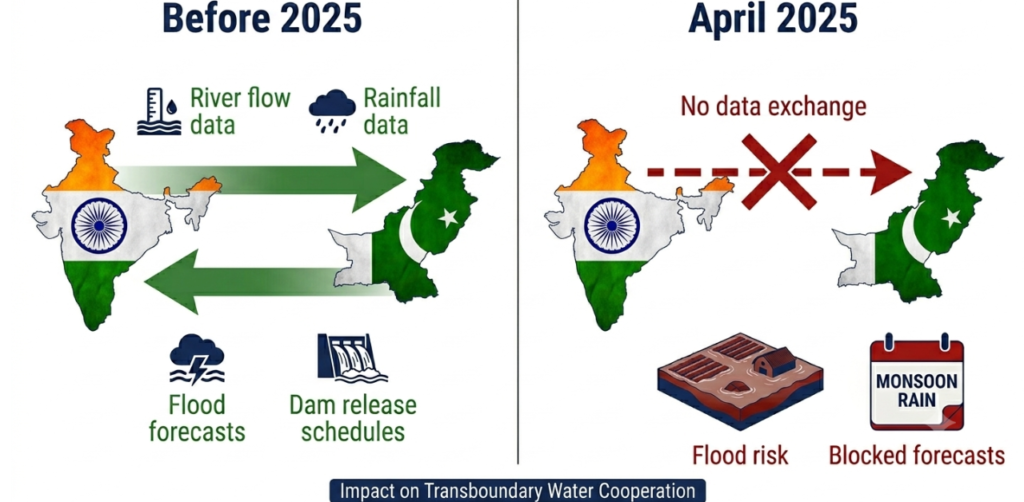
- Article VI (data): Each side keeps daily records of river flow, reservoir releases, and canal withdrawals. It sends them to the other side every month, no later than three months after the month ends. Data needed for operations can be requested daily. Extra hydrological data must be supplied on request, if available.
- Article VII (planned works): A country that plans works that would interfere with river waters, and that it believes would materially affect the other country, must notify the other. It must also share the data it has on the work.
- Article IV(8) (floods): Each country must pass on, as early as practicable, any information on extraordinary reservoir releases and flood flows that may affect the other.
The Permanent Indus Commission, set up by Article VIII, is the regular channel for these exchanges.
Since April 2025, India has treated these duties as paused. That hurts flood planning. A dam release without notice can flood farms downstream. Satellite data and river models can fill part of the gap. They cannot replace official release schedules. See how flood risk analytics and GIS for climate resilience support water planning.
5. How does the dispute process work?
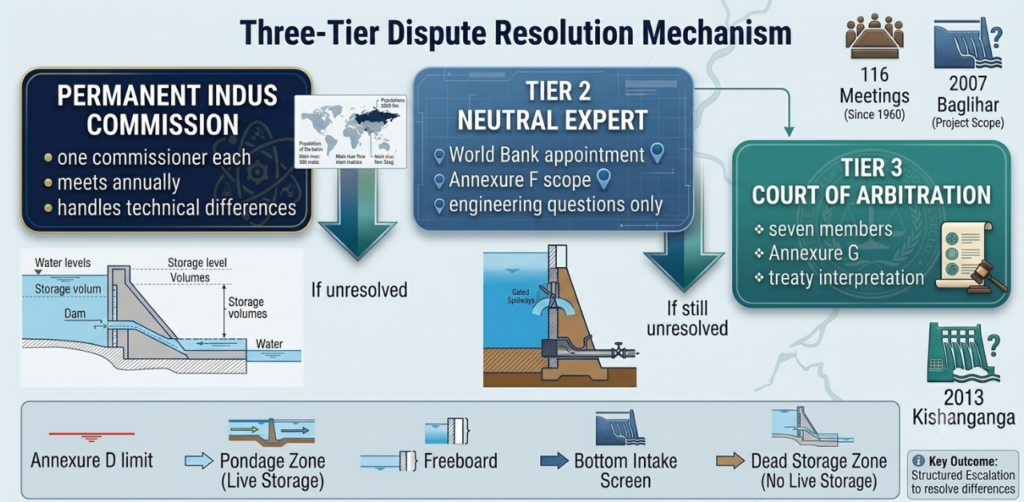
Article IX sets three mechanisms for settling disagreements. Which one applies depends on the type of issue.
- Questions go first to the Permanent Indus Commission. Each country names one commissioner. The Commission must meet at least once a year.
- Differences are technical matters listed in Annexure F. If the Commission cannot agree, a Neutral Expert decides them.
- Disputes are the other matters. After talks or mediation, a Court of Arbitration decides them under Annexure G.
The path is not a fixed ladder. The Commission may send a difference to the Court, or settle it another way. A Neutral Expert can also say that a difference should be treated as a dispute. Article IX distinguishes between questions, technical differences, and legal disputes. Each category follows a different procedure under the treaty.
Here is where things stand. Pakistan started Court of Arbitration proceedings in August 2016. India asked for a Neutral Expert in October 2016. Both tracks now run at the same time. India says the treaty does not allow that. India has not taken part in the Court’s proceedings. Reports say it has also skipped Neutral Expert meetings since November 2025.
The Court in this case has five members, chaired by Professor Sean D. Murphy. The Neutral Expert’s final decision is expected around July 2027. The timeline below lists the key dates.
6. Can the treaty end or change?
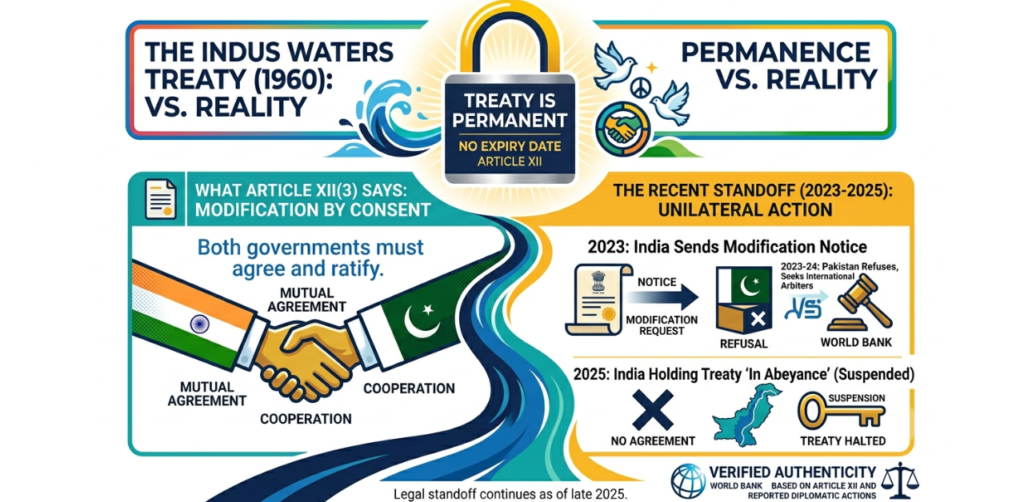
No. The treaty has no exit clause. Article XII(3) allows changes only by a ratified treaty between both governments. Article XII(4) says the treaty continues until both governments end it the same way.
India sent formal notices seeking changes in January 2023 and again in August 2024. Pakistan said a change needs both sides to agree. The Court later found that no treaty clause forces Pakistan to negotiate changes.
India then announced on April 23, 2025, that it would hold the treaty in abeyance. The word “abeyance” does not appear in the treaty. The Court said it has no technical meaning in international law. On August 31, 2026, the Court ruled unanimously that none of India’s grounds can justify suspending or ending the treaty. It said the treaty remains fully in force. India rejects the ruling. Read the full story in our treaty suspension article, or see the PCA case record.
What has changed since the treaty was signed in 1960?
| Date | What happened |
| September 19, 1960 | India and Pakistan sign the treaty in Karachi. It enters into force on January 12, 1961, with retrospective effect from April 1, 1960. |
| August to October 2016 | Pakistan starts Court of Arbitration proceedings. India asks for a Neutral Expert |
| January 2023 and August 2024 | India sends notices asking to modify the treaty |
| July 6, 2023 | The Court rejects India’s objections to its competence |
| January 2025 | The Neutral Expert rules that he is competent to decide the technical differences India referred |
| April 23, 2025 | India announces the treaty will be held in abeyance |
| June 27, 2025 | The Court finds that India’s abeyance cannot limit its competence |
| August 8, 2025 | The Court issues its award on the general interpretation of the treaty |
| November 8, 2025 | The Court decides Pakistan’s request for clarification of that award |
| May 15, 2026 | The Court issues its award on maximum pondage |
| August 31, 2026 | The Court rules the treaty remains fully in force and orders interim measures at Ratle |
| July 2027 (expected) | The Neutral Expert’s final decision on the Kishenganga and Ratle designs |
Why do the main points matter in 2026?
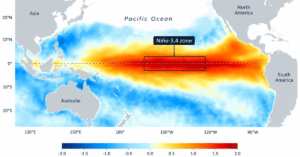
Climate stress is rising. Glaciers melt faster, monsoon patterns shift, and El Niño years change river flow. See what Super El Niño 2026 could mean for the region. Farms depend on these rivers too, so water planning and smart agriculture matter more each year. With data sharing paused and dams under dispute, each main point decides who can plan for floods and droughts.
Key terms in simple words
- Riparian: a country the river flows through.
- Eastern rivers: Ravi, Beas and Sutlej.
- Western rivers: Indus, Jhelum and Chenab.
- Domestic use: drinking, household, municipal and industrial use. It does not include farming or power.
- Non-consumptive use: use like navigation or fishing, where the water stays in or returns to the same river.
- Agricultural use: irrigation.
- Run-of-the-river hydropower: power made from the river’s natural flow with little storage.
- Pondage: the small amount a run-of-the-river plant may hold for daily or weekly power demand.
- Abeyance: India’s word for pausing the treaty. The treaty has no such clause.
- Neutral Expert: an engineer appointed through the World Bank to decide technical differences.
- PIC: the Permanent Indus Commission.
Conclusion
The Indus Water Treaty main points are more than a list of rivers. Each rule sets what a country may do, who checks it, and where disputes go. In 2026, data sharing, dam limits, and the dispute process are under the most strain.
For the full picture, read our Indus Water Treaty guide. You can read the original text at the UN Treaty Collection. The Court’s decisions are listed on the PCA case record.
Research note: This article explains the main provisions of the Indus Waters Treaty using the treaty text and the Permanent Court of Arbitration’s press releases and case record. The positions of India and Pakistan are attributed to each government. Last reviewed on November 17, 2026
FAQs
Does the Indus Waters Treaty guarantee Pakistan 80% of the water?
No. The western rivers carry roughly 80% of the Indus Basin’s average annual flow, while the eastern rivers carry about 20%. However, the treaty does not guarantee a fixed 80/20 water share. It allocates specific rivers and defines the permitted uses of their waters.
What is the role of the Permanent Indus Commission under the Indus Waters Treaty?
The Permanent Indus Commission is the official communication channel between India and Pakistan under Article VIII. Each country appoints one commissioner. The Commission exchanges information, discusses treaty-related questions, and must meet at least once a year.
Why are the Ratle and Kishenganga hydropower projects disputed?
The projects have raised questions about whether their designs comply with the treaty’s hydropower and storage limits. The Court of Arbitration and the Neutral Expert are examining different aspects of these issues through parallel proceedings.
What happens if India and Pakistan disagree over water data?
Article VI requires both countries to exchange river-flow, reservoir-release, and canal-withdrawal data. Article IX provides mechanisms for addressing treaty-related disagreements. The Permanent Indus Commission is the regular channel for communication, although India has treated data-sharing duties as paused since April 2025.
Can Pakistan challenge an Indian dam project under the Indus Waters Treaty?
Yes. Pakistan can raise concerns through the treaty’s dispute-resolution mechanisms. Technical differences may go to a Neutral Expert, while legal disputes may be referred to a Court of Arbitration under Article IX and the relevant annexures.