| Quick Answer: As of September 2026, the Indus Water Treaty remains suspended by India but legally in force, according to a Hague Court of Arbitration ruling on August 31, 2026. The tribunal rejected India’s unilateral abeyance declaration and restricted construction at India’s Ratle Hydroelectric Project pending a Neutral Expert decision expected in July 2027. India has rejected the ruling’s jurisdiction. |
Indus Water Treaty remains one of the most significant water-sharing agreements in modern history. However, what happens when two nuclear-armed neighbours come into conflict over a water resource that supports more than 300 million people? This is not a hypothetical scenario. It reflects the reality surrounding the treaty today.
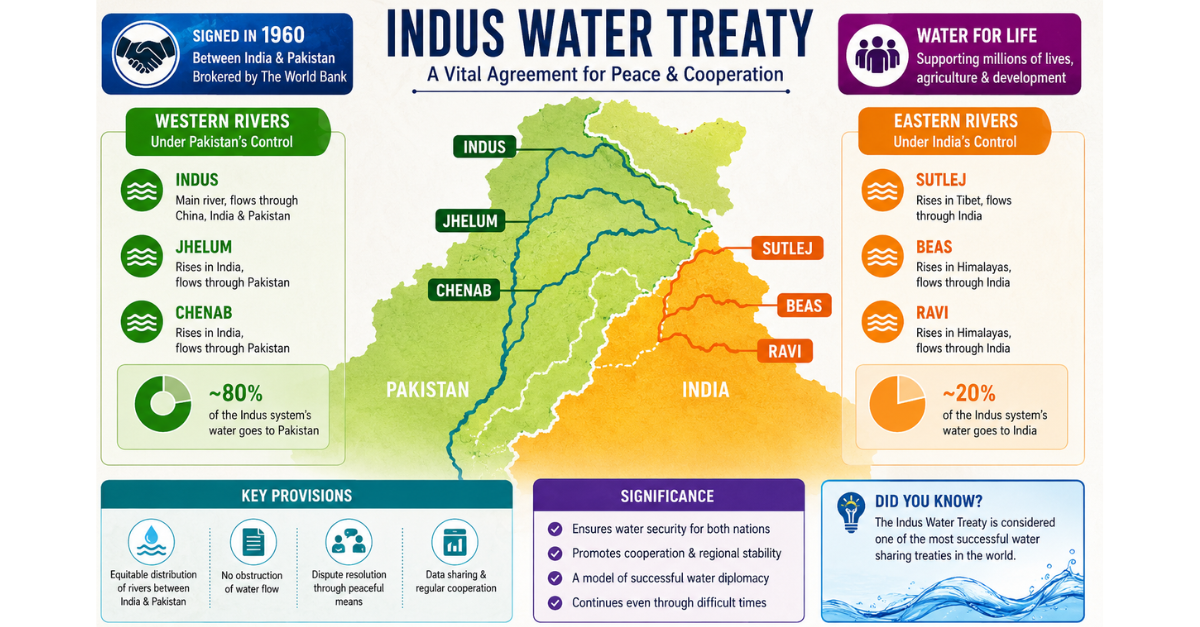
The Indus Water Treaty is a water-sharing agreement signed between India and Pakistan on 19 September 1960. Brokered by the World Bank, it allocates the Ravi, Beas, and Sutlej rivers to India and the Indus, Jhelum, and Chenab rivers to Pakistan. To explore the treaty’s twelve articles, river allocation mechanics, and key legal provisions in detail, read our complete breakdown of the Indus Water Treaty main points. Notably, the treaty remained in force for more than six decades before India suspended its obligations in April 2025. For a complete understanding of the treaty’s history, river allocations, disputes, and current status, read our comprehensive guide to the Indus Water Treaty.
For over 60 years, the treaty survived three wars, military standoffs, and decades of political tensions. However, India’s decision to suspend the agreement after the Pahalgam attack has created its most serious crisis. As a result, the Indus Water Treaty now faces unprecedented strain. Today, the treaty remains critical because it governs six major rivers that support agriculture, energy production, and the livelihoods of millions across the region.
Why the Indus Water Treaty Still Matters Today?
Pakistan depends on the Indus River system for nearly 80% of its irrigated agriculture. Some experts believe the agreement is overly generous to India. Growing concerns about climate change and rising energy demands have increased calls to revise the treaty.
The Indus Water Treaty was signed by India and Pakistan in 1960. It establishes rules for sharing the waters of the Indus River system. The agreement covers the Indus River and its major tributaries, including the Jhelum, Sutlej, and Beas rivers. Importantly, the deal was signed by the World Bank and is considered one of the world’s most important water treaties of its time.
Key Takeaways
- Signed on September 19, 1960.
- Brokered by the World Bank.
- India controls the Ravi, Beas, and Sutlej.
- Pakistan receives primary rights over the Indus, Jhelum, and Chenab.
- India suspended treaty obligations in April 2025 after the Pahalgam attack.
Background and History of the Indus Water Treaty
The Indus Water Treaty was born out of one of the most urgent water crises in post-independence history. Understanding its background requires going back to 1947.
The 1947 Partition Problem
In August 1947, the partition of British India created India and Pakistan. As a result, the Radcliffe boundary cut through the Indus River system, giving India control of key headworks and canals in Punjab, while Pakistan inherited farmland dependent on those waters.
On April 1, 1948, India temporarily restricted the flow of water to some Pakistani canals. Although the supply was later restored, the incident created deep mistrust and highlighted the urgent need for a permanent water-sharing agreement backed by a legal framework.
World Bank Mediation and Nine Years of Negotiations
In 1952, both countries invited the World Bank to mediate the dispute. Earlier, David Lilienthal had proposed joint river development, helping to shift negotiations from conflict to cooperation.
Over nine years of discussions, both sides exchanged proposals but failed to agree on dividing the rivers equally. Eventually, the breakthrough came when it was decided to split the six rivers into two groups instead of sharing each river equally. As a result, this required major infrastructure investment to replace existing canal systems.
To support this, the World Bank helped create the Indus Basin Development Fund, backed by several countries. This funding made it possible for Pakistan to build replacement works and helped turn the agreement into a practical and politically acceptable solution.
The Sindh Taas Agreement: Signing of the Treaty
The Indus Water Treaty was signed in Karachi on September 19, 1960. Notably, Indian Prime Minister Jawaharlal Nehru and Pakistani President Field Marshal Ayub Khan put their signatures on the document, with World Bank President Eugene Black also signing as a guarantor. The treaty came into force retrospectively from April 1, 1960. In Pakistani discourse, the agreement is sometimes called the Sindh Taas Agreement (Sindh Taas meaning Indus Basin in Urdu), a name that reflects Pakistan’s deep identification of the treaty with the security of its water supply.
Indus Water Treaty Rivers: How the Six Rivers Were Divided

The Indus River system comprises six major rivers flowing from the Himalayas and the Tibetan Plateau. The allocation of these rivers is the central mechanism of the treaty and the source of most disputes.
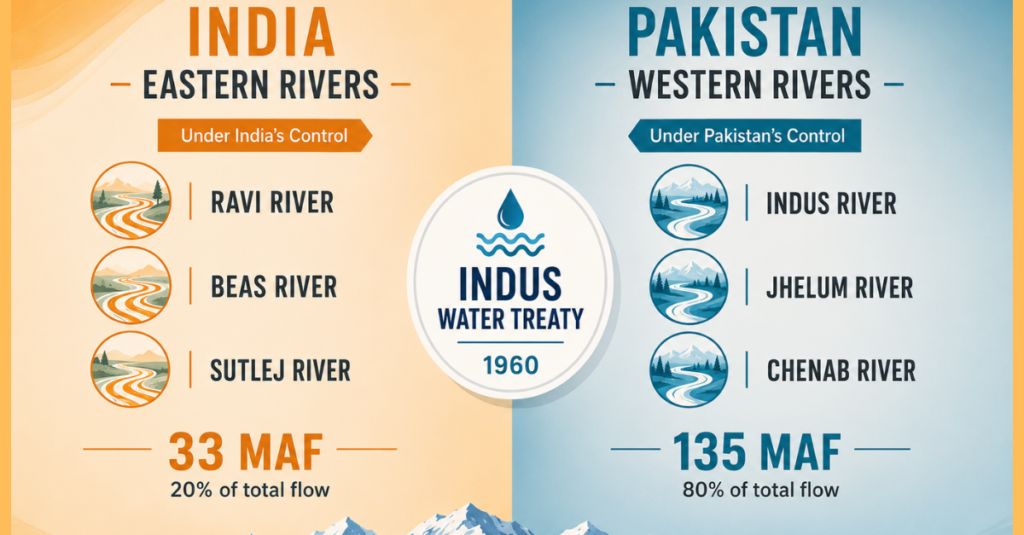
Eastern Rivers Allocated to India
India received full and exclusive rights over the three eastern rivers:
- Ravi River
- Beas River
- Sutlej River
India can use these rivers for any purpose, including consumptive use, irrigation, hydropower, and industrial use, without restriction. Together, these rivers carry roughly 33 million acre-feet (MAF) of water annually, representing about 20% of the Indus system’s total flow.
Western Rivers Allocated to Pakistan
Pakistan received the primary rights over the three western rivers:
- Indus River
- Jhelum River
- Chenab River
These three rivers carry approximately 135 MAF annually, representing about 80 %of the total Indus system flow. However, India is allowed limited use of western rivers for domestic consumption, non-consumptive uses, and run-of-the-river hydropower generation, but cannot impound or divert significant volumes.
River Allocation Comparison Table
| Feature | Eastern Rivers (India) | Western Rivers (Pakistan) |
| Rivers Included | Ravi, Beas, Sutlej | Indus, Jhelum, Chenab |
| Annual Flow | ~33 MAF (20% of total) | ~135 MAF (80% of total) |
| Primary Beneficiary | India | Pakistan |
| Permitted Uses (Other Country) | None (exclusive to India) | Domestic, non-consumptive, limited hydro |
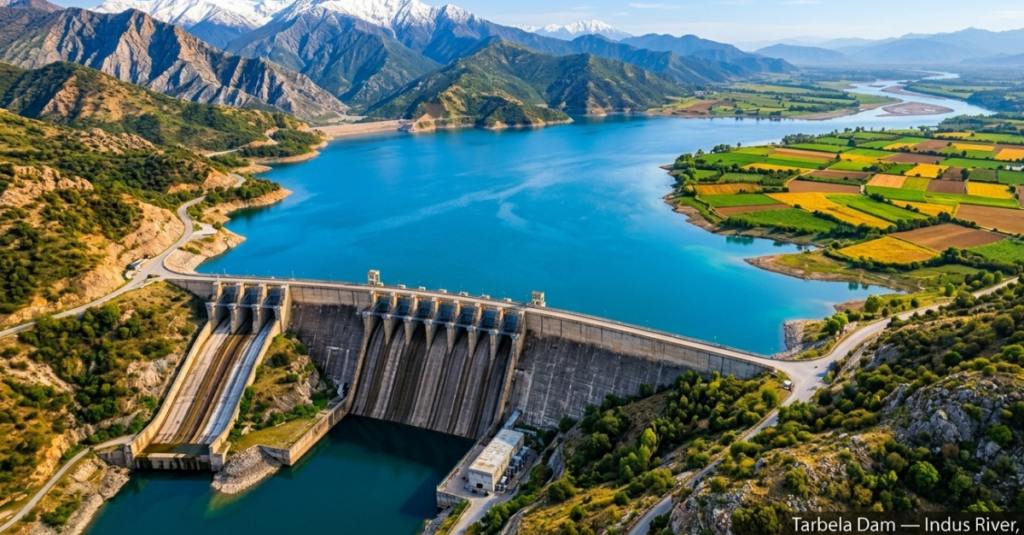
| Key Infrastructure (Recipient) | Bhakra-Nangal, Shahpurkandi Dam | Tarbela Dam, Mangla Dam |
| Population Supported | Punjab, Haryana, Rajasthan (India) | Punjab and Sindh provinces (Pakistan) |
The lopsided flow allocation, giving Pakistan 80% of the water, was intentional. Pakistan, as the lower riparian state, faced a structural disadvantage because most of its irrigated farmland depended on rivers that originated in or passed through Indian territory. The treaty recognised this dependence and designed the allocation to compensate for it.
Indus Water Treaty Main Points and Key Provisions
The Indus Water Treaty 1960 consists of twelve articles and eight annexures. If you want a deeper explanation of every provision, permitted use, storage limit, and dispute mechanism, read our complete guide on the Indus Water Treaty1960. The following are the most important provisions that define how both countries interact with the river system.
Article I: Definitions
Article I provides precise definitions of terms used throughout the treaty, including the six rivers, their tributaries, and key technical concepts such as consumptive use, non-consumptive use, and agricultural use. These definitions have been the subject of prolonged legal arguments because both India and Pakistan have interpreted several terms differently in the context of hydropower projects.
Articles II and III: River Allocations
Article II grants India unrestricted use of the eastern rivers. Article III grants Pakistan use of the western rivers while placing specific limitations on India’s use of those rivers. India may use western river water for domestic purposes, non-consumptive use (such as navigation and fishing), and limited irrigation of land that was already irrigated before the treaty was signed. India is explicitly prohibited from constructing storage works beyond specified small capacities on the western rivers without Pakistan’s consent.
Article IV: Transitional Arrangements
During a ten-year transitional period from 1960 to 1970, India was required to continue supplying water from the eastern rivers to Pakistani canals to allow time for Pakistan to build replacement canals and link projects funded by the Indus Basin Development Fund. This transitional period was essential because Pakistani farms could not be left dry while new infrastructure was being constructed.
Article VII: Future Cooperation
Article VII is frequently overlooked but contains an important cooperative clause. It requires both countries to exchange hydrological data, give advance notice of engineering works on shared rivers, and cooperate on flood management. This article created the legal basis for the Permanent Indus Commission.
Article XI: Dispute Resolution Mechanism
The treaty establishes a three-tier dispute resolution mechanism. First, the Permanent Indus Commission (PIC) attempts to resolve differences through direct negotiation. If the commission fails, the issue is referred to a Neutral Expert appointed by the World Bank. If the Neutral Expert mechanism is also insufficient, the matter goes to a Court of Arbitration. This three-tier system was designed to prevent disputes from escalating to political confrontation.
Article XII: Duration and Modification
The treaty has no expiry date and is intended to be permanent. However, Article XII(3) allows either party to request modifications through negotiation. India invoked this article in 2023 to formally propose the renegotiation of the treaty, citing changed circumstances, including climate change, population growth, and new energy needs. Pakistan rejected the request, arguing the treaty is a permanent settlement that cannot be reopened unilaterally.
The Permanent Indus Commission and Dispute Resolution
The Permanent Indus Commission (PIC) is the institutional backbone of the Indus Water Treaty. It was established under Article VIII and functions as the principal channel of communication between the two governments on water management.
Structure and Functions of the PIC
The PIC consists of one commissioner from each country, both of whom must be high-ranking government officials. The commission is required to meet at least once a year, alternating between India and Pakistan. Its functions include exchanging flow data, inspecting works under construction, examining complaints, and attempting to resolve differences before they become formal disputes.
Since 1960, the PIC has met over 100 times and resolved numerous technical disagreements quietly and without public drama. This record of quiet diplomacy is often cited as evidence that the treaty’s mechanisms do work when both sides are willing to engage.
Neutral Expert and Court of Arbitration
When the PIC cannot resolve a disagreement, the treaty allows either party to request the appointment of a Neutral Expert by the World Bank. The Neutral Expert handles technical differences such as engineering specifications and design parameters. In 2022, the World Bank simultaneously activated both a Neutral Expert and a Court of Arbitration to address disputes over India’s Kishanganga and Ratle hydroelectric projects. This unprecedented dual activation reflected the depth of the procedural disagreement between the two countries and created an institutional conflict that both sides handled differently.
Breakdown of PIC Meetings
India stopped attending PIC meetings in 2024, citing Pakistan’s refusal to agree to treaty modifications and ongoing disputes over the Kishanganga and Ratle projects. The breakdown of these meetings represents the most serious institutional failure in the treaty’s history since the commission was established in 1960.
Major Disputes and Controversies Over the Decades
The Indus Water Treaty has a well-documented history of disputes, most of which have been resolved through the treaty’s own mechanisms. The following are the most significant ones.
The Salal Dam Dispute (1970s-1987)
India’s construction of the Salal hydroelectric project on the Chenab River in Jammu and Kashmir prompted prolonged negotiations with Pakistan, which objected to the design of the pondage (storage capacity). Negotiations continued for nearly a decade before a bilateral agreement was reached in 1978, and construction was completed in 1987. The Salal dispute is often cited as a model example of the treaty’s dispute resolution process working as intended.
Wullar Barrage / Tulbul Navigation Project
India began constructing the Tulbul Navigation Project on the Wullar Lake in Kashmir in 1984. Pakistan objected that the project constituted a storage work on the Jhelum River, which is a western river allocated to Pakistan. India countered that the project was a navigation work, not a storage facility. Construction was halted in 1987 pending negotiations, and the dispute remains unresolved as of 2025, making it one of the longest-standing open disagreements under the treaty.
Baglihar Dam Dispute (2005-2010)
Pakistan formally complained to the World Bank about the design of India’s Baglihar hydroelectric project on the Chenab River in 2005. A Neutral Expert was appointed and delivered his findings in 2007. The Neutral Expert ruled mostly in India’s favour, finding the design of the dam largely consistent with the treaty, though he required certain modifications to the pondage and the spillway design. This was the first time the Neutral Expert mechanism was formally activated, and it demonstrated that the process could function despite political tensions.
Kishanganga and Ratle Projects (2016-present)
The Kishanganga hydroelectric project on the Jhelum tributary and the Ratle project on the Chenab became the central disputes of the 2010s. Pakistan objected to the design specifications of both projects. In 2016, Pakistan requested both a Neutral Expert and a Court of Arbitration. India objected to the competence of the Court of Arbitration, arguing that because a Neutral Expert had already been requested for the same projects, the Court of Arbitration lacked jurisdiction. In 2023, the Court of Arbitration issued an award confirming its own competence, which India rejected. By 2024, India had stopped attending both processes.
Dispute Timeline Comparison Table
| Dispute | River | Period | Resolution Status |
| Salal Dam | Chenab | 1970s to 1987 | Resolved by bilateral agreement |
| Wullar Barrage / Tulbul | Jhelum | 1984 to present | Unresolved (construction halted) |
| Baglihar Dam | Chenab | 2005 to 2007 | The Neutral Expert ruled mostly for India |
| Chutak, Nimoo-Bazgo | Indus tributaries | 2010s | Resolved after modifications |
| Kishanganga | Jhelum tributary | 2010 to present | Court of Arbitration ongoing |
| Ratle | Chenab | 2015 to present | Court of Arbitration ongoing |
Indus Water Treaty Suspended: The 2025 Crisis
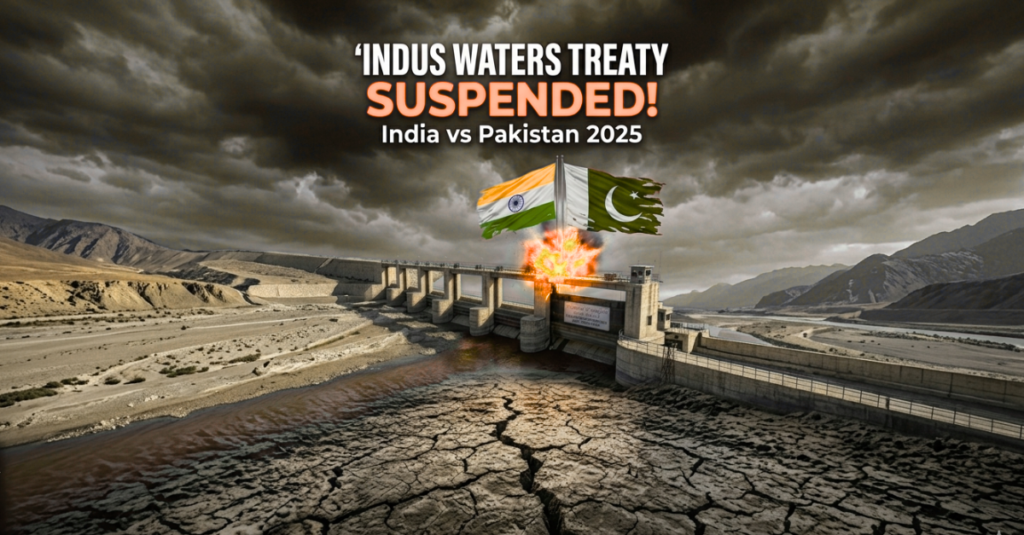
The most dramatic development in the history of the Indus Water Treaty occurred in April 2025 when India formally suspended the treaty following a deadly terror attack in Pahalgam, Jammu and Kashmir.
The Pahalgam Attack and India’s Response
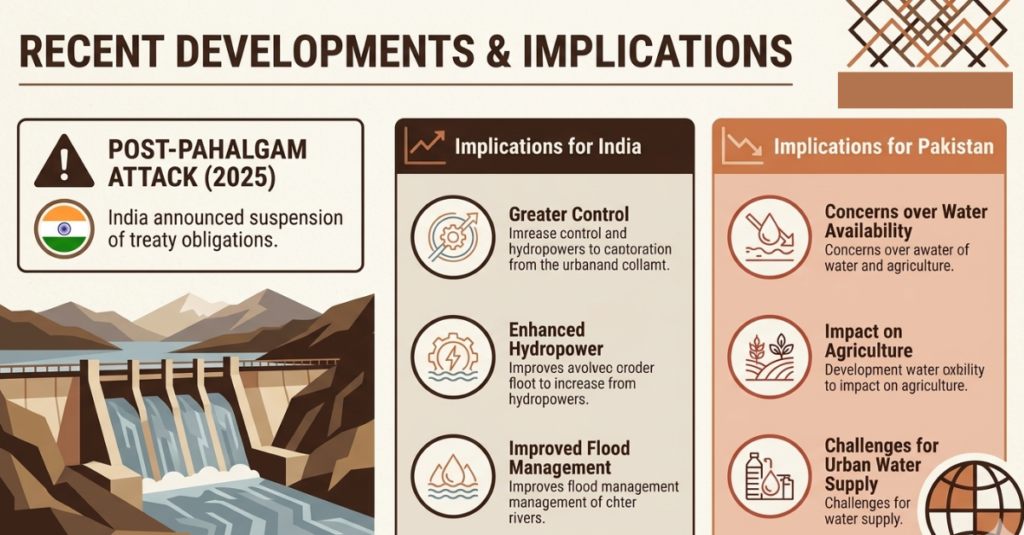
On April 22, 2025, a terrorist attack in Pahalgam killed 26 civilians, most of them tourists. India held Pakistan-based militant groups responsible and blamed Pakistan for complicity. On April 23, 2025, India formally announced that it was holding the Indus Water Treaty in abeyance, becoming the first time in the treaty’s 65-year history that India had taken such a step. Indian Prime Minister Narendra Modi’s statement that blood and water cannot flow together became one of the most widely quoted formulations of India’s changed approach to water diplomacy.
What Suspension Means Legally
The treaty does not contain an explicit suspension clause. India’s decision to hold the treaty in abeyance is therefore legally unprecedented and contested. International water law experts have noted that unilateral suspension of a permanent treaty is itself a violation of treaty obligations under international law. Pakistan characterised India’s move as the weaponisation of water and filed objections through diplomatic channels.
According to legal analyses published in 2025, the treaty’s Article XII makes modifications possible only through bilateral agreement, not unilateral action. Experts from institutions, including the Permanent Court of Arbitration, have noted that even in extreme circumstances, state practice in international law generally disfavors unilateral abrogation of water treaties because of the severe humanitarian consequences.
Practical Implications of Suspension for Pakistan
However, due to geographical and infrastructural constraints, the reality is that it would take a while, on a very short-term scale, for India to be able to cut off water supplies to Pakistan. Around 117 billion m³ of water flow each year in the rivers to the west. Building the necessary infrastructure to block or divert this volume will not be possible. As per the 2025 study from Observer Research Foundation, the quantity of water in the eight western rivers is capable of covering the entire Kashmir Valley by deep water annually if it is diverted, making it impossible to address the matter instantly.
However, with the suspension, India has a better chance of continuing to build hydropower on western rivers without having to comply with the treaty’s requirements. India could ramp up storage operations, use more water for generation, and decrease minimum flows, all of which, over time, would lead to lower and less consistent flows to Pakistan.
Pakistan’s Position
Pakistan rejected the suspension as illegal and called it an act of economic aggression. Pakistani officials stated that 80 per cent of the country’s irrigated agriculture depends on western river flows and that any sustained reduction would trigger food insecurity for over 237 million people. Sustained water insecurity on this scale directly accelerates displacement, a crisis examined in our report on how climate displacement is becoming a global survival threat. Pakistan also announced it would challenge the suspension at the Permanent Court of Arbitration and through the United Nations.
Indus Water Treaty Current Status (2026 and Beyond)
As of September 2026, the Indus Water Treaty is not just suspended; it has become the subject of an active international arbitration battle over whether the suspension itself was ever legal. What began as India’s April 2025 decision to place the treaty in abeyance has since escalated into a full legal and rhetorical standoff between the two countries.
Escalating Rhetoric Through Mid-2026
In June 2026, India’s Ministry of External Affairs stated that the treaty would remain suspended until Pakistan permanently ends cross-border terrorism. Days later, India’s water resources minister C.R. Patil hardened this position further, stating that New Delhi was working to ensure Pakistan would not receive any share of the Indus water in the coming years. Pakistan has separately raised concerns, writing to India on at least three occasions between 2025 and May 2026 about sudden, unexplained flow variations on the Chenab River, according to regional security analysts.
The Hague Ruling on Treaty Validity (August 2026)
On August 31, 2026, a Court of Arbitration sitting under the treaty framework at The Hague delivered a status award concluding that the Indus Water Treaty remains legally in force, and that India’s unilateral decision to place it in abeyance was not permitted under the treaty or international law. The tribunal also placed interim restrictions on construction activity at India’s Ratle Hydroelectric Project on the Chenab River, pending a decision expected from a separate World Bank-appointed Neutral Expert process in July 2027.
India rejected the ruling, maintaining that the Court of Arbitration lacks jurisdiction over what it considers a sovereign decision. Pakistan, meanwhile, gained a significant diplomatic and legal foothold from the award, since the tribunal’s position supports its long-standing argument that the treaty cannot be suspended unilaterally. However, the ruling has not resolved the practical dispute over actual water flows, and does not by itself compel India to resume full treaty compliance.
The future of the treaty likely now hinges on three tracks running in parallel: the pending 2027 Neutral Expert decision, any renewed bilateral negotiations, and the broader possibility that both countries eventually agree to a modernized water-sharing framework that accounts for climate change and shifting energy needs.
Timeline of Recent Events
| Year | Event |
| 2016 | Uri attack leads India to suspend PIC meetings and pledges maximum use of eastern rivers |
| 2017 | Kishanganga Dam completed; Ratle construction continues; Pakistan objects |
| 2019 | Pulwama attack; India reiterates full eastern river utilisation |
| 2022 | World Bank activates Neutral Expert and Court of Arbitration simultaneously |
| 2023 | India invokes Article XII(3) to propose treaty modification; Pakistan refuses; Court of Arbitration confirms jurisdiction |
| 2024 | India issues formal notice to amend treaty; calls off all PIC meetings |
| April 2025 | Pahalgam terror attack; India suspends treaty obligations |
| 2025 | Pakistan files legal challenges; international community urges dialogue |
| June 2026 | India reiterates suspension until Pakistan ends terrorism; water minister vows to stop Pakistan’s water share entirely |
| Aug 2026 | Hague court rules treaty still in force; restricts Ratle project construction pending 2027 Neutral Expert decision |
Climate Change and the Case for Renegotiation
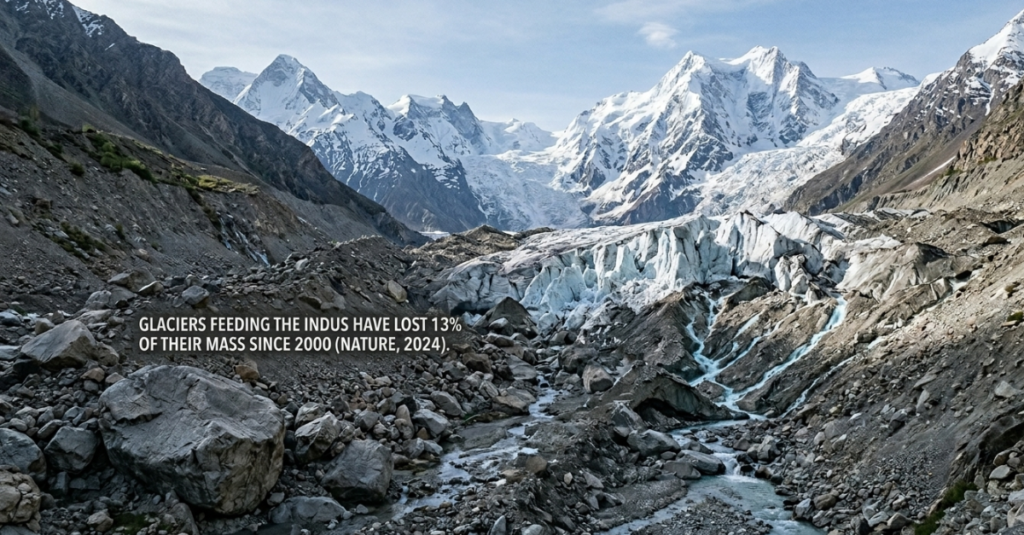
In addition to the security aspect, the treaty should be updated for technical reasons. Furthermore, the Indus Water Treaty was formed at an early stage of climate science. Glacial recession in the Karakoram ranges and the Himalayas is now heavily impacting the hydrology of the Indus basin, for example, by increasing water supply and driving more variability in flows. The broader pattern of extreme weather disrupting South Asia’s water systems is explored in depth in our analysis of extreme weather events reshaping the region’s climate future. Glacial recession is presently reshaping the hydrology of the Indus basin, for instance, by increasing flows, variability of flows, etc, in fundamental ways.
Accelerated ice loss has been recorded in studies published in peer-reviewed scientific journals since 2020 up to the present, which will initially lead to a rise in river flows (glacial melt surge). However, it will then sharply drop as the glaciers disappear in the next decade or two. Furthermore, the El Niño phenomenon compounds this variability further, as our detailed guide on the El Niño crisis in Pakistan and its geospatial implications explains.
The Indus Water Treaty also predates modern hydropower technology and includes storage requirements on western rivers that were originally based on 1950s technology. Climate adaptation has been the basis for India and Pakistan’s repositioning of their own demands. However, India and Pakistan do not agree on what kind of changes they can expect to be dealt with.
International Community’s Role
The World Bank, which brokered the original treaty and serves as a guarantor, has called for both countries to return to dialogue. The Bank has expressed that it does not take sides in the dispute and has urged both the Neutral Expert process and the Court of Arbitration to be allowed to function. Moreover, for further analysis of India-Pakistan water diplomacy, see the World Bank’s Indus Waters Treaty page and reporting from Britannica’s treaty overview.
Why the Indus Water Treaty Matters for UPSC and Global Policy?
Therefore, the Indus Water Treaty is one of the most consistently examined topics in competitive examinations, including the UPSC Civil Services Examination, because it sits at the intersection of international law, hydrology, South Asian geopolitics, and economic development.
Relevance for UPSC Aspirants
For UPSC preparation, the Indus Water Treaty appears in Prelims under General Studies Paper 1 (Indian Geography and Modern History) and in Mains under GS Paper 2 (International Relations and India’s Foreign Policy). Key areas to understand include the river allocation mechanism, the three-tier dispute resolution process, the role of the World Bank, the Kishanganga and Ratle disputes, the 2025 suspension, and the legal debate about treaty modification. Aspirants looking for the Indus Water Treaty PDF version of the original document can access it through the World Bank’s official website.
A Model for Global Water Governance
Despite its current difficulties, the Indus Water Treaty is studied in universities worldwide as a model of how two hostile states can still cooperate on shared natural resources. Furthermore, it has informed the design of other transboundary water agreements in the Nile Basin, the Mekong River, and the Jordan Valley.
Ultimately, the treaty’s fundamental lesson, that technical cooperation is possible even when political relations are hostile, remains highly relevant for the more than 260 transboundary river basins around the world.
Economic Significance by the Numbers
| Indicator | Pakistan | India |
| Share of Indus water allocation | 80% (135 MAF) | 20% (33 MAF) |
| Agricultural land irrigated by the Indus system | 80% of cultivated land | Punjab, Haryana, Rajasthan farming |
| Population supported | Over 237 million (61% of basin pop.) | Significant portions of northern states |
| GDP contribution of water-dependent agriculture | 23% of GDP | Varies by state |
| Hydropower dependency | Tarbela (3,478 MW) and Mangla (1,150 MW) | Kishanganga (330 MW), Baglihar (900 MW) |
| Water use for agriculture | 93% of available water | Substantial eastern river use |
Pakistan’s water-dependent agriculture faces growing pressure from climate variability and rising demand. Discover how smart agriculture technology is helping farmers adapt with higher yields and lower resource use.
For more in-depth analysis of international policy and digital strategy, visit aigeo360.com, which covers geopolitics, international relations, and data-driven strategy.
Conclusion
The Indus Water Treaty is widely regarded as a major success in international diplomacy, having survived three wars, multiple crises, and decades of geopolitical tension. Its strength lies in transforming a zero-sum conflict into a stable institutional framework that has supported water security for over 300 million people. Readers seeking a detailed explanation of the treaty’s provisions, river allocations, and dispute resolution framework can explore our comprehensive guide to the Indus Water Treaty 1960. For a deeper look at what the agreement actually contains, read our breakdown of the Indus Water Treaty Main Points.
Three key lessons:
- The treaty divides six rivers between India and Pakistan, with around 80% of the flow allocated to Pakistan and 20% to India. The eastern rivers (Ravi, Beas, Sutlej) go to India, while the western rivers (Indus, Jhelum, Chenab) are allocated to Pakistan.
- Its three-tier dispute resolution system (Permanent Indus Commission, Neutral Expert, and Court of Arbitration) has helped resolve many technical issues, though it is under serious strain in 2025.
- India’s suspension of the treaty in April 2025 after the Pahalgam attack marks its most severe crisis, raising questions about the future of water-sharing in a security-driven geopolitical environment.
The future of the treaty now depends on whether India and Pakistan can return to dialogue or move further into conflict. For millions dependent on these rivers for food, farming, and daily life, a stable agreement remains essential. Stay updated on this critical issue by following aigeo360.com for the latest analysis on South Asian geopolitics and international water law. The 2025 suspension event, including its causes and global reactions, is explained in detail in a separate detailed article.
FAQs
Is the Indus Water Treaty permanently cancelled or just suspended?
As of 2025, the treaty is suspended, not permanently cancelled. India placed it “in abeyance,” meaning it is temporarily paused. The treaty has no cancellation clause under international law, and Pakistan has legally challenged the suspension at the Permanent Court of Arbitration. Most international legal experts agree that one country cannot unilaterally cancel a permanent treaty of this nature.
Can India actually stop water from flowing into Pakistan?
Not immediately. The western rivers carry approximately 117 billion cubic metres of water annually. India currently lacks the physical infrastructure to block or divert this volume. However, India can regulate release timing from existing dams like Baglihar and Kishanganga, halt flood data sharing, and accelerate new storage projects over time, all of which would gradually reduce the predictability and volume of flows reaching Pakistan.
Why does Pakistan get 80% of the Indus water under the treaty?
Because Pakistan is the lower riparian country, meaning the rivers flow from India into Pakistan. When partition happened in 1947, Pakistan inherited vast irrigated farmland but lost control of the headworks and canals feeding that land to India. The 80/20 split was deliberately designed to compensate Pakistan for this structural disadvantage and ensure its agricultural survival as a newly independent state.
What did the Hague Court rule on the Indus Water Treaty in August 2026?
On August 31, 2026, the Court of Arbitration ruled that the Indus Water Treaty remains legally binding despite India’s 2025 suspension, and that India’s abeyance declaration was not valid under international law. The tribunal also restricted construction at India’s Ratle Hydroelectric Project until a separate Neutral Expert process concludes in July 2027. India has rejected the ruling’s jurisdiction, so the practical dispute over water flows remains unresolved.