| Quick answer: Smog vs Fog comes down to their composition and effects. Fog is a natural atmospheric phenomenon made of tiny water droplets suspended near the ground. Smog is polluted air containing harmful gases and fine particles. Fog mainly reduces visibility, while smog can damage human health. The two can also occur together when atmospheric conditions trap moisture and pollutants near the surface. |
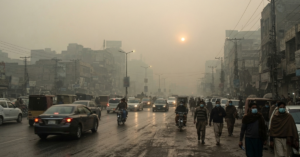
You step outside, and the air looks thick and gray. You can barely see the end of the street. Is it fog or smog? Understanding smog vs fog is important because both can reduce visibility, but they have very different causes and health effects.
The smog vs fog question matters because one is mainly a visibility problem and the other is a health risk. This guide shows you how each one forms, how to tell them apart, and what to do about each. You will also see real examples, from London in 1952 to satellite images of northern India.
What Is Fog?
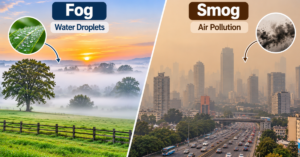
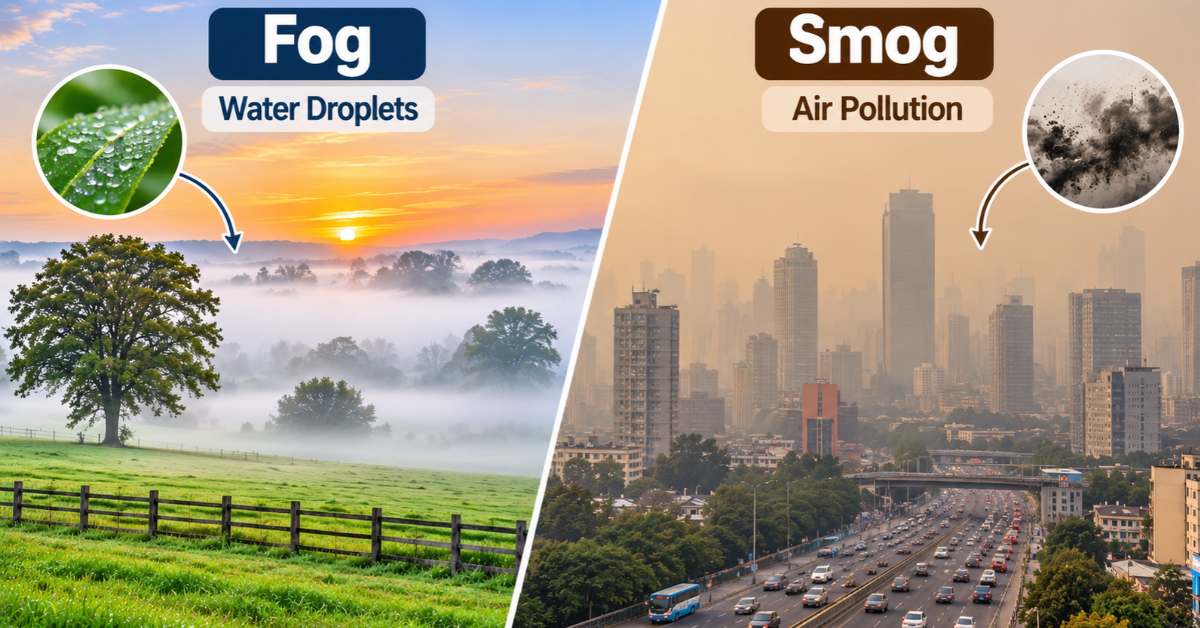
Fog is a cloud that sits on the ground. It is made of tiny water droplets, or ice crystals, hanging in the air near the surface. In the smog vs fog comparison, fog is a natural form of suspended water droplets, not pollution.
Meteorologists use a clear rule. Under the international definition, fog cuts visibility to below one kilometre, or about 0.62 miles. If you can see farther than that, the weather service calls it mist.
Fog forms when moist air near the surface cools to its dew point or gains enough moisture to become saturated. Water vapor then condenses around tiny particles in the air and forms microscopic droplets that stay suspended. This often happens on clear, calm nights, when the ground loses heat and cools the air above it.
Here are three facts about fog:
- It is natural.
- It is made of water.
- Radiation fog often clears after sunrise, but other types can last all day.
What Is Smog?
The word smog blends “smoke” and “fog.” It describes air that is thick with pollution. The haze may look like fog, but the main ingredients are not water. They are pollutants from burning fuel, vehicles, factories, and farm fires.
Smog is polluted air containing a mix of harmful gases and airborne particles. Its makeup depends on the pollution sources and the weather. Industrial smog is commonly linked to sulfur dioxide and particulate matter from burning fuel. Photochemical smog develops when sunlight drives reactions between nitrogen oxides and volatile organic compounds (VOCs), forming ground-level ozone. These pollutants can irritate your eyes, nose, throat, and lungs.
There are two main kinds of smog:
- Industrial smog. Some people call it sulfurous or black smog. It comes from burning coal and other fuels. It is common in cold weather.
- Photochemical smog. Sunlight reacts with vehicle and industrial gases and forms ozone. NASA notes that this type usually develops in warmer conditions in summer.
Smog needs two things: a pollution source and weather that traps the pollution near the ground.
Smog vs Fog: The Core Differences
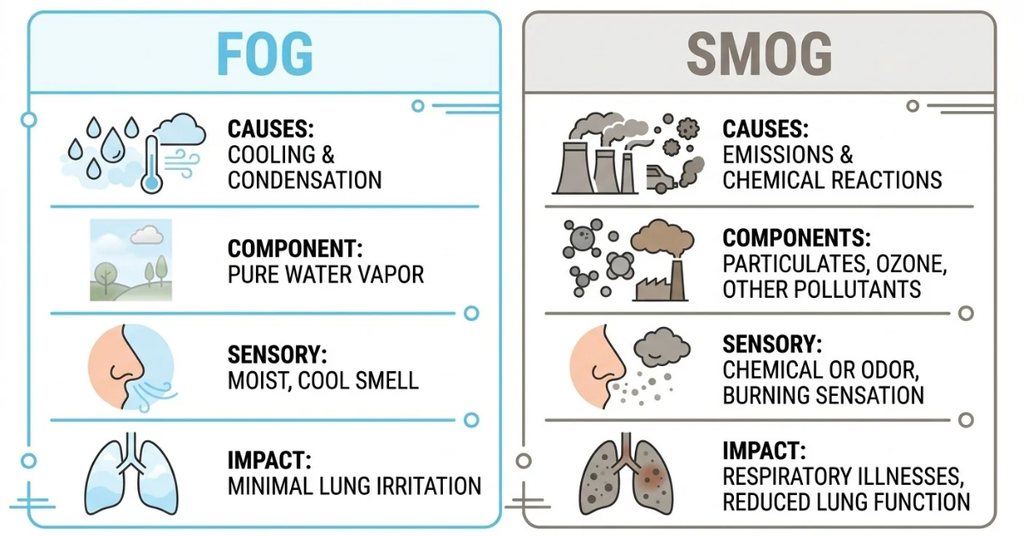
This table gives you the short answer. This smog vs fog comparison highlights the key differences in their composition, formation, visibility, and health effects.
| Feature | Fog | Smog |
| Main ingredient | Water droplets or ice crystals | Smoke, gases, fine particles |
| Origin | Natural cooling of moist air | Primary emissions plus chemical reactions in the air, often trapped by weather |
| Color | Usually white or gray; can look discolored if polluted | Gray, brown, yellow, or dark; varies |
| Smell | Usually none, or a damp smell | May smell smoky or sharp, but many harmful pollutants have no smell |
| Clears by itself? | Radiation fog often clears after sunrise; other types can last all day | Can last hours or days when stagnant weather traps pollutants |
| Common conditions | Cool, moist air and suitable atmospheric conditions | Pollution emissions and atmospheric conditions that favor pollutant formation or accumulation |
| Health effect | Mainly a visibility hazard; polluted fog may carry harmful substances | Eye, throat, and lung problems |
| Main danger | Poor road visibility | Poor visibility and poor air |
The biggest split is the last two rows. Fog is mainly a visibility problem. Smog can be both a visibility problem and a breathing problem.
How to Tell If It Is Fog or Smog
You do not need an instrument to make a good guess. This simple field test can help you identify smog vs fog by looking at visibility, moisture, smell, and other environmental clues.
- Check the color. Fog looks white or pale gray. Smog looks dirty gray, brown, or yellowish, especially around the sun.
- Use your nose. Fog has little smell. Smog often smells like smoke or chemicals.
- Feel your eyes and throat. Fog feels damp and cool. Smog stings your eyes and scratches your throat.
- Watch the timing. Radiation fog is thickest before sunrise and often thins out as the day warms up. Smog can stay through the afternoon because smoke and haze must be moved away by wind or rain.
- Look for wet surfaces. Look for moisture. Fog may leave tiny water droplets on cars, grass, and windows. However, this is only a clue, not a reliable confirmation.
- Check the air quality index. A high AQI means pollution levels are elevated, even if you cannot tell from appearance alone whether the haze is fog, smoke, or a mix. Use an official air quality source rather than relying only on your eyes.
No single sign is perfect. These are only visual and sensory clues, not scientific confirmation. Satellite observations, air quality monitoring stations, and weather measurements give more reliable evidence when fog and pollution overlap. Sometimes the answer is both, which brings us to the next section.
When Fog and Smog Mix
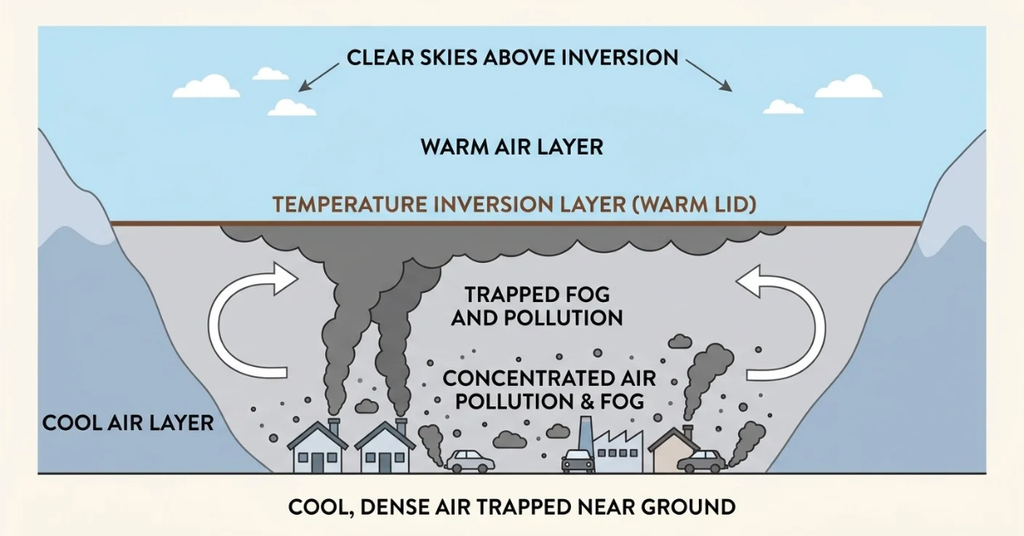
Many people think it must be one or the other. In real life, fog and smog often blend together.
NASA’s Earth Observatory looked at this when an astronaut photographed a thick haze over Italy’s Po Valley and asked, “Fog or smog?” The atmospheric scientist who answered said it was probably a combination of both. In fall and winter, a temperature inversion traps cool, moist air near the surface. Pollution builds up in that trapped layer. When fog forms, its droplets can absorb soluble gases such as sulfur dioxide and nitrogen dioxide, allowing chemical reactions to produce secondary particles. When the droplets evaporate, they can leave tiny polluted particles behind. That is how a hazy, polluted layer forms.
NASA’s Earth Observatory shows the same pattern over northern India. A satellite image from 17 December 2004 shows fog spreading across the plains and mixing with a river of haze that flowed toward Bangladesh and the Bay of Bengal. The overlying pollution muted the brightness of the fog.
This kind of mix can form in regions with heavy winter pollution. If you want to see how this plays out locally, read our guide on smog in Pakistan.
Fog does not create smog on its own. Under stagnant conditions, a temperature inversion limits vertical mixing, so fog and air pollution can interact. The result affects both visibility and air quality.
Smog vs Fog vs Haze vs Mist
Two more words confuse people: haze and mist. This table sorts out all four.
| Term | What it is | Visibility | Typical look |
| Fog | Water droplets near the ground | Under 1 km | White, dense |
| Mist | Lighter suspension of water droplets | 1 km or more | Thin, grayish veil |
| Haze | Tiny dry particles such as dust or smoke | Reduced, no strict cutoff | Dull, bluish or brownish |
| Smog | Air pollution involving gases and particles, sometimes mixed with fog | Variable | Gray, brown, or yellow |
The Royal Meteorological Society notes that mist is used when visibility is above one kilometre, and that the World Meteorological Organization criteria also require relative humidity above 95 percent. The upper visibility limit for mist varies by country. Haze, on the other hand, is a suspension of extremely small, dry particles, not water droplets.
Smog vs Haze
Smog vs haze is a close call. Both come from particles in the air. The difference is a matter of degree and chemistry. Haze is a general term for reduced clarity caused by suspended particles. Smog refers to polluted air involving a mix of harmful gases and particles, including pollutants formed through chemical reactions in the atmosphere. Many people call a very thick haze smog, and that is fine in daily speech.
7 Common Types of Fog and How They Form
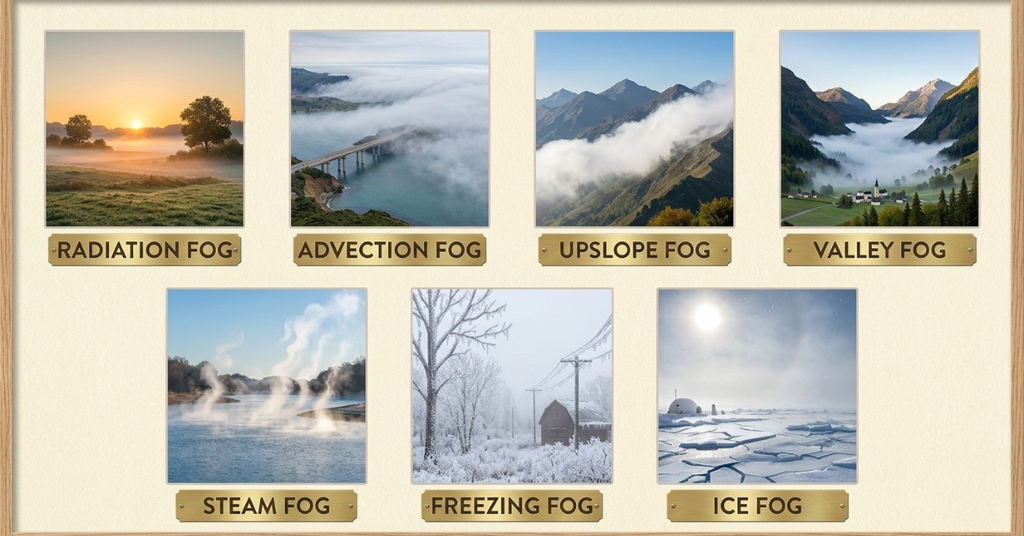
Fog comes in several forms. Each one forms in a different way.
- Radiation fog. It forms on clear, calm nights as the ground cools. It is the most common type over land, and it often clears after sunrise.
- Advection fog. Warm, moist air moves over a cooler surface, such as cold seawater. It can last all day and travel long distances.
- Upslope fog. Moist air is pushed up a hill or mountain and cools as it rises.
- Valley fog. Cold air sinks and pools in low ground, so fog fills the valley.
- Steam fog. Cold air moves over warmer water. Water evaporates from the surface and condenses as it mixes with the colder air above. Some people call it evaporation fog.
- Freezing fog. Fog made of supercooled droplets that freeze on contact with surfaces. It can coat roads and cause black ice.
- Ice fog. It forms in extreme cold, where vapor turns straight into ice crystals.
These are common categories, not seven separate types in one universal system. For example, valley fog is often a form of radiation fog. Smog has fewer types. It is classed by the pollutants and weather behind it: industrial smog and photochemical smog.
Is Fog Dangerous to Breathe?
Fog itself is mostly suspended water droplets and is not inherently toxic. However, the droplets can contain or interact with airborne pollutants, especially in industrial and urban areas.
The real danger of fog is on the road. In the US, the National Weather Service issues a Dense Fog Advisory when visibility drops to a quarter mile or less across a large area. This is a US advisory standard, not a global definition.
Smog is different. It carries fine particles and gases that reach deep into the lungs. The World Health Organization updated its air quality guidelines in September 2021. Its guidelines recommend a PM2.5 level of 5 micrograms per cubic metre as an annual average and 15 micrograms per cubic metre over 24 hours. These are guideline levels, not legal limits. Many cities exceed them by a wide margin during smog season.
One more point. When fog and pollution mix, the fog droplets can hold harmful gases. So “foggy” air in a polluted region is not always clean air. If the AQI is high, treat the air as unsafe no matter what the weather report calls it.
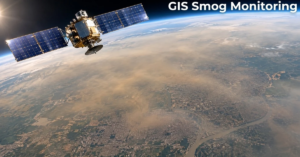
How Satellites Help Distinguish Smog and Fog
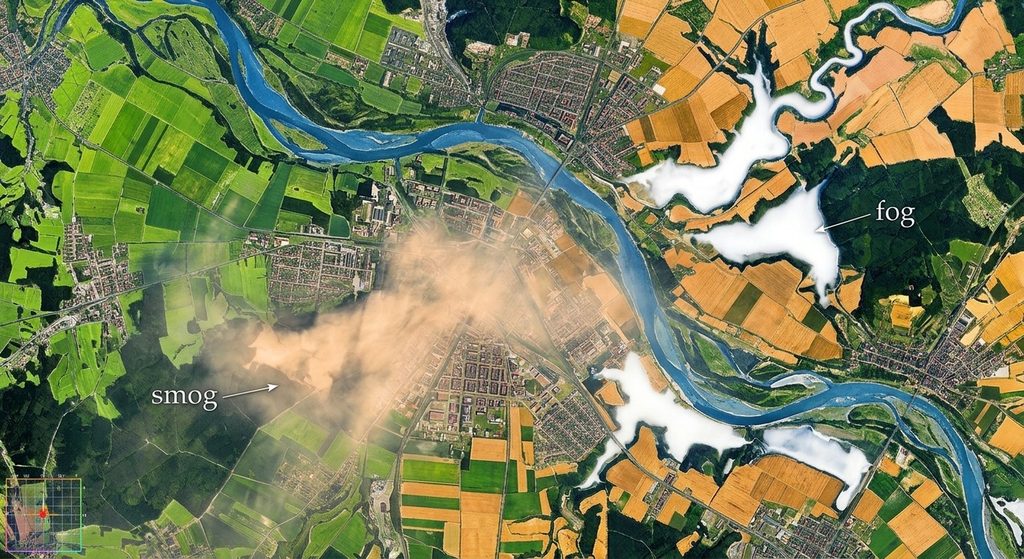
Can satellites tell fog from smog? Partly. Satellites give a wide view, but color alone is not enough.
In natural-color images, fog usually looks white, and clouds have sharp, pure white edges. Polluted haze often looks gray or tan with softer edges. A NASA image of China during a heavy pollution event showed the haze in gray, while the white areas were clouds and fog. But color can mislead. Fog mixed with pollution can look discolored, so a gray patch is not proof of smog.
Scientists also use satellite aerosol measurements, such as aerosol optical depth (AOD). Satellite aerosol measurements represent atmospheric-column information, not a direct measurement of surface-level PM2.5. Ground observations and atmospheric models help establish the relationship. Experts therefore combine natural-color imagery, aerosol data, ground-level air quality readings, and weather data such as humidity, wind, and temperature inversions. GIS brings these layers together on one map, showing where pollution builds up, how it spreads, and which areas face the most exposure. This is the same type of layered analysis behind modern climate intelligence and spatial work like GIS mapping services.
The same approach supports GeoAI early warning systems, which combine satellite and ground data to flag hazards sooner.
Real Examples of Smog and Fog
London, December 1952. A cold fog settled over the city, and coal smoke from homes and factories got trapped beneath it. The Great Smog lasted from 5 to 9 December. The UK Met Office reports that thousands of tonnes of pollutants were emitted each day. The initial official estimate recorded about 4,000 deaths. Later research suggested that the total toll, including longer-term effects, may have reached around 12,000. The disaster led to the Clean Air Act of 1956. You can read the official account on the Met Office page about the Great Smog.
Po Valley, Italy. This is a fog and pollution mix, as explained earlier. NASA describes it in detail in its Smog or Fog? Actually, a Bit of Both feature.
Pure fog. A coastal advection fog over the sea, or a radiation fog over a clean countryside field at dawn, is made mostly of water droplets. It can look like smog from a distance, but it has no added pollution.
What to Do on a Foggy Day vs a Smoggy Day
On a foggy day:
- Slow down and use low-beam headlights.
- Keep more distance from the car in front.
- Wait for the fog to lift before long trips if you can.
On a smoggy day:
- Check your local AQI before you go out.
- Limit outdoor exercise, especially for children, older adults, and people with asthma.
- Keep windows closed and use an air purifier indoors if you have one.
- Wear a well-fitted N95 or FFP2 mask outdoors when the AQI is high. These masks can reduce exposure to particles, but they do not filter harmful gases such as ozone, sulfur dioxide, or nitrogen dioxide. Follow local public health guidance.
On a foggy and smoggy day: follow the smog advice first. The fog makes the road risk worse, and the pollution makes the air risk worse.
Conclusion
The smog vs fog question has a simple answer. Fog is made of water droplets. Smog is polluted air. Fog is mainly a visibility hazard. Smog can affect your health, and it can last for hours or days when the air stays still.
To tell them apart, check the color, the smell, the timing, and the AQI. When both are present, trust the air quality reading over what your eyes see.
Now that you know the difference, you can read the sky with more confidence. If you live in a region with heavy winter pollution, learn how local smog forms in our article on smog in Pakistan.
FAQs
What is the difference between fog and smog?
Fog is a ground-level cloud made of water droplets. Smog is air pollution made of smoke, gases, and fine particles. Fog is natural and mainly a visibility hazard. Smog is mainly human-made and can harm your health.
How can you tell if it is fog or smog?
Look at the color, smell, and timing, but treat these as clues, not proof. Fog is usually white, has little smell, and often thins out after sunrise. Smog often looks gray or brown and may sting your eyes. The air quality index and local monitoring data give a more reliable answer.
What is the difference between haze and smog?
Haze is a general loss of clarity caused by tiny dry particles such as dust or smoke. Smog is polluted air involving a mix of harmful gases and particles, including pollutants formed through chemical reactions in the air.
What are the 7 types of fog?
The seven common types are radiation fog, advection fog, upslope fog, valley fog, steam fog, freezing fog, and ice fog. Each one forms through a different cooling or moisture process.
Can smog occur without fog?
Yes. Photochemical smog can develop without fog when sunlight drives chemical reactions involving nitrogen oxides and volatile organic compounds (VOCs). It can occur even on clear, sunny days
Is fog dangerous to breathe?
Fog itself is not inherently toxic, because it is mostly water droplets. But fog over a polluted city can contain or interact with pollutants, so check the AQI before you assume the air is safe.
Why does smog get worse in winter?
Winter often brings temperature inversions, low wind speeds, and more fuel burning for heating. When the air does not mix, pollutants stay close to the ground and build up. Crop burning and industrial emissions can add to the problem in some regions.
What is the difference between fog and a smoke machine?
Natural fog is a cloud of condensed water. A stage fog machine heats a special fluid to make a thick, fog-like cloud. It looks similar, but it is made by a machine and is not weather.
Sources and Further Reading
- NASA Earth Observatory, Smog or Fog? Actually, a Bit of Both
- NASA Earth Observatory, Haze and Smog over India (image of the day, 17 December 2004)
- UK Met Office, The Great Smog of 1952
- Royal Meteorological Society, Met Matters articles on fog and mist
- World Health Organization, Global Air Quality Guidelines (2021)
- US National Weather Service, Dense Fog Advisory criteria