| Climate change in Pakistan is a growing environmental and humanitarian crisis driven by rising temperatures, glacier melt, extreme floods, heat waves, and changing monsoon patterns. Although Pakistan contributes less than 1% of global greenhouse gas emissions, it remains one of the world’s most climate-vulnerable countries. The 2022 floods, which submerged one-third of the country and caused more than $30 billion in damage, highlighted the severity of this crisis. Climate adaptation through climate finance, early warning systems, geospatial intelligence, and AI-powered risk analytics is essential to protect Pakistan’s future. |
Climate change in Pakistan is a major issue for a country that emits among the least greenhouse gases of any nation its size. Globally, the north of Pakistan is home to thousands of glaciers that are actively melting. In 2022, devastating flooding inundated one-third of the country and killed over 1,700 people. Over $30 billion was required to repair the damage. Currently, over 240 million residents are at risk of losing access to basic resources.
There are many examples of major climate injustices across the world. Pakistan is one of the countries where the least amount of greenhouse gases is emitted. This results in flooding, melting glaciers, farmland loss, and heat waves becoming the norm. Millions of residents are losing their homes and farms to climate emergencies.
Beyond the scientific jargon, Climate Change in Pakistan is a current reality, not a future concern, with visible impacts on people, agriculture, and ecosystems. Currently, there are many devastating and concerning statistics to describe the climate emergency. This article collects that information, explains the emergency, and what must be done to mitigate the situation.
What makes climate change in Pakistan uniquely alarming?
| Pakistan is highly vulnerable to climate change because it faces multiple climate risks at the same time, including glacier melting, extreme heat, floods, and water insecurity, while contributing less than 1% of global greenhouse gas emissions. |
The alarming issue in Pakistan is the country’s total climate change vulnerability, coupled with almost zero contribution to the problem. Pakistan is responsible for about 0.8 to 0.9% of the world’s annual greenhouse gas emissions (EDGAR, 2023). The Global Climate Risk Index places the country among the five most climate-vulnerable countries. No country of that size combines the problems of glacial melt, monsoon intensification, extreme heat, and chronic lack of resources.
Pakistan’s position in the global climate risk rankings
Pakistan’s high level of climate exposure is an irrefutable reality that demands the attention of the global community. According to the ND-GAIN Index (2024), Pakistan has the fifth most climate-vulnerable population in the world. The Germanwatch Global Climate Risk Index also ranks Pakistan as the eighth most climate-risk-affected country, reflecting decades of extreme weather events, widespread economic losses, and significant loss of life.
The UNDP reports that over the last 50 years, Pakistan’s average annual temperature has increased by 0.5°C. In Northern Pakistan’s mountainous regions, the average temperature rise is even more alarming, at approximately 2°C above the long-term average. In some years, specific regions or seasons have recorded temperature anomalies exceeding 8°C above the historical average, according to the Pakistan Meteorological Department (PMD). A 2024 study reported that climate change in the Hindu Kush-Himalaya-Karakoram region is accelerating, meaning this region is warming more rapidly than many other parts of the world.
The devastating injustice at the heart of Pakistan’s climate crisis
Pakistan is responsible for far less than 1% of the world’s total greenhouse gas emissions. Comparatively, the US’s total contribution to atmospheric CO2 since 1750 stands at 24.5%. While China is responsible for 28% of the world’s emissions every year (NIH, 2023). Pakistan is experiencing droughts, floods, heat, and the collapse of glaciers that far exceed anything the largest polluters are experiencing.
As a result, Pakistan contributes less than 1% of global greenhouse gas emissions but remains among the world’s most climate-vulnerable countries, making it a major example of climate injustice. The communities least responsible for causing global warming are suffering its most devastating consequences. Why climate refugees are the human face of this injustice demonstrates powerfully that this is not an abstract policy debate. It is a life-and-death reality for millions of real people right now.
How are Pakistan’s glaciers melting and why does it threaten millions?
| Pakistan’s 7,000+ glaciers, the largest ice mass outside the poles, are receding 40–60 meters per decade, with Hindu Kush-Karakoram-Himalaya glaciers retreating 65% faster than in previous decades. Since these glaciers feed the Indus River, their loss threatens water security for over 240 million people. |
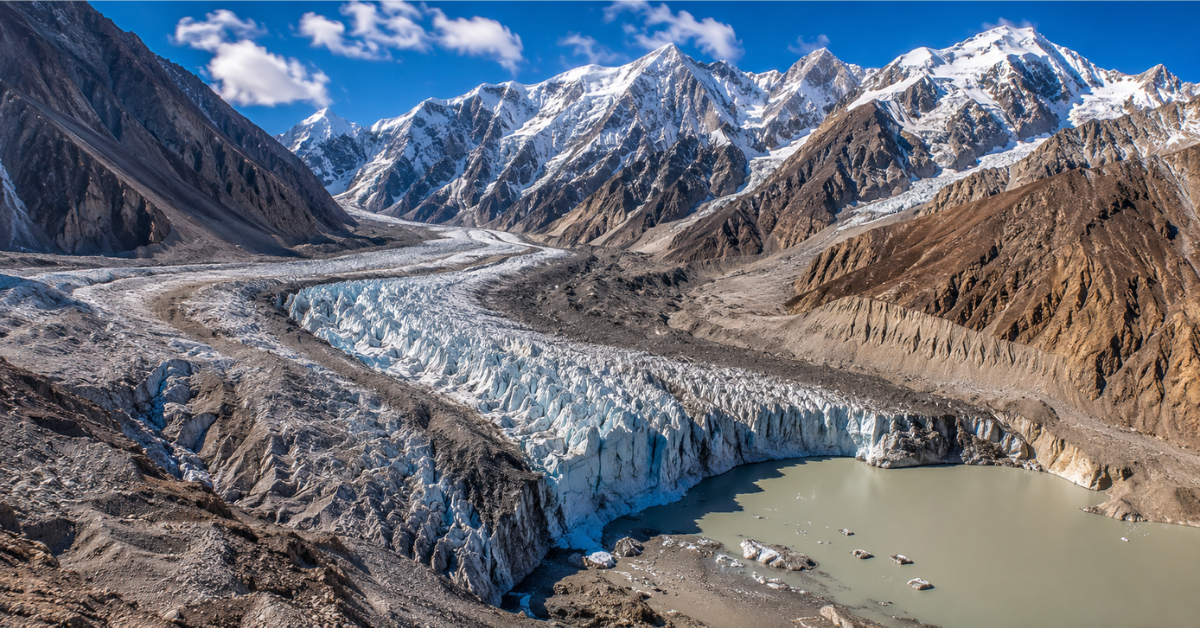
Pakistan is home to more than 7,000 glaciers, the largest concentration of ice outside the polar regions, earning the region its name: the Third Pole. These glaciers are the primary water source for the Indus River system, supporting agriculture, hydropower, and the daily needs of millions of people across the country (UNDP, 2023; ICIMOD, 2023). But climate change is now melting these glaciers at an accelerating rate, creating glacial lakes that threaten downstream communities with flooding, a risk that is already 65% worse than in previous decades. .
The Third Pole and Pakistan’s 7,000 glaciers
The Third Pole, or the largest non-polar ice aggregation in the world, is located in Northern Pakistan and consists of the three great mountain ranges of the Hindu Kush, Karakoram, and the Himalayas. These glaciers are essentially the towers of water for an entire civilization. These glaciers feed the Indus River and sustain the hydropower and agriculture of the entire country.
Unfortunately, Pakistan’s water towers are being dismantled. According to the UNDP, Pakistan’s glaciers are receding at a rate of 40–60 meters per decade. The glaciers of the Hindu Kush–Karakoram–Himalaya region are retreating 65% faster than in previous decades (Pamir Times, 2025). In 2025, Pakistan launched its Glacier Conservation Strategy to strengthen long-term glacier protection and climate adaptation. However, the World Economic Forum noted that, as of March 2026, early warning systems still could not reliably forecast glacial lake outburst floods (GLOFs), leaving many mountain communities vulnerable to sudden and potentially devastating disasters.
How GIS-based environmental monitoring tracks glacial retreat and water systems in real time is one of the most important technological advances supporting Pakistan’s climate adaptation planning. Spatial data from satellite sensors is now essential for monitoring glacier mass, lake levels, and GLOF risk in near-real time.
What are glacial lake outburst floods and how dangerous are they?
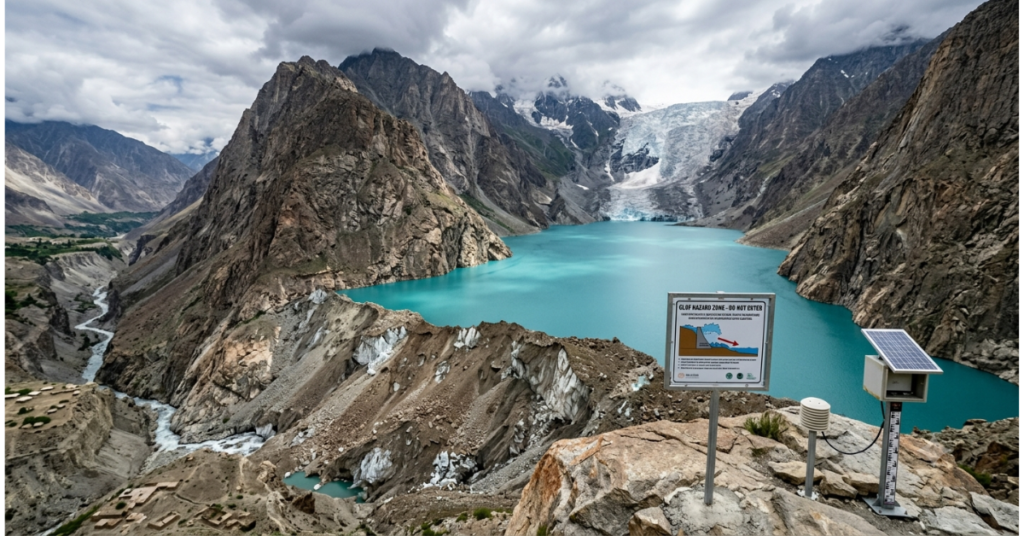
A lake formed by meltwater trapped behind an ice or debris dam can suddenly break its dam, leading to an outburst flood. A glacial lake outburst flood can devastate an entire valley. In Pakistan’s northern valleys, GLOFs can travel at such a high velocity that they have the potential to threaten the lives of those downstream and can destroy all heavy and light infrastructure.
Gilgit-Baltistan and Khyber Pakhtunkhwa now have over 3,000 glacial lakes that cover approximately 135 square kilometers. Out of all glacial lakes, 36 have been designated as highly dangerous by the NDMA (2025) and pose a threat to over 7 million people. In the same year, the NDMA issued four GLOF warnings in Pakistan. The GLOF-II project of the Green Climate Fund and UNDP built 411 flood protection structures, installed 218 early warning systems, and created 60 safe havens across 24 vulnerable valleys, helping protect more than 211,000 people living in high-risk exposure zones. Despite the improvements, the situation worsens at a rate faster than protective structures can be built.
Predictive modeling and AI-powered hazard assessment are increasingly being applied to GLOF risk mapping in Pakistan, using machine learning to model lake breach probabilities, downstream inundation zones, and vulnerable population exposure.
Climate Change in Pakistan: How It Is Reshaping Monsoon, Floods, and Heat
Climate change is intensifying irregular and deadly monsoons in Pakistan. A World Weather Attribution study of 2025 determined that monsoon rains in northern Pakistan are about 15 percent stronger when the world is at 1.3 degrees Celsius. Heat waves are starting sooner, lasting longer, and becoming increasingly deadly. In 2024, some areas of Gilgit-Baltistan hit above 48 degrees Celsius at above 1,200 meters in elevation.
The 2022 floods: a catastrophe that shocked the world
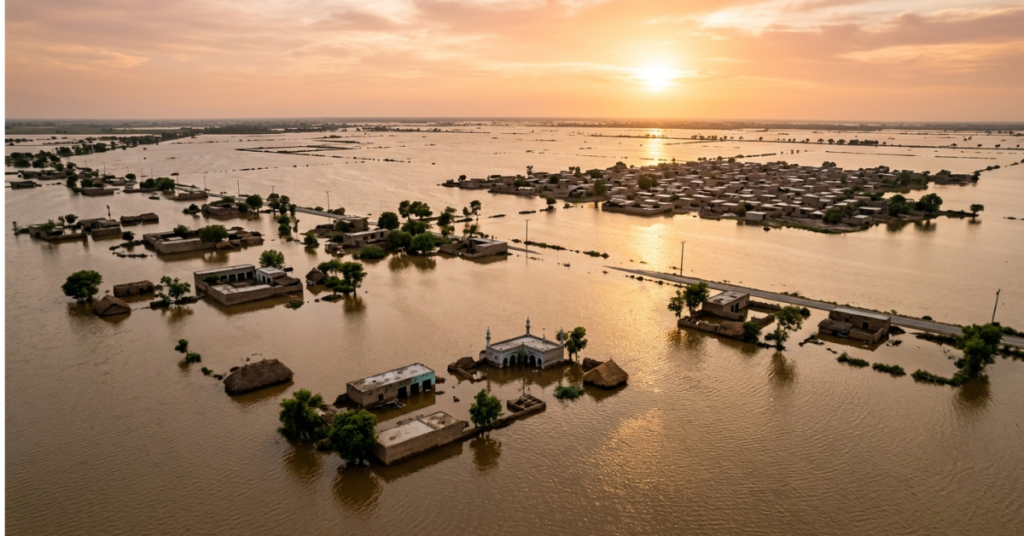
The 2022 floods in Pakistan are considered one of the most shocking climate emergencies of all time. The combination of repeated heat waves in May and June that melted glaciers, record-breaking monsoon rains, and a landscape that was already at saturation contributed to a disaster where, by August, one-third of Pakistan was underwater.
The aftermath was catastrophic. The floods resulted in the loss of 1,700 lives, displaced many millions, and caused greater than $30 billion in economic loss, according to a post-disaster needs assessment led by the World Bank, Asian Development Bank, EU, and UNDP (World Bank, 2023). A national emergency was declared in Pakistan. 4.4 million acres of crops were lost. A global donor conference in January 2023 pledged about $10 billion in aid, and by 2024, Pakistan received only $2.8 billion of that (Al Jazeera, 2025). This broken promise shows that climate financing for Pakistan is not about generosity, but rather a matter of ethics and justice.
The catastrophic scale of Pakistan’s extreme weather reality shows that 2022 was not an isolated event. It was the most visible peak of an accelerating trend that continues to intensify year after year.
Deadly heat waves and intensifying monsoon rainfall
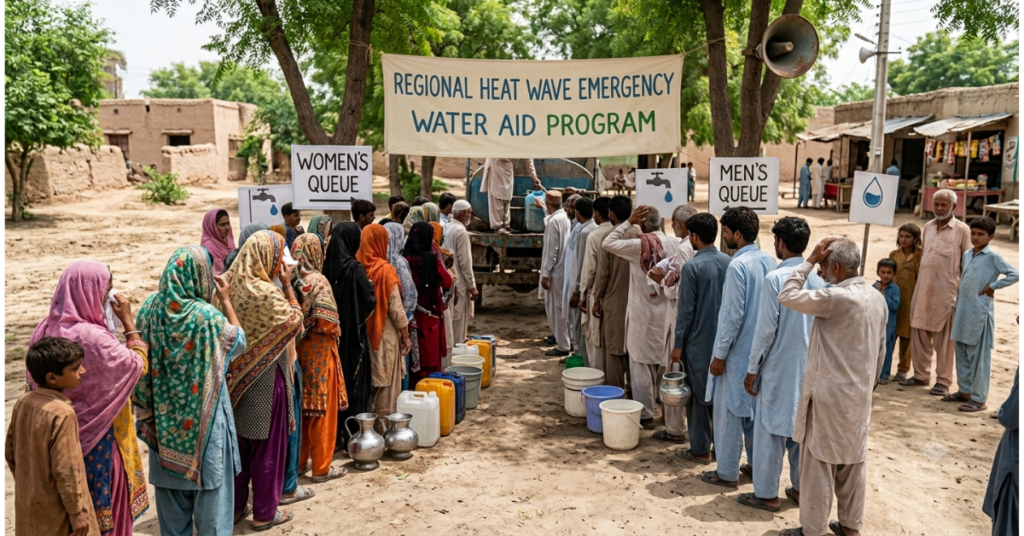
In Pakistan, heat waves are happening with more intensity, more frequency, and in more locations across the country. The 2024 heat event saw temperatures reach 40-42°C in Karachi and 42-44°C in the coastal districts of Sindh. Of the 2,547 cases of heat stroke reported, food insecurity was also declared in 26 districts. This affected 8.6 million people (International Rescue Committee, 2024).
Further, the monsoon season brings more rain and floods because the Indian Ocean is holding more moisture. The 2025 World Weather Attribution reported that as the world warms, northern Pakistan’s rains and floods will become more frequent. Therefore, Pakistan’s monsoon season is no longer a consistent flooding event. It is an open-ended, worsening threat.
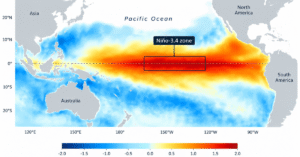
The disturbing patterns visible in Pakistan’s El Niño-driven climate disruptions provide critical context for understanding how global climate patterns interact with Pakistan’s existing vulnerabilities to produce compounding disasters.
Does your organization work on climate adaptation, disaster risk, or environmental sustainability in South Asia? Explore geospatial intelligence and AI-powered climate analytics at AI Geo Navigators and see how data-driven tools are helping communities prepare for a warming world.
How is climate change in Pakistan destroying agriculture and food security?
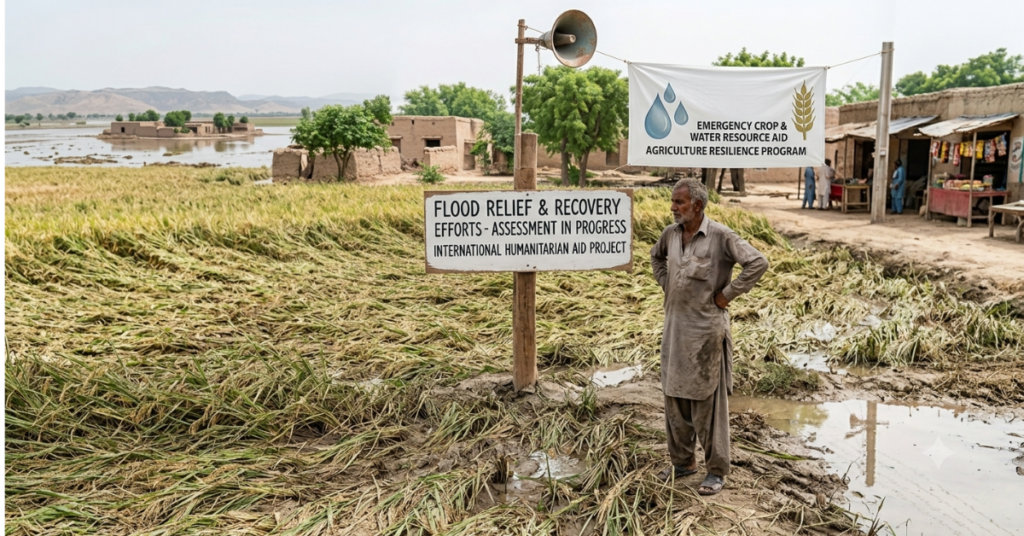
| Climate change in Pakistan threatens agriculture, which depends on the Indus River for 90% of its irrigation. The 2022 floods destroyed crops across 4.4 million acres, while heat, erratic monsoons, and coastal salinity are cutting yields, pushing food insecurity toward 8.6 million people in 2024 alone. |
Climate change in Pakistan is jeopardizing the entire agricultural infrastructure, which relies on the Indus River for irrigation. The Indus River Glacier’s retreat is likely to further restrict flows to the river. Extreme temperatures and sudden changes in weather patterns are reducing yields, damaging land, and leading to widespread poverty and food insecurity in rural areas.
The Indus River system is under severe water stress
The Indus River sustains agriculture in Pakistan. It waters 90 percent of the land, generates one-third of the nation’s electricity through hydropower, and serves over 240 million people. Climate change is now endangering this system from two sides.
In the short term, accelerated glacial melt increases river flows, heightening floods and damaging irrigation. In the long term, as glaciers recede, river flows will diminish, and Pakistan will lose its primary water source for agriculture and its large population. Irregular Monsoon systems disrupt the planning of planting and harvesting, while the overall increase in temperature leads to greater evaporation and water loss, along with increased water demands.
Decision support and applied GIS solutions for water resource management are helping Pakistani water managers map river basin dynamics, model future flow scenarios, and identify the most vulnerable irrigation systems before they fail under climate stress.
Crop failures, food insecurity, and climate displacement
The 2022 floods devastated millions, including the agricultural impacts of climate change in Pakistan. Floods wiped out crops in 4.4 million acres and caused entire harvests in Sindh and Balochistan to be lost. Additionally, wheat and rice yields are negatively affected by climate stress during times of heat and humidity in crop growth phases in the Punjab region, which is known as the breadbasket of Pakistan. Furthermore, saline intrusion along the Arabian coast of Pakistan is affecting the agricultural lands of coastal Sindh.
With the impact of cascading climate change, food insecurity is rapidly increasing in Pakistan. The International Rescue Committee views the upcoming 2024 heat waves as a potential food crisis for more than 8.6 million people. The collapse of livelihoods is the precursor for forced climate change migration. This leads to increased rural-urban migration, resulting in further strain on urban infrastructure.
The growing human toll of climate displacement and its devastating links to Pakistan’s climate crisis make clear that this is not simply an environmental story. It is a humanitarian emergency unfolding across millions of lives right now.
Remote sensing and land-use change analytics are providing critical data on crop damage mapping, agricultural land degradation, and the spatial extent of flood-driven displacement across Pakistan’s most vulnerable districts.
What is Pakistan doing to fight back against climate change?
While facing large financial limitations, Pakistan has been making even larger strides to deal with climate change. Pakistan submitted its updated NDC 3.0 to the UNFCCC in September 2025, pledging to reduce emissions by 50% by 2035 (17% unconditional + 33% conditional) and to raise the proportion of clean renewables and hydropower to at least 60% by 2030. A Pakistan Climate Change Authority was established in 2024 to coordinate national action, and Pakistan has issued $500 million in green bonds.
Pakistan’s NDC 3.0 and national climate commitments
Under substantial financial and other constraints, Pakistan’s updated Nationally Determined Contribution, NDC 3.0, submitted to the UNFCCC in September 2025, established a broad framework on climate action. The NDC established a 17% unconditional target for emissions reductions, with an additional 33% conditional on international climate finance. The NDC introduced Green Budget Tagging to track climate-related expenditures of the government. Pakistan also issued a Green Sukuk of PKR 20 billion in 2025, introduced a Climate Support Levy in the 2025/26 national budget, and adopted a Pakistan Green Taxonomy.
In addition, the Climate Change Performance Index (CCPI) 2025 also recognized Pakistan for its relatively low per capita greenhouse gas emissions and for its low per capita energy use. However, a low score for climate policy ambition and renewable energy deployment reflected the need for much faster implementation and much greater international financial support.
The urgent case for why climate finance for developing nations like Pakistan must accelerate argues compellingly that Pakistan cannot deliver on its adaptation and mitigation commitments without a massive, genuine increase in international climate financing flows.
Smart technology and geospatial tools supporting adaptation
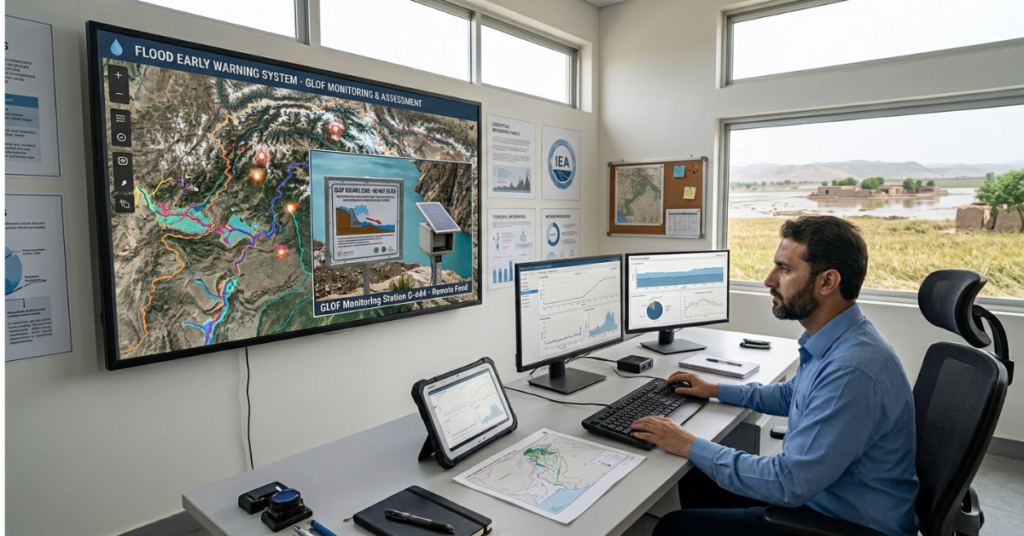
Technology is increasingly central to Pakistan’s climate adaptation efforts. Satellite imagery, machine learning, and geospatial intelligence are helping planners identify at-risk communities, monitor flood dynamics in real time, and model future climate scenarios. The NDMA’s GLOF monitoring program uses satellites and ground sensors to issue early warnings, often a week or more in advance, for the most dangerous glacial lakes.
The AI-powered geospatial platforms are increasingly being used for climate risk assessment, disaster preparedness, and environmental monitoring. These tools are helping Pakistan’s adaptation planning move beyond reactive crisis response toward genuinely proactive, data-driven risk management.
ESG consulting and environmental sustainability services further support Pakistani organizations and government agencies in embedding climate risk into development planning, investment decisions, and institutional strategy.
What does the future hold for climate change in Pakistan?
Climate change in Pakistan until the year 2050 is unspeakably dire. It is predicted that by 2050, the population will reach 338 million. This larger population means a greater burden on already stressed systems for water, food, and energy. It is also predicted that, by the year 2035, the emissions caused by the development of Pakistan will increase from 405 MtCO2e in the year 2015 to 2,559 MtCO2e. This is all expected to happen as the energy sector and industrial sector expand. Without climate finance of massively expanded scale, adaptation investments will not help to prevent the climate crisis from getting worse in Pakistan.
Projections through 2050 and the alarming data
The future of climate change in Pakistan demands urgent action. According to published estimates, Pakistan will require $40–50 billion in annual climate investment through 2050 to strengthen climate resilience and adapt to escalating climate risks. In comparison, Pakistan had received only $2.8 billion of the $10 billion pledged at the 2023 international donor conference by 2024. This substantial funding gap threatens to slow adaptation efforts and increase future economic losses and human suffering.
Glaciers melt, and the Indus River system will have even less water, threatening the agricultural economy. According to the World Economic Forum, the Third Pole glaciers feed over 60% of Pakistan’s water and support over 240 million people. If temperatures continue to rise as predicted, we will see the significant loss of these glaciers.
How global warming facts are reshaping the outlook for climate-vulnerable nations like Pakistan presents the broader scientific context that makes Pakistan’s situation so urgent and so deeply connected to global emissions decisions made in the world’s wealthiest economies.
Why climate justice for Pakistan cannot wait
Pakistan is indisputably a victim of the climate crisis even if it produces less than 1% of the emissions that cause it. Every decade, climate change is killing thousands of Pakistanis and displacing tens of thousands more, costing tens of billions of dollars. Therefore, funding climate projects in Pakistan is not donating one’s charity; it is paying a debt.
Pakistan’s situation sits at the center of the global debate over climate justice and who bears responsibility for funding adaptation in vulnerable nations. The Loss and Damage Fund, which will operate after COP28 in Dubai, is a historic attempt to recognize that this debt exists, although the donations so far are only a small fraction of what is needed. Therefore, for the remaining decade, the international community must prioritize the urgent situation in Pakistan. This will entail a substantial increase in financing Loss and Damage, fulfilling existing climate commitments and accelerating the provision of concessional loans and grants.
Geospatial data production and spatial analytics services are supporting Pakistan’s climate planning by generating the high-quality, ground-truthed data that both national agencies and international funders need to assess risk, target resources, and measure the impact of adaptation investments.
Comparison table: Pakistan’s climate vulnerability vs. its emissions contribution
| Indicator | Pakistan | United States | China |
| Share of global GHG emissions | Less than 1% | Approx. 13% annually | Approx. 28% annually |
| Historical cumulative CO2 (1750-2020) | Negligible | 24.5% | 13.9% |
| Global Climate Risk Index ranking | 5th most vulnerable | Low risk | Moderate risk |
| ND-GAIN vulnerability score | 5th highest | Well-resourced | Moderate |
| 2022 disaster cost | $30 billion in floods | Not comparable | Not comparable |
| Glaciers at risk | Over 7,000 melting | Minimal glacial exposure | Some in Tibetan Plateau |
| Annual climate finance needed | $40-50 billion (est.) | Net contributor | Net contributor |
| NDC ambition (2025) | 50% reduction by 2035 | Varies by administration | Peak emissions before 2030 |
Key takeaways
- Climate change in Pakistan ranks among the world’s most severe and unjust crises. Pakistan contributes less than 1% of global emissions but faces some of the most devastating climate impacts on earth.
- Over 7,000 glaciers in Pakistan’s northern mountains are melting at an accelerating rate, threatening water security for over 240 million people who depend on the Indus River system.
- The 2022 floods, which submerged one-third of Pakistan and caused $30 billion in damage, were made significantly more likely and more intense by climate change. Similar events are now becoming more frequent.
- Pakistan’s agriculture, which feeds over 240 million people, is directly threatened by erratic monsoons, glacier loss, extreme heat, and floods that are all being intensified by climate change.
- Pakistan needs $40 to $50 billion per year in climate investment through 2050. Closing that gap through international climate finance and advanced adaptation tools is an urgent global responsibility.
Conclusion
The data on climate change in Pakistan is clear, urgent, and deeply troubling. A country that contributes less than 1% of global emissions is already paying a catastrophic price for a crisis it did not create. Glaciers are vanishing. Floods are intensifying. Harvests are failing. Millions of people are being displaced. And the funding needed to address this emergency is arriving at a fraction of the required speed and scale.
Solving Pakistan’s climate crisis requires three things working together, as part of the broader global response the climate emergency demands: increased international climate finance, smarter adaptation solutions powered by geospatial intelligence and AI-driven risk analytics, and a global commitment to climate justice.
If you work in climate planning, disaster risk management, or environmental sustainability and want to understand how geospatial intelligence is supporting adaptation in climate-vulnerable regions, explore the full range of services and capabilities at AI Geo Navigators. From spatial data production to risk analytics and decision intelligence, the platform brings the data clarity that climate action urgently demands.
FAQs
Q: Why Is Climate Change in Pakistan So Severe Despite Low Emissions?
Pakistan’s geography places it at the intersection of multiple climate hazards: the world’s densest concentration of glaciers outside the poles, a monsoon system intensified by warming oceans, and a largely agricultural economy with limited adaptive capacity. Because of this, even small increases in global temperature produce disproportionately severe impacts on Pakistan’s water, food, and disaster systems.
Q: What caused the 2022 Pakistan floods?
The 2022 Pakistan floods were caused by a combination of record-breaking monsoon rainfall and accelerated glacial melt driven by prolonged heat waves. Climate change in Pakistan made these heat waves more likely and increased monsoon rainfall intensity. The disaster submerged one-third of the country, killed over 1,700 people, and caused more than $30 billion in economic damage.
Q: What is Pakistan doing about climate change?
Pakistan submitted its updated NDC 3.0 to the UNFCCC in September 2025, pledging a 50% emissions reduction by 2035 (17% unconditional through domestic resources, 33% conditional on international climate finance) and committing to 60% clean energy by 2030. The country established a Pakistan Climate Change Authority in 2024, launched a Glacier Conservation Strategy in 2025, and issued Green Bonds and a Green Sukuk to fund climate action. However, international climate finance remains far below what Pakistan urgently needs.
Pakistan’s climate emergency is a global responsibility. Learn how smart geospatial tools are helping vulnerable communities prepare and adapt. Contact AI Geo Navigators today.