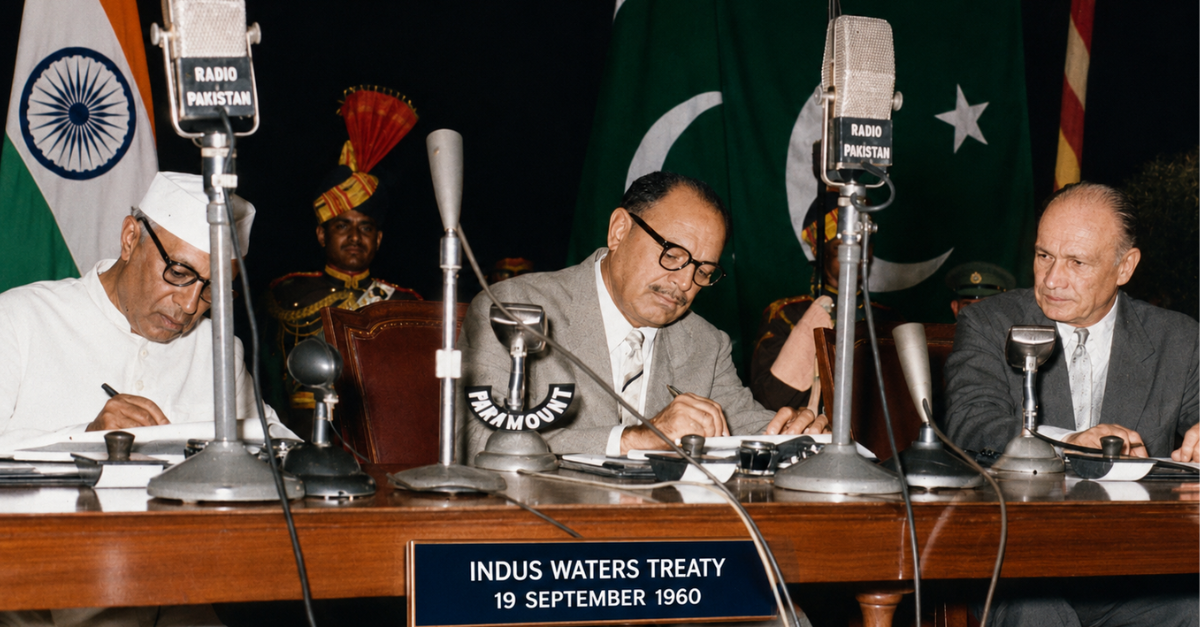
| Quick answer: The Indus Water Treaty 1960 is a permanent bilateral agreement signed on September 19, 1960, in Karachi between India and Pakistan and brokered by the World Bank. It allocates six Indus basin rivers between the two countries, establishes the Permanent Indus Commission, and sets up a three-tier dispute resolution system. With no expiry date, it has served as the legal framework for Indus water sharing for over 65 years. |
The Indus Water Treaty 1960 is a permanent bilateral agreement signed on September 19, 1960, in Karachi between India and Pakistan and brokered by the World Bank. It allocates the six rivers of the Indus basin between the two countries, establishes the Permanent Indus Commission, and sets up a three-tier dispute resolution system.
With no expiry date, the treaty has served as the legal framework for Indus water sharing for over 65 years and remains central to water security in the region.
This article examines what was agreed in 1960, why that year was a turning point in Indo-Pak water relations, and how the treaty’s original provisions are interpreted today.
While this article focuses on the original 1960 agreement, the broader history, river allocations, major disputes, and recent developments are explained in our complete guide to the Indus Water Treaty.
Why was 1960 the year the treaty was finally signed?
India and Pakistan signed the Indus Water Treaty in 1960 after nine years of failed negotiations because a workable engineering solution, international financing, and political will on both sides finally aligned.
What made the 1950s so difficult?
In May 1952, formal negotiations began after the World Bank convened a working party of engineers from both nations. However, all the plans failed to materialise over the past six years as India and Pakistan clashed over whether Pakistan had a legal entitlement to the water or only a historical claim. In 1958, negotiators broke the deadlock by agreeing to divide the rivers into separate systems, giving each country its own rivers without dependency on the other.
The role of the Indus Basin Development Fund
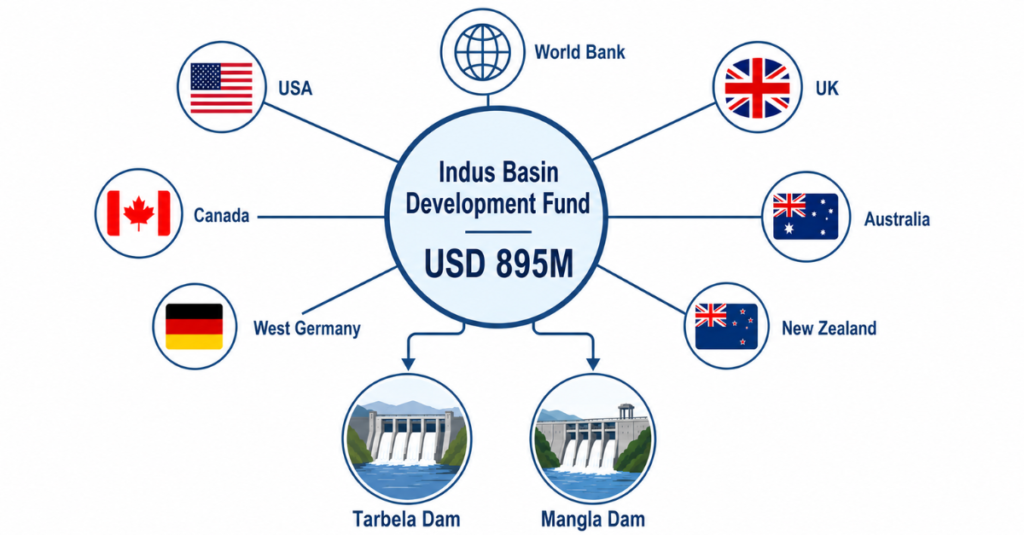
The current canal network in Pakistan was relying on the eastern rivers, which were being abandoned. It had to build six new canals for those flows, two large storage dams, and a large distribution network. World Bank President Eugene Black established the Indus Basin Development Fund with contributions from Australia, Canada, West Germany, New Zealand, the United Kingdom, and the United States.
Furthermore, the World Bank’s own figures show that the total value of the fund at signing was some 895 million U.S. dollars. If it hadn’t been for that financial package, there would have been no Pakistani government willing to sign the deal.
Moreover, over the next decade (1960 to 1970), India would be able to continue feeding the water of these rivers to the Pakistani canals while Pakistan constructed its replacement projects, thus eliminating the prospect of an immediate agricultural crisis.
What exactly did the 1960 treaty text agree to?
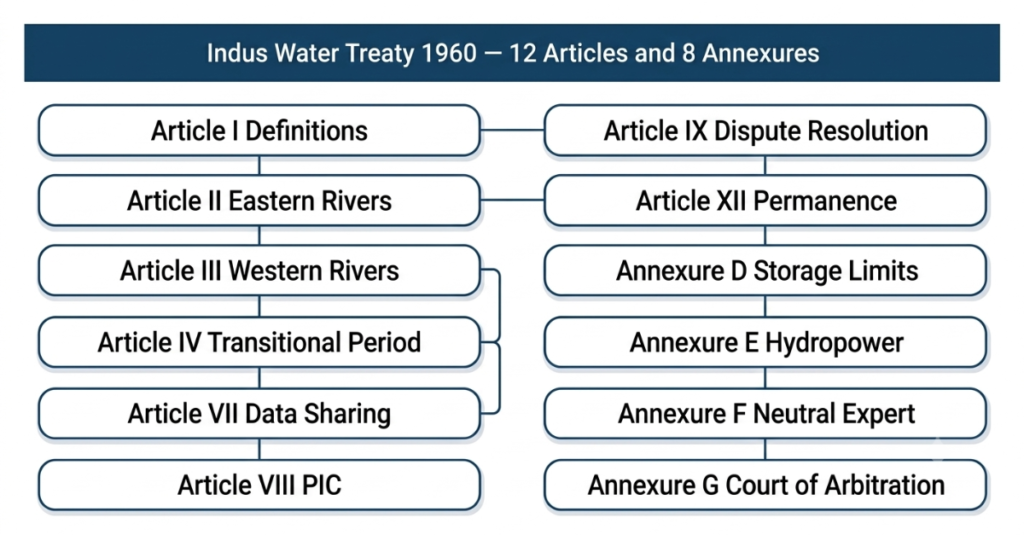
The Indus Water Treaty 1960 contains twelve articles and eight technical annexures, each serving a specific purpose.
Article I: definitions
Article I established definitions for every technical term in the treaty. Consumptive use means water absorbed by crops, evaporated, or removed from the river. Non-consumptive use means water used without reducing total flow, such as run-of-the-river power generation. Consequently, India and Pakistan have interpreted these definitions differently since 1960, making them a source of every major dispute over modern hydropower projects.
Articles II and III: river allocation mechanics
Article II granted India unrestricted use of the three eastern rivers: Ravi, Beas, and Sutlej. India may use these for any purpose with no obligation to Pakistan. In contrast, Article III granted Pakistan primary use of the Indus, Jhelum, and Chenab, while limiting India to domestic, non-consumptive, and run-of-the-river hydropower uses on those rivers. The critical restriction: India cannot build storage works on western rivers beyond the limits in Annexure D without Pakistan’s prior consent. This storage restriction is the central point of every major dispute since 1960.
Article IV: transitional period mechanics
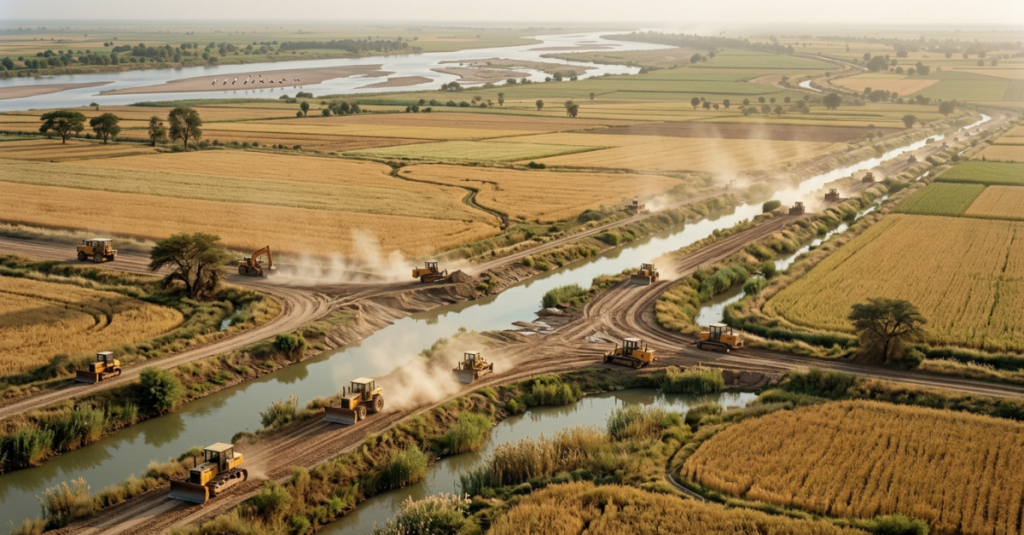
Article IV required India to supply declining volumes of eastern river water to Pakistani canals each year from 1960 to 1970, starting at 3.125 million acre-feet in year one and reducing as Pakistan’s replacement infrastructure came online. MIT Water Diplomacy research states that World Bank engineers verified each construction milestone while negotiators finalised the project schedule for each project.
Article VII: data sharing
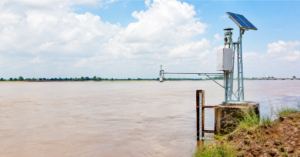
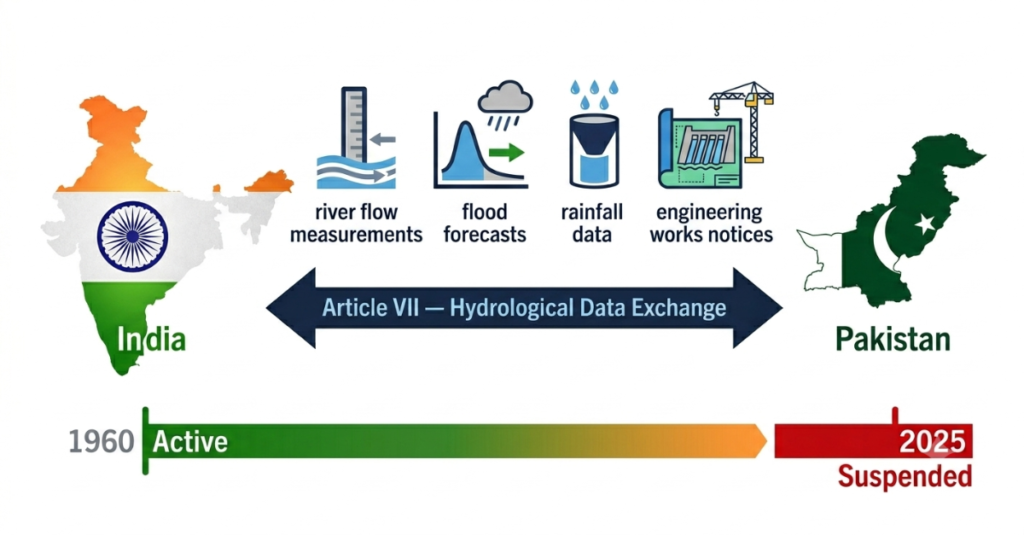
Article VII required both countries to share river flow data, give advance notice of engineering works, and cooperate on flood management. In 1960, this was a routine clause. However, today, it is the treaty’s most consequential provision. India suspended compliance in April 2025 by halting hydrological data sharing, leaving Pakistan without upstream flow and flood forecasting data for the first time since 1960. The significance of data sharing has increased in recent years, particularly after the 2025 crisis discussed in our complete guide to the Indus Water Treaty.
Articles VIII, IX, and XII
Article VIII created the Permanent Indus Commission, one commissioner from each country, meeting annually and resolving over 100 technical disagreements quietly between 1960 and 2016. Meanwhile, Article IX established the three-tier dispute resolution process: the Commission, then a Neutral Expert appointed through the World Bank, and finally a Court of Arbitration. Article XII declared the treaty permanent, terminable only by a duly ratified bilateral treaty. Article XII(3) allows modifications but requires both governments’ consent. India invoked this in 2023 and 2024 to request renegotiation; Pakistan refused both times.
What did each country gain and lose in 1960?
Importantly, the 1960 treaty was not an equal compromise. Both sides made concessions and received specific guarantees.
| Category | India gained | Pakistan gained |
| Rivers | Ravi, Beas, Sutlej — unrestricted | Indus, Jhelum, Chenab, primary rights |
| Annual volume | ~33 MAF (20% of system) | ~135 MAF (80% of system) |
| Key infrastructure | Bhakra-Nangal, Shahpurkandi | Tarbela, Mangla, six link canals |
| Financial support | None required | ~USD 895M (Indus Basin Development Fund) |
| Transitional guarantee | Obligation to supply until 1970 | Eastern river supply guaranteed for 10 years |
| Legal certainty | Eastern rivers are permanently secured | Western rivers are permanently secured |
| What each gave up | All claims on western rivers beyond permitted uses | All eastern river allocations after 1970 |
How do the 1960 provisions shape disputes today?
Every major dispute under the Indus Water Treaty since 1960 has been an argument over how to apply the original 1960 text to engineering situations that did not exist in 1960.
The storage restriction problem
The treaty’s Annexure D specifies maximum storage volumes for India on western rivers, calibrated to 1950s engineering standards. The Baglihar dam dispute (2005 to 2007) turned on whether a modern gated spillway exceeded these limits. The Neutral Expert ruled the design largely compliant but required modifications. Similarly, the Kishanganga dispute (2010 to 2013) required the Court of Arbitration to determine whether a diversion permitted under the 1960 text applied to a tributary arrangement that did not exist at the time of signing.
The definitions problem
Terms like pondage and consumptive use, written for 1960 dam technology, are now contested for modern hydropower designs. Both India and Pakistan argue from the same 1960 text to opposite conclusions. The case for updating the treaty’s technical annexures through bilateral agreement is strong regardless of the broader political dispute.
Article XII and the modification debate
India’s 2023 and 2024 invocations of Article XII(3) are the first formal use of the modification mechanism since 1960. India cites glacial melt, new technology, and demographic change. Conversely, Pakistan argues that bilateral consent is required and cannot be compelled unilaterally. Both positions have legal merit. The full dispute history is in our Indus Water Treaty disputes.
Indus Water Treaty 1960: the original agreement at a glance
| Article / Provision | What was said in 1960 | Why it matters today |
| Article I | Defined consumptive use, non-consumptive use, agricultural use, pondage | Every dam dispute turns on how these 1960 definitions apply to modern engineering |
| Article II | India gets unrestricted use of the Ravi, Beas, and Sutlej | India may develop the eastern rivers with no obligation to Pakistan |
| Article III | Pakistan gets primary use of the Indus, Jhelum, and Chenab; India is limited to permitted uses | India’s hydropower projects on western rivers must fit within these 1960 limitations |
| Article IV | Ten-year declining supply schedule, 1960 to 1970 | Established that transitions must be funded and managed |
| Article VII | Both countries must share hydrological data and give advance notice of works | India suspended this in April 2025; loss of flood data is Pakistan’s most immediate risk |
| Article VIII | Created the Permanent Indus Commission, annual meetings | India stopped attending PIC meetings in 2024 for the first time since 1960 |
| Article IX | Three-tier dispute resolution: PIC, Neutral Expert, Court of Arbitration | Both mechanisms were activated simultaneously in 2022 for the first time |
| Annexure D | Maximum storage volumes India may use on the western rivers | Central to Baglihar (2005), Kishanganga (2010), and Ratle (2015) disputes |
| Article XII | Treaty is permanent; modifications require bilateral consent | India invoked XII(3) in 2023 and 2024; Pakistan refused both times |
Conclusion
The Indus Water Treaty 1960 is a precisely worded technical document whose twelve articles and eight annexures were calibrated to the engineering realities of 1960. Its durability came from its specificity: by defining everything from consumptive use to exact transitional supply volumes, it gave both sides a shared legal language to argue within rather than fight outside.
Nevertheless, that same specificity is now its weakness. A document written for 1960s dam technology cannot fully answer the engineering and environmental questions of 21st-century disputes.
While this article focuses on the original 1960 agreement, the broader history, river allocations, major disputes, and recent developments are explained in our complete guide to the Indus Water Treaty.
To understand the full picture of where the treaty stands today, read the complete Indus Water Treaty guide. Regarding the World Bank’s current position, see the World Bank Indus Waters Treaty fact sheet. For the original treaty text as registered with the United Nations, see the UN Treaty Collection.
FAQs
Q1. What is the Indus Water Treaty 1960 in simple terms?
The Indus Water Treaty 1960 is a permanent water-sharing agreement between India and Pakistan, signed on September 19, 1960, and brokered by the World Bank. It gives India full control of the Ravi, Beas, and Sutlej rivers and Pakistan primary control of the Indus, Jhelum, and Chenab, with a commission to manage the arrangement and a three-tier mechanism to resolve disputes.
Q2. Why did it take nine years to sign?
Ultimately, the core obstacle was a fundamental disagreement about water rights that neither international law nor bilateral negotiation could resolve. The deadlock broke only when the World Bank proposed physically dividing the rivers and then organised USD 895 million to fund Pakistan’s replacement infrastructure, making the agreement financially viable for Pakistan.
Q3. Can the Indus Water Treaty 1960 be cancelled or changed?
The treaty cannot be cancelled unilaterally. Article XII states it is permanent and can only be modified by a duly ratified bilateral treaty. However, India placed it in abeyance in April 2025, but the Permanent Court of Arbitration ruled in June 2025 that unilateral suspension is not permitted under the treaty’s own text.