What is climate financing?
“Climate finance refers to local, national or transnational financing—drawn from public, private and alternative sources of financing—that seeks to support mitigation and adaptation actions that will address climate change” (Ministry of Climate Change & Environmental Coordination (MoCC&EC)). Ministry Of Climate Change and Environmental coordination (MoCC&EC) first established its climate finance wing in 2023 to regulate, manage, and coordinate climate finance in order to meet the climate change mitigation and climate change adaptation goals, committed under national and international climate change frameworks like Paris agreement and nationally determined contributions NDCs. It also plays a major role in climate finance and carbon markets policy or strategy development.
Keywords; Climate finance, Pakistan’ climate budget, FY2023-24, FY2024-25, FY2025-26, FY2026-27, Public Sector Development Programme (PSDP), Green Pakistan Programme
Why climate budget matters
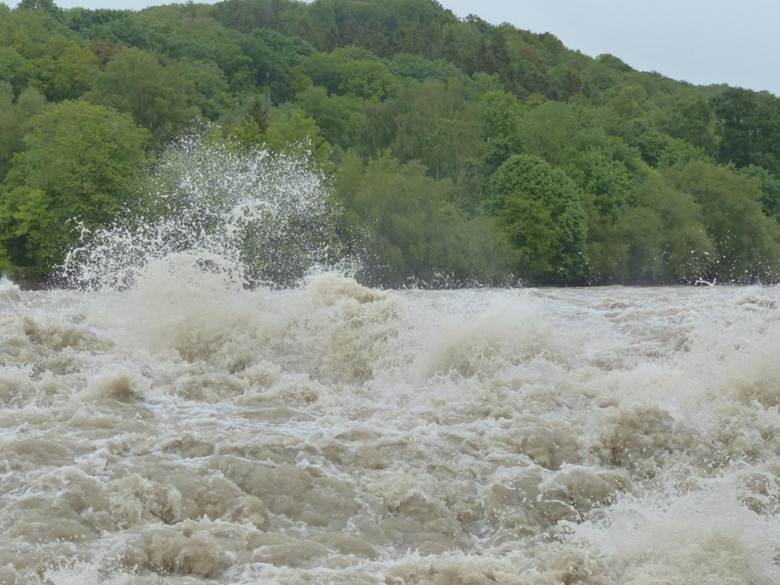
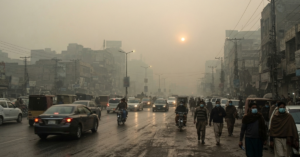
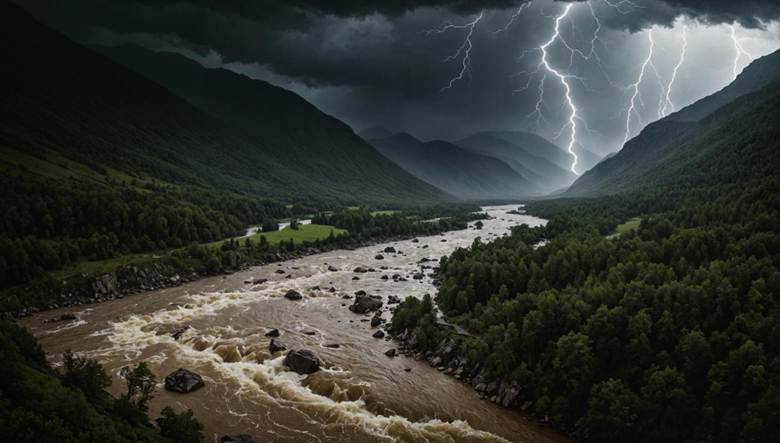
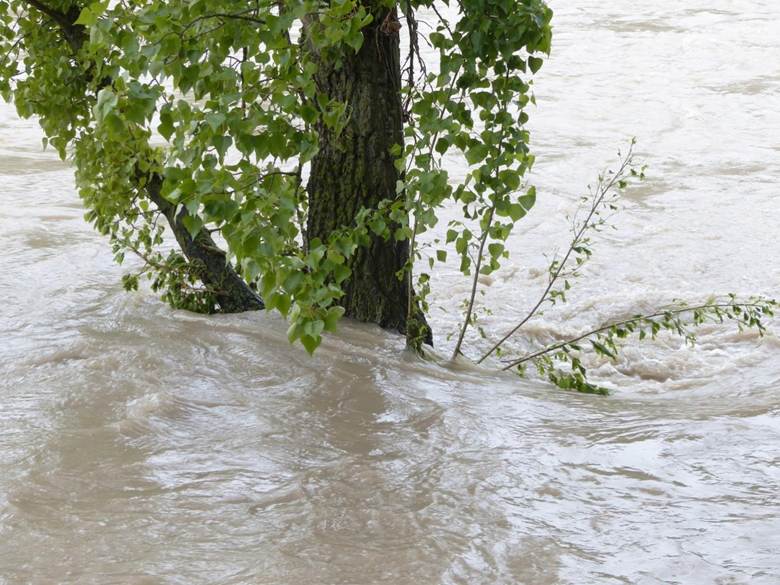
Climate budget matters the most for countries like Pakistan which are already susceptible to the effects of changing climate, For example, the August 2022 monsoon rain triggered the devastating floods with over 33 million people affected by the floods. It matters so that country can direct the finance and opportunities into projects and sectors that need urgent climate action and attention. Economically Pakistan is under huge debts, with high inflation rates and poverty; it can no long bear the additional cost incurred by the changing climate, as per the World Bank report, Pakistan incurred $29.3 billion in terms of poverty and livestock: 11.1% of 2020 GDP: the cost which keeps on increasing every year with the frequent and disastrous natural hazards.
Historical analysis of Climate Budgets in Pakistan
FY2023-2024
In the fiscal year 2023-2024 Pakistan dedicated a total of Rs.9.5 billion to the Ministry Of Climate Change and Environmental Protection, of which Rs.4.05 billion was explicitly allocated for direct climate focus projects and Public Sector Development Programme (PSDP).
A pivotal step taken under this budget was the introduction of the Climate Budget testing (CBT). Climate Budget Testing is a framework which tracks the government expenditures related to the Climate Change Mitigation and Climate Change Adaptation efforts, while aiming to inculcate climate change considerations into fiscal policy and public finance management, so that financial resources and funds are allocated toward addressing climate related challenges. It was reported by the Ministry of Finance that the whole budget allocated for climate sensitive purpose in FY 2023-2024 was 15.7% of PSDP and 8.1% of Running of Civil Government (ROCG). The categorization used in this context includes 3 main groups of adaptation, mitigation and supporting sectors, with each group having 40 groups of sub-categories, of which more than 5,000 cost centers were tagged for the climate-sensitive data.
One thing to note here is that, the climate budget for the FY2023-24 declined from Rs.14 billion to Rs.4, 050 million as compared to the previous year’s budget.
How the FY2023-24 budget was utilized?
The budget was spent in various projects and Programme:
- Green Pakistan Programme: where Rs.3.9 billion was allocated for national forest restoration and scaling
- Biosafety Clearing House: Where Rs100 million was allocated for monitoring of Genetically modified Organisms (GMO)
- Water Quality Monitoring: In this Rs.26 million was designated For Sustainable Capacity Building and Water SDGs
- Climate Resilient Urban Human Settlement: Under this project Rs.20 million was assigned for resilient town planning
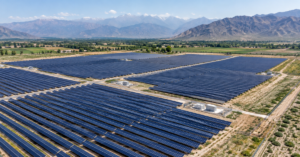
Beyond the allocation of the budget to specific climate change division, the budget was allocated to the cross sectors as well mainly agriculture and energy. For example, Rs.30, 000 million was allocated to the Solarization of agriculture tube wells to transition energy use towards renewable sources and to reduce the carbon footprints in the agricultural sector.
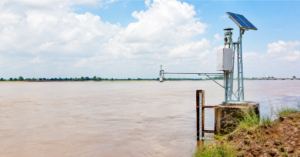
Secondly, under the Green Revolution2.o, Rs.5, 000 million was disbursed for climate smart agriculture practices. Also, under the aviation division Rs.110 million was allocated for the installation of meteorological infrastructure like weather surveillance Radars in areas like Multan and Sukkur, as well as a new observatory in Naran, in order to improve the early warning systems for heat waves and floods.
In the Annual Plan 2023-2024, the Government of Pakistan has included food and food security as a key component of the “Environment” pillar under the “5Es Framework”.
FY2024-2025
Following the introduction of the climate budget tagging in the FY2023-24, the FY2024-25 climate budget tagging focused on three kinds of data:
- BE 2023-24: ROCG 8.1%, PSDP 15.7%
- RE 2023-24: ROCG 7.7%, PSDP 19.3%
- BE 2024-25: ROCG 7.7%, PSDP 15.3%
In this fiscal year climate budget Rs.1.5 trillion was allocated for the PSDP, which was higher than the previous year’s climate budget. At the same time, the water resource division acquired Rs.184.6 billion from the budget
In this year Pakistan was able to secure international climate financing as well. Pakistan secured $ 1.5 billion in climate finance, $1.4 billion from IMF’s RSK and $82 million from Green Climate Fund. Domestically Pakistan acquired Rs.30 billion through Green Sukuk. In this specific fiscal year, Pakistan also introduced its National Adaptation Plan. However, the funding in the preparedness decreased by 30.08% received Rs.47, 434 million. The response sector got 15,876 million, recovery and rehabilitation received Rs.1, 142 million, and mitigation sector was allocated Rs.212, 861 million, Adaptation received Rs.46, 625 million and other supporting areas received Rs.18, 887 million.
FY2025-26
For the FY2025-26, Rs.17.57 trillion, federal expenditure was planned. Government allocated 6.9% of its budget, 8.2% of its PSDP, and 1% of the budget for disaster.
The water resource division experienced a decline in its budget from Rs.184.6 billion to Rs.133.4 billion-a total of 27% cut from the previous year’s allocation, While, NDMA and cabinet division for disaster response and rehabilitation received less then Rs.20 billion. NDRMF was allocated Rs.1, 100 million, climate change division received Rs.2, 784 million. In the climate domain: Rs.85, 435 million in Adaptation, Rs.603, 000 million in mitigation, and 28,331 million in other supporting areas. Likewise, in the disaster field, Rs.33163 million was allocated, Rs.15876 million was disbursed in response, and Rs.1142 was allocated for Recovery and Rehabilitation.
Pakistan was able to submit its third NDC to UNFCCC. NDC3.0 pledged $565.7 billion to climate finance through 2040. In FY2025-26, the Federal Government of Pakistan has “adopted climate budget as a governance system to mainstream climate considerations into policy decision making.” With the unveiling of the 2025-2026 Budget, the tagging exercise has been expanded to include expenditures on grants and subsidies as well. No less than 0.2% of grants and 50% of subsidies are climate responsive. The Resilience and Sustainability Facility (RSF) at the IMF has pledged itself to provide Pakistan with US$1.4 billion to tackle the climate issue and one of the primary aims of the facility was to integrate climate considerations into the budget planning and process.
The budget for environmental protection development was reduced to Rs.2.784 billion from Rs.6.257 billion in FY2024–2025. The ministry of climate change was decreased from Rs.3.5 billion to Rs.2.7 billion.
FY2026-27
Only Rs.2.78 billion of the Rs.1 trillion awarded to the Federal Public Sector Development Program for the fiscal year 2026–2027 went to the federal climate change division.
Nearly the whole budget (94.27%) has been allocated to the up scaling of green Pakistan Programme; Rs.2.49 billion has been set aside for it. The budget allocation for the climate change is as follow:
- Climate Change Adaptation Rs.70, 462 million has been allocated,
- Climate Mitigation Rs.124, 067 million,
- Supporting Areas Rs.19, 490 million has been set aside,
It should be emphasized that, Adaptation decreased by Rs.85.43 billion, the amount of mitigation has fallen to Rs.603 billion, and the volume of supporting allocations has reduced from Rs.28.33 billion. In all categories the trend is downward.
There’s one area in which progress is being made; post-disaster financing. The amount of funds allocated to disaster preparedness went up from Rs.33.16 billion to Rs.42.84 billion. The amount of money raised for responses increased from Rs.15.87 billion to Rs.32.77 billion. The recovery and rehabilitation increased from Rs.1.14 billion to Rs.21.48 billion.
To strengthen the technical capacities of ministry of climate change and environmental protection Rs.40. 661 million has been allocated. Rs.51.6 million is the budget allocation for the Green Skills for Sustainable Development. For water resources division Rs.103.1 million has been set aside.
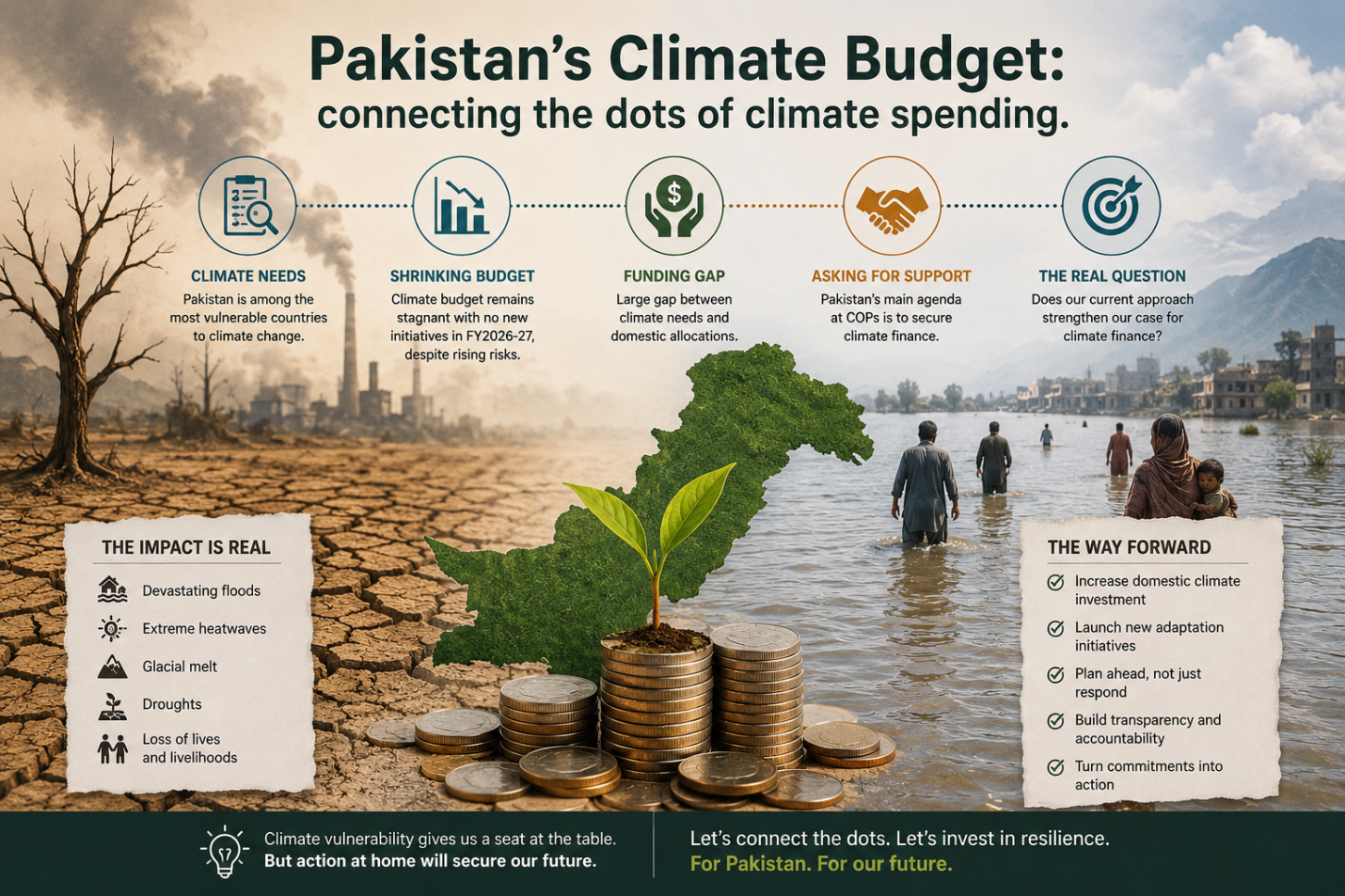
The FY 2026-27 climate budgets spending has seen a significant cut of the budget, at the same time there are no new initiatives introduced. For a country still recovering from the damage of the 2022 floods, the allocation under the new budget and the country having now new initiatives or plans to combat the effect of climate change is dangerously alarming.
Comparison of climate budget:
FY2023-24, 2024-25, 2025-26, 2026-27
A Five-Year Decline
- FY2021–22: Rs 14.3 billion
- FY2023–24: Rs 9.5 billion
- FY2024–25: Rs 6.26 billion
- FY2025–26: Rs 2.78 billion
- FY2026–27: Rs 2.48 billion
Over five years, the climate ministry’s direct PSDP allocation has fallen by approximately 83%.
The Four-Year Picture
| Fiscal Year | MoCC&EC PSDP Allocation | Year-on-Year Change | Share of Total PSDP |
| FY2023–24 | Rs 9.5 billion | — | ~0.95% (PSDP ~Rs 1,001bn) |
| FY2024–25 | Rs 5.257 billion | -45% | ~0.48% (PSDP ~Rs 1,100bn estimated) |
| FY2025–26 | Rs 2.78 billion | -47% | ~0.28% (PSDP ~Rs 1,000bn) |
| FY2026–27 | Rs 2.48 billion | -11% | 0.25% (PSDP Rs 1,000bn) |
Compared to the four years the ministries were consistently underfunded, no matter which government or finance minister was in charge of the budget at the time. The total drop over the three years is 74%, in addition to a massive previous drop of Rs 14.3 billion in FY2021–22.
What Stays the Same across All Four Years?
There are two features of the structure which repeat from one year to the next, and more important than any individual allocation figure.
First, the majority of the ministry’s ever-reducing budget has been utilized on the single flagship project of the ministry: the Green Pakistan Programme with the objective of afforestation and ecosystem restoration. That one project takes up 94% of the ministry allocation in FY26-27. This is not uncommon; this has been the trend throughout that time. The result is also predictable: funding for technical capacity-building, urban climate-risk planning, and institutional strengthening, the non-spectacular aspects of climate governance, fall short, usually a few percentage points each.
Second, the budget of the dedicated ministry was cut and climate-related expenditure didn’t go out of Pakistan’s books, it simply shifted. The water resource management, flood protection, provincial energy projects and disaster-resilience work are becoming more and more part of the other ministries’ line items and provincial budgets, which is not under MoCC&EC. The total of climate related expenditure, which is spread throughout the broader PSDP (water, flood, energy, sanitation, provincial projects), is more than Rs.353 billion by FY2026-27, which is over 140 times the amount allocated to the Climate Ministry.
What is the justification?
The budget for a single fiscal year can somehow be justified: an IMF program, a reprioritization etc, but 4 years in the same direction is a more difficult argument to defend or label as just a circumstance. It signals a policy decision that federal climate governance has become a small symbolic line item and the medium-to-heavy lifting of the financial burden of climate adaptation is being shifted to sectorial ministries and provinces based on the rationale of the devolved responsibilities of the 18th Amendment. That devolution argument has some substance: Water and Disaster Management are indeed provincial matters in Pakistan’s constitution. Without consolidated responsibility, devolution of responsibility adds to the transparency problem each year.
Fragmented by design
Each of the four budgets reviewed here presents the appropriation for climate differently and there is no consistent, all-encompassing federal ledger on the Climate Ministry’s spending versus the total of climate tagged spending across government. The climate budget tagging initiative, launched in Pakistan following the 2022 floods, was designed to address exactly this: but assigning over 5,000 cost centers as “climate-relevant” does not necessarily indicate the money is being spent on the communities most at risk of flooding, droughts, and heat stress.
Beyond the climate ministry
Pakistan’s claim to international funds to fight climate change at COP’s forums, in negotiations on loss-and-damage, and with multilateral lenders, is based on the premise that it is a climate-susceptible country, but with limited fiscal space. Not one, but two, of those arguments are undermined, rather than strengthened, by the fact that its own special climate institution is being slowly gutted over the past four years.
Conclusion
In a climate where such spending is spread out and not labeled, nobody has the answers, there is no single ledger that a citizen, a journalist or international donor can look at and ask if climate resilience spending is sufficient, increasing or at least coherent. What is available within the dedicated ministry is, itself, thinly spread: 94% of the ministry’s total budget is allocated to a single Programme, the Green Pakistan Programme, and only a few million rupees are allocated to the less glamorous but more fundamental work of technical capacity-building and urban flood-risk planning, the very kind of institutional muscle that a climate-vulnerable country needs most.