| Quick answer: The Indus Water Treaty main points cover six areas: river allocation, permitted uses on each country’s rivers, storage and pondage restrictions on western rivers, the Permanent Indus Commission structure, a three-tier dispute resolution mechanism, and a permanence clause with a modification process. Each point has specific legal language that India and Pakistan have interpreted differently in every major dispute since 1960. |
Most articles about the Indus Water Treaty main points give you a bullet list and stop there. What they never explain is what each provision actually does in practice, how permitted uses are triggered, what pondage limits mean for a dam engineer, and why the data-sharing clause has become more consequential than the river allocation itself.
This article covers only the main points and provisions. For the full 1960 history, read the Indus Water Treaty 1960. For the complete overview, including current status, read the Indus Water Treaty.
What are the Indus Water Treaty main points in plain language?
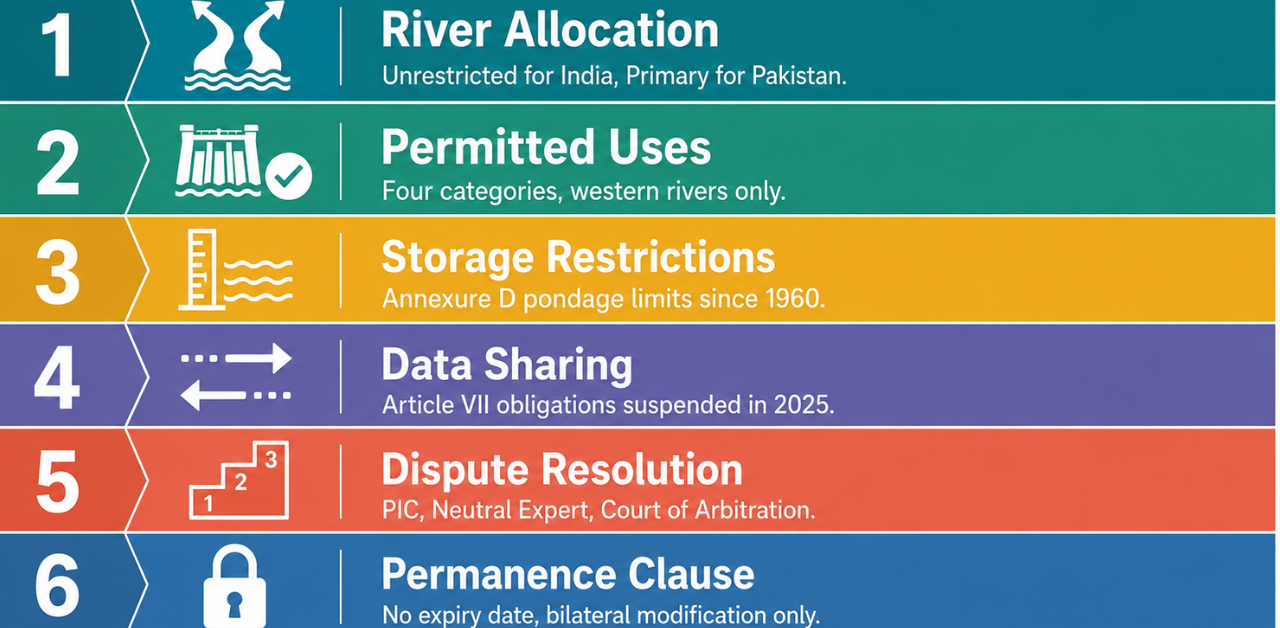
The Indus Water Treaty main points have six core elements. Each contains detailed sub-provisions that determine exactly when a country is in compliance and when it is not.
| Main point | One-line rule | Where it gets complicated |
| 1. River allocation | India: Ravi, Beas, Sutlej. Pakistan: Indus, Jhelum, Chenab | Unrestricted for India versus primary rights for Pakistan drives every dispute |
| 2. Permitted uses on western rivers | India may use western rivers for domestic, non-consumptive, and limited irrigation | The consumptive versus non-consumptive boundary is where all hydropower disputes begin |
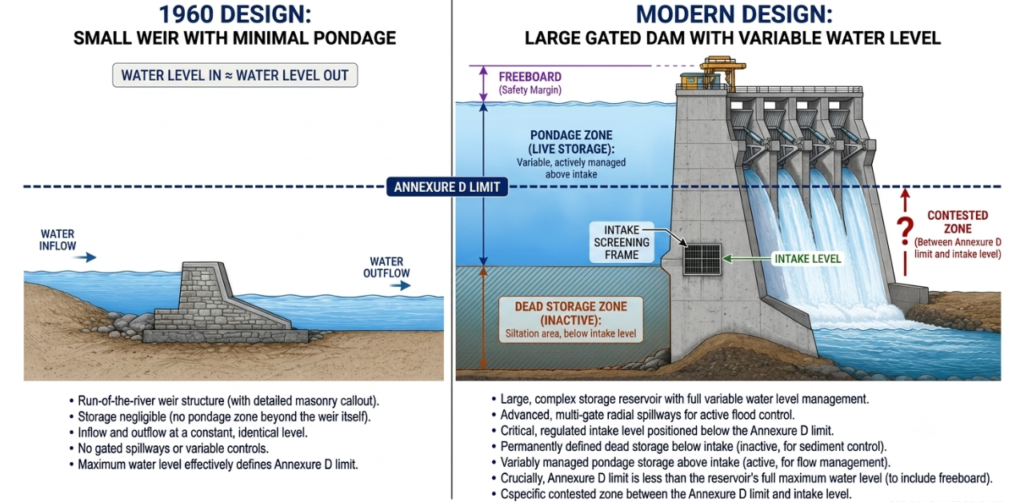
| 3. Storage and pondage restrictions | India cannot build significant storage beyond Annexure D limits | Pondage limits were written for 1960 dam technology; modern designs test every boundary |
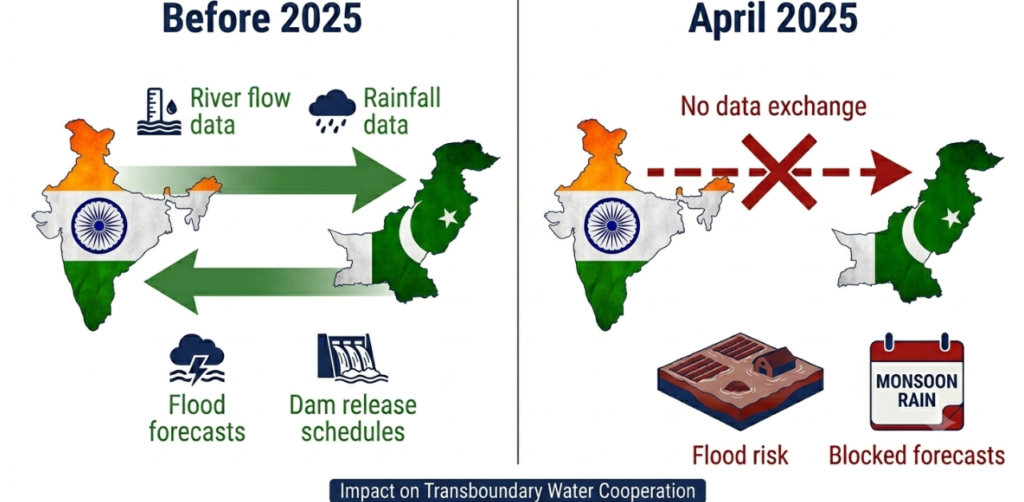
| 4. Data sharing and notification | Both countries must share flow data and give advance notice of works | India suspended this in 2025; the impact may exceed any physical water reduction |
| 5. Dispute resolution | Three tiers: PIC, Neutral Expert, Court of Arbitration | The question-versus-dispute distinction determines which tier applies |
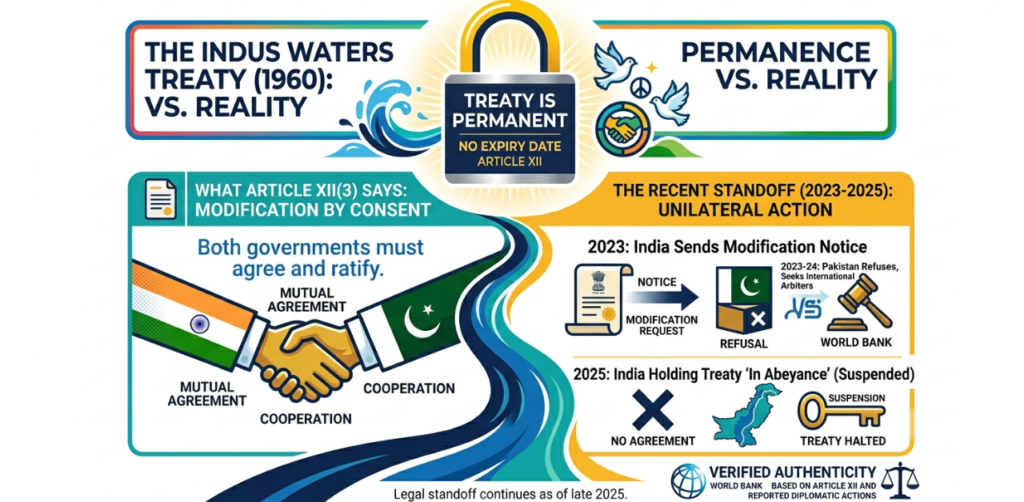
| 6. Permanence and modification | No expiry date; changes need both governments to agree | India invoked the modification clause in 2023 and 2024; Pakistan refused; standoff continues |
1: How does the river allocation actually work?
Article II grants India unrestricted use of the Ravi, Beas, and Sutlej. Unrestricted means India may use these for any purpose with no obligation to maintain any flow into Pakistan. India needs no consent, no advance notice, and no data sharing for the eastern river projects.
What do primary rights mean for Pakistan?
Article III grants Pakistan primary use of the Indus, Jhelum, and Chenab. Primary, not unrestricted. India retains specific permitted uses on these same rivers. Pakistan cannot prevent India from exercising those uses. Additionally, Article III requires Pakistan to let eastern river tributaries flow into India where they naturally join. Pakistan cannot divert these to increase its western river supply, a provision almost no competitor summary mentions.
2: What are the permitted uses on Western rivers?
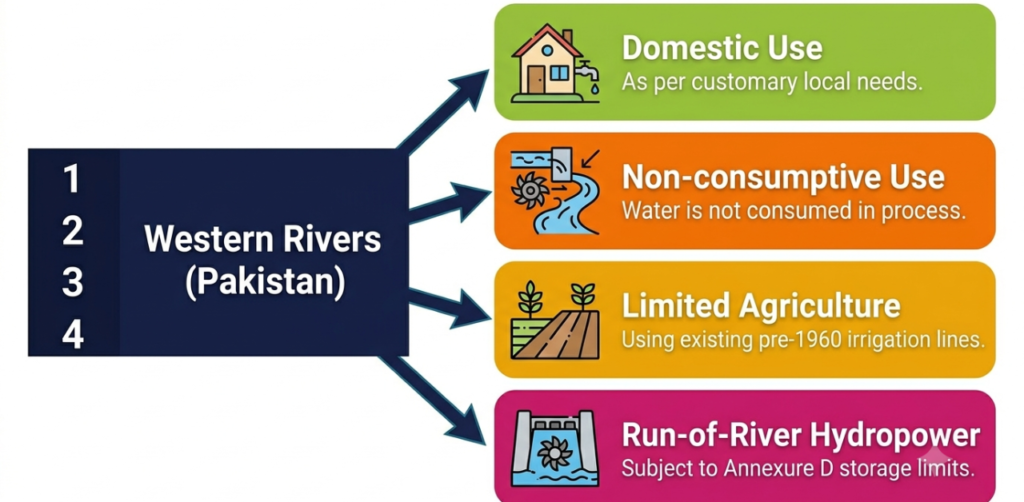
The permitted uses in Article III are the single most litigated part of the treaty. India may use western river water for four purposes only: domestic use, non-consumptive use such as navigation and run-of-the-river hydropower, limited pre-treaty agricultural irrigation under Annexure B, and hydropower generation within Annexure D and E design limits.
Why are consumptive versus non-consumptive causes in every dispute
Non-consumptive use returns the same volume to the river after use. Run-of-the-river hydropower is the clearest example. Consumptive use does not return because water is absorbed, evaporated, or diverted. The problem is modern dams. Large reservoirs evaporate significant volumes. Pondage holds water back temporarily. According to the American Society of International Law’s 2025 analysis, the Neutral Expert’s January 2025 award found that pondage calculations for modern plants require applying Annexure D’s formulas to installed capacity and load factors, a technical exercise the 1960 drafters did not anticipate.
3: What do storage and pondage restrictions actually limit?
Annexure D defines pondage as a small reservoir for daily or weekly flow regulation. The maximum pondage is calculated from installed capacity and specified operating hours. In 1960, this formula worked for small weirs. By 2005, India’s Baglihar plant at 900 megawatts produced a pondage calculation Pakistan argued exceeded Annexure D limits. The Neutral Expert in 2007 required modifications to spillway gate heights to bring the design within limits.
Why predictability matters more than volume
Storage restrictions matter not because India steals water but because they protect Pakistan’s flow predictability. Understanding river flow patterns and storage monitoring requires precise geospatial data, which is why organisations increasingly rely on AI-powered GIS and remote sensing to support water resource analysis.
A Pakistani irrigation engineer allocating canal water weeks in advance needs to know what volume will arrive from upstream. If India can vary releases widely, Pakistan’s planning becomes impossible even if the total annual volume stays within limits. The Court of Arbitration’s 2025 award on maximum pondage for Kishanganga and Ratle found India must store less live water than its engineers designed. India rejected the award. The full background of the disputes is in the Indus Water Treaty.
4: What does the data-sharing obligation actually require?
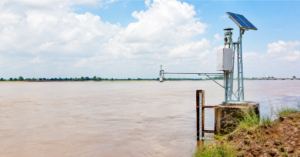
Article VII requires both countries to maintain discharge observation stations, share flow data regularly, give advance notice of engineering works, and cooperate on flood management. In practice, this means India provides Pakistan with upstream flow measurements, glacier melt data, rainfall figures, and dam release schedules. Pakistan provides India with flow data from shared tributary sections.
Why 2025 data suspension matters more than the treaty suspension
India suspended Article VII data sharing in April 2025. Pakistan’s IRSA cannot accurately forecast inflows without upstream data. Flood preparation is impossible without advance notice of dam releases. Accurate hydrological monitoring depends on geospatial intelligence tools like those used in GIS, and climate resilience tools can support transboundary water management.
According to Pakistan’s water authorities, cited in a July 2025 NPR report, the 2025 monsoon season was the first time since 1960 that Pakistan entered the high-water season without upstream flow data from India. The practical damage from this information blackout may exceed any physical water reduction India can achieve in the short term.
5: How does the three-tier dispute resolution work in practice?
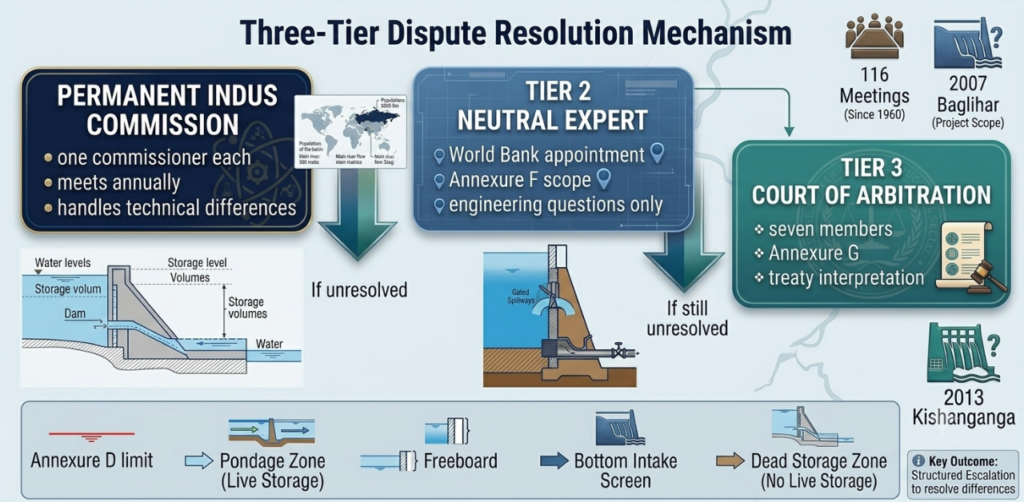
Tier one is the Permanent Indus Commission, one commissioner from each country, meeting annually. The PIC resolved over 100 technical disagreements between 1960 and 2016. India stopped attending in 2024.
Tier two is the Neutral Expert, appointed through the World Bank under Annexure F. The Neutral Expert handles technical questions only, meaning engineering specifications, flow calculations, and design parameters, not legal questions about treaty rights.
Tier three is the Court of Arbitration under Annexure G, seven members with authority to interpret the treaty itself. In June 2025, the Court confirmed its own jurisdiction over the Kishanganga and Ratle disputes. As the American Society of International Law noted, Annexure G expressly states the court decides all questions relating to its own competence, a provision India itself agreed to in 1960. India rejected the ruling.
6: What does the permanence clause actually say?
Article XII(1) states the treaty shall remain in force until terminated by a duly ratified treaty concluded for that purpose between the two governments. Both governments must actively negotiate and ratify a new agreement specifically to end the existing one. Neither country can terminate unilaterally.
Article XII(3) allows modifications by a duly ratified treaty with both governments’ consent. India issued formal notices in January 2023 and again in 2024 requesting modifications, citing climate change and population growth. Pakistan refused both times, arguing that bilateral consent cannot be compelled. Both positions have textual support. The legal standoff is examined in our Indus Water Treaty current status guide.
Why the Indus Water Treaty Main Points Matter Today?
The Indus water treaty main points are more important today than they were in 1960. Population growth, climate change, glacier melt, and increasing water demand have placed additional pressure on the Indus Basin. Hydropower projects on the western rivers continue to test the limits of Annexure D and Annexure E, while the suspension of Article VII data sharing has increased concerns about flood forecasting and agricultural planning.
As water becomes more strategically important across South Asia, disputes are increasingly focused on how treaty provisions should be interpreted rather than on the treaty’s existence itself. Understanding the Indus water treaty main points is therefore essential for understanding current India–Pakistan water disputes.
Conclusion
The Indus Water Treaty main points are not just a list of which country gets which rivers. Each provision contains detailed sub-rules that determine exactly when a country is in compliance and when it is not. The asymmetry between India’s unrestricted eastern river rights and Pakistan’s primary western river rights, the four permitted use categories, the Annexure D pondage formula, the Article VII data obligations, the three-tier dispute mechanism, and the Article XII modification process together form a legal system governing one of the world’s most critical river basins for over 65 years.
For the complete picture, read the Indus Water Treaty pillar guide and the Indus Water Treaty 1960. The original treaty text is available through the UN Treaty Collection. Details of PCA proceedings can be found in PCA Indus Waters Kishanganga and Ratle.
FAQs
What are the Indus Water Treaty main points in one paragraph?
The six Indus water treaty main points are river allocation, permitted uses, storage restrictions, data sharing, dispute resolution, and permanence. India gets unrestricted use of the Ravi, Beas, and Sutlej. Pakistan gets primary use of the Indus, Jhelum, and Chenab. India may use western rivers only for domestic, non-consumptive, limited agricultural, and run-of-the-river hydropower purposes within Annexure D limits. Both countries must share flow data. Disputes go first to the PIC, then the Neutral Expert, then the Court of Arbitration. The treaty is permanent and can only be modified by bilateral agreement.
Which main point has caused the most disputes?
The storage and pondage restriction in Annexure D has caused more disputes than any other main point. It was the central issue in Baglihar (2005 to 2007), Kishanganga (2010 to 2013), and Ratle (2015 to present). Annexure D was written for 1960 engineering standards, and modern dams do not fit cleanly within its definitions.
Why does data sharing matter more than water allocation right now?
Because India suspended hydrological data sharing in April 2025, Pakistan entered the monsoon season without upstream flow forecasts for the first time since 1960. The total annual water volume may not change significantly in the short term, but the unpredictability from removing data sharing causes immediate agricultural and flood management damage.
Can India stop water from going to Pakistan under the Indus Water Treaty?
No. The treaty does not allow India to completely stop the flow of the western rivers allocated for Pakistan’s primary use. However, India retains specific rights for domestic use, hydropower generation, and limited irrigation under Article III and the annexures.
Who enforces the Indus Water Treaty?
The treaty is administered through the Permanent Indus Commission. Technical questions may be referred to a Neutral Expert under Annexure F, while legal disputes may proceed to a Court of Arbitration under Annexure G.