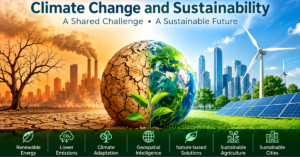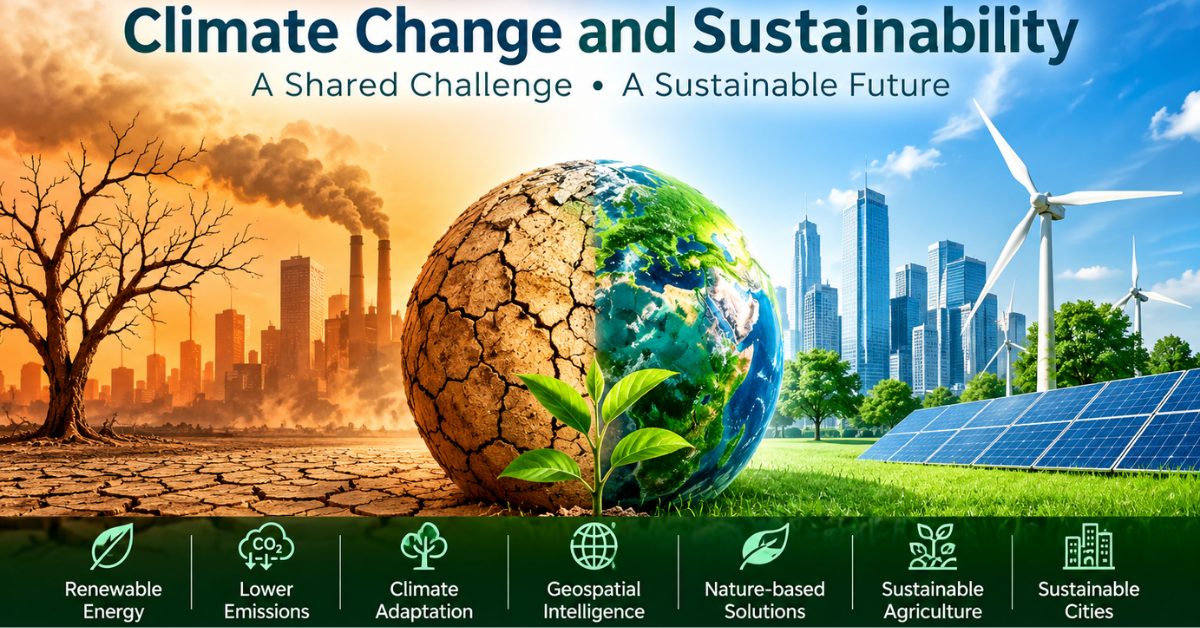
| Quick answer: Climate change and sustainability now sit at the center of economic and policy decision-making. Closing the gap between climate ambition and real-world results requires progress across seven key areas. These include renewable energy, emissions reduction, climate adaptation, geospatial intelligence, nature-based solutions, sustainable agriculture, and resilient cities. |
The World Meteorological Organization’s State of the Global Climate 2025 report confirms that 2015–2025 were the eleven hottest years on record, with 2025 landing around 1.43°C above the pre-industrial baseline, slightly cooler than 2024’s record 1.55°C, but still well within the warmest years ever measured. Full implementation of current national climate pledges would leave the world on track for roughly 2.3–2.5°C of warming by 2100, per UNEP’s Emissions Gap Report 2025. Reaching the 1.5°C pathway now requires cutting global emissions 40% below 2019 levels by 2030. The seven fixes below outline where the clearest, evidence-backed opportunities for progress exist.
The 7 urgent climate change and sustainability solutions
1. Clean Energy Transition replacing fossil fuels with renewable energy sources such as solar and wind, alongside nuclear and other low-carbon power sources.
2. Emissions reduction, cutting greenhouse gases across transport, buildings and industry.
3. Climate adaptation, building resilience against impacts that are already locked in.
4. Geospatial intelligence, using satellite and AI-driven data to target climate action more precisely.
5. Nature-based solutions, protecting and restoring forests, wetlands and oceans.
6. Sustainable agriculture, lowering emissions from food production and cutting food waste.
7. Sustainable cities, decarbonizing urban buildings, transport and infrastructure.
These seven areas are not independent solutions operating in isolation. Renewable energy and emissions reduction directly mitigate climate change. Adaptation measures limit damage from warming that is already locked in. Nature-based solutions can deliver both mitigation and adaptation benefits. Agriculture and cities need sector-specific transformations. Geospatial intelligence provides the data needed to target and monitor these efforts.
How Climate Change and Sustainability Are Connected
Climate change is a specific environmental problem: the long-term rise in global temperature driven mainly by greenhouse gas emissions. Sustainability is a broader framework that meets present economic, social, and environmental needs without compromising future generations. Climate action is a major part of sustainability, but the two are not synonymous. A company may reduce waste and support fair labor while still carrying a heavy carbon footprint.
In practice, climate change has become an urgent sustainability priority. Rising temperatures threaten food systems, water supplies, and ecosystems that support other sustainability goals. That is why the seven solutions in this article sit inside a sustainability frame rather than a narrower emissions-only one.
Why Climate Action Is Becoming More Urgent
Climate action is becoming more urgent because climate indicators continue to worsen even as countries accelerate clean-energy deployment. According to WMO’s State of the Global Climate 2025, 2015–2025 were the eleven hottest years on record, while ocean heat content and sea level reached new highs. The report also tracked Earth’s energy imbalance as a headline indicator for the first time. Its 2024 report confirmed 2024 as the warmest calendar year on record, at 1.55°C above pre-industrial levels.
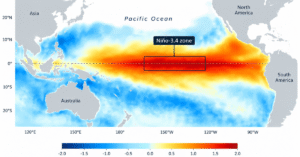
Neither figure alone means the Paris Agreement’s long-term 1.5°C goal has been breached; that threshold uses a multi-decade average. For broader context, see our climate change overview and our coverage of El Niño’s climate impacts.
The gap between current commitments and climate goals
UNEP’s Emissions Gap Report 2025: Off Target, published ahead of COP30, found that full implementation of updated national climate pledges (NDCs) would put the world on a path toward roughly 2.3–2.5°C of warming by 2100, an improvement on the 2.6–2.8°C projected in the 2024 edition of the same report. Continuing under current policies rather than pledges would still mean around 2.8°C.
Staying on a 1.5°C pathway now requires cutting global emissions 40% below 2019 levels by 2030 and 55% by 2035; a 2°C pathway requires 25% and 35% cuts over the same milestones. By the report’s cutoff in September 2025, only about a third of Parties to the Paris Agreement had submitted the stronger pledges due for this cycle, which is why UNEP titled the report “Off Target.”
Why every fraction of a degree matters
The difference between 1.5°C and 2°C of warming is not just a matter of degree; it changes outcomes for entire ecosystems. The IPCC’s Special Report on Global Warming of 1.5°C found that coral reefs would decline by 70–90% at 1.5°C of warming, but that virtually all reefs (over 99%) would be lost at 2°C. The same report found the likelihood of an ice-free Arctic summer rises from once per century at 1.5°C to at least once per decade at 2°C. Sea level rise, heat extremes and flooding all scale unevenly with temperature, so relatively small increases in warming produce disproportionately larger impacts.
On the economic side, Swiss Re Institute estimates that on the current emissions trajectory, the world could lose 11–14% of global GDP by 2050 compared with a world without climate change, rising to as much as 18% in a severe, no-mitigation scenario, which is part of why the seven fixes below are treated as urgent rather than optional.
Solution 1: Renewable Energy for Climate Change and Sustainability
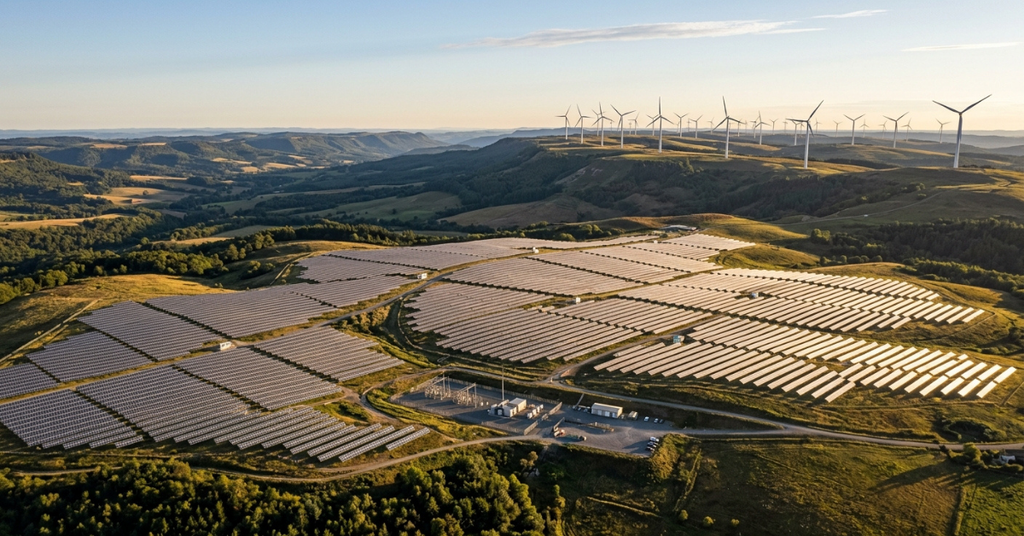
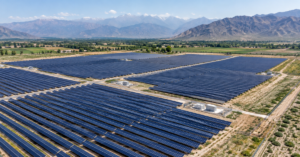
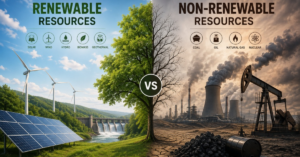
Accelerating the transition to clean energy cuts emissions by replacing fossil-fuel power with renewable sources such as solar and wind, alongside nuclear and other low-carbon energy sources. It also supports the electrification of transport and heating.
What the evidence shows
According to the International Energy Agency’s Global Energy Review 2025, five clean technologies, solar PV, wind power, nuclear power, electric cars, and heat pumps—have prevented about 2.6 billion tonnes of CO2 emissions every year, roughly 7% of global energy-related emissions. Global energy-related CO2 emissions still reached a record 37.8 billion tonnes in 2024, so this progress has slowed emissions growth rather than reversed it. Clean energy investment has continued to climb over the past several years. Organizations can track exactly where that shift is happening in their own footprint using our climate, ESG and sustainability intelligence services.
What needs to happen next
- Expand renewable electricity generation and grid capacity
- Scale up energy storage to manage variable supply
- Retire fossil fuel capacity on a schedule aligned with new supply coming online
- Electrify transport and building heating where feasible
- Reduce methane leakage from oil and gas operations
- Pair renewable deployment with efficiency standards for buildings and appliances
| Key takeaway: Clean energy technologies are already avoiding billions of tonnes of emissions annually, but fossil fuel replacement needs to accelerate substantially to bend the global emissions curve downward, not just slow its rise. |
Solution 2: Cut Greenhouse Gas Emissions
Cutting greenhouse gas emissions requires lower energy use, greater efficiency, and a phaseout of fossil fuels across all sectors. Transport alone accounts for roughly a quarter of global energy-related CO2 emissions, according to IEA data, with road vehicles responsible for the large majority of that total, which is why electrification and efficiency standards for cars, vans and trucks carry so much weight in emissions strategies.
Transport and buildings
Electrifying vehicles and improving building efficiency are among the most direct levers governments and companies have available.Countries that combine carbon pricing with efficiency standards and public transit investment often achieve faster emissions reductions than those using a single policy. However, results depend on the local energy mix and enforcement.
Hard-to-abate industries
Steel, cement, shipping and aviation are harder to decarbonize because there is no simple electricity substitute for their core processes. Experts increasingly use carbon capture, utilization and storage (CCUS) and carbon dioxide removal (CDR) for specific sectors. These technologies should complement, not replace, emissions cuts elsewhere. Modelling this kind of sector-specific risk is part of what our risk analytics and decision intelligence work supports.
Key takeaway: Emissions cuts have to happen across transport, buildings and heavy industry at the same time. No single sector or technology can close the gap alone.
Solution 3: Invest in Climate Adaptation for Climate Change and Sustainability
Climate adaptation reduces harm from warming that is already locked in. It strengthens infrastructure, institutions, and early warning systems to help people and economies withstand climate shocks. This work overlaps closely with disaster risk reduction, since both aim to lower vulnerability before a hazard turns into a disaster.
Adaptation finance
Adaptation is chronically underfunded relative to mitigation, and the newest data makes the gap concrete. UNEP’s Adaptation Gap Report 2025, published just before COP30, estimates that developing countries will need US$310–365 billion a year by 2035 for adaptation, while international public adaptation finance reached only US$26 billion in 2023, down from US$28 billion the year before. Adaptation needs remain 12 to 14 times higher than current funding flows. Current trends also put the Glasgow Climate Pact’s goal of doubling 2019-level adaptation finance by 2025 out of reach.
Early warning systems
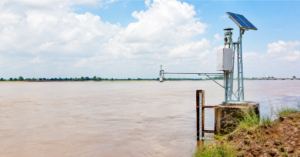
Early warning systems offer high-value adaptation benefits. Modest investments in forecasting and alerts can reduce damage from severe events. The World Meteorological Organization has found that advance warnings can reduce weather-related damage. Development institutions also report that wider early warning coverage could save many lives each year. Our flood monitoring and early warning work applies this directly to flood-prone river systems.
| Key takeaway: Adaptation protects the people and assets already exposed to climate impacts, but the newest UNEP data shows it needs a far larger and faster flow of finance than it currently receives. |
Solution 4: Use Geospatial Intelligence to Target Climate Action
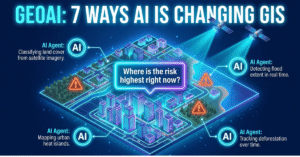
Geospatial intelligence does not reduce emissions on its own. It helps planners identify risk, target investment, and monitor whether adaptation and mitigation projects are actually working, an enabling layer rather than a stand-alone fix.
GIS and satellite monitoring
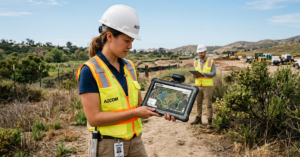
Satellite-based remote sensing and GIS help researchers map flood exposure, track deforestation, and monitor drought across large areas. They also support planning in regions with limited ground-based monitoring. Researchers can combine elevation data, rainfall records, and land-use layers to identify roads, buildings, and communities at risk from rising rivers. This approach helps planners in South Asia, sub-Saharan Africa, and small island states make better adaptation investment decisions. Our AI GIS mapping work is built around exactly this kind of data-scarce environment.
AI-powered climate risk analysis
Machine learning models layered on geospatial data can classify land cover, detect change over time, and forecast how risk might shift under different warming scenarios. These tools can produce more consistent risk information in places that previously had very little, though data quality still limits how far model outputs should be trusted without ground-truthing. See how this plays out in our work on AI in disaster management.
| Key takeaway: Geospatial intelligence makes every other fix on this list easier to plan, fund and monitor. It multiplies the impact of adaptation and mitigation spending rather than replacing it. |
Solution 5: Nature-Based Solutions for Climate Change and Sustainability
Nature-based solutions (NbS) use healthy ecosystems, forests, wetlands, soils and oceans to absorb carbon, reduce climate impacts and support biodiversity at the same time. They complement rapid decarbonization rather than substitute for it. Our environmental sustainability work focuses on this intersection of ecosystem protection and measurable climate outcomes.
Forests, wetlands and oceans

Forests, wetlands and oceans collectively absorb a large share of human CO2 emissions each year, though the exact proportion varies by estimate and by which sinks are counted. Protecting existing tropical forests avoids releasing carbon that is difficult to recapture once lost, while restoring peatlands and mangroves can reduce flood risk for downstream communities as a secondary benefit. UNEP’s State of Finance for Nature 2026 report puts a precise number on the funding gap: in 2023, only about US$220 billion supported nature-based solutions worldwide, against US$7.3 trillion flowing into nature-negative activities — for every dollar invested in protecting nature, roughly $30 was spent on activities that degrade it.
Biodiversity and climate change
Climate change and biodiversity loss reinforce each other: warming and shifting rainfall patterns destroy habitat, while the loss of healthy ecosystems weakens the natural carbon sinks that help regulate the climate system. Treating the two as separate problems tends to produce weaker outcomes on both fronts.
| Key takeaway: Protecting and restoring ecosystems delivers real climate benefits, but effectiveness depends on location, ecosystem condition and long-term management. NbS works best alongside emissions cuts, not instead of them. |
Solution 6: Transform Food and Agriculture Systems
Transforming food systems lowers emissions from livestock, fertilizer use and land clearing, while also cutting the food waste that adds emissions without producing any food. Precision agriculture is one of the more practical entry points for farmers and agribusinesses trying to act on this.
Sustainable agriculture
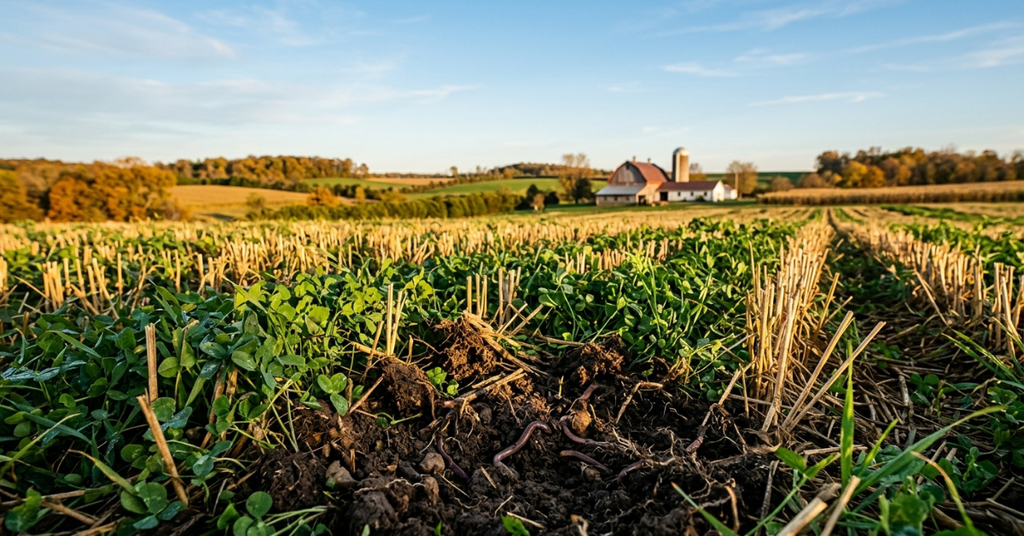
Agriculture contributes a substantial share of global greenhouse gas emissions once land-use change, farming, processing and transport are all counted, though estimates of the exact share vary by methodology. Regenerative practices, cover cropping, reduced tillage, agroforestry can help sequester carbon in soil, though how durable that sequestration is depends heavily on how the land is managed afterward.
Food waste and dietary emissions
Food waste adds emissions without producing any food, making it one of the more straightforward reduction opportunities in the system. Shifting toward lower-meat diets in high-income countries is often cited as one of the higher-impact individual actions available, though the size of the effect depends on which foods are being replaced and by what.
| Key takeaway: Food-system emissions come from several distinct sources, production, land use and waste, so effective strategies usually combine changes across all three rather than focusing on just one. |
Solution 7: Climate-Resilient Cities for Climate Change and Sustainability
Cities are major sources of greenhouse gas emissions and also some of the most effective places to implement climate policy quickly, because dense infrastructure and transport networks concentrate the impact of any single change.
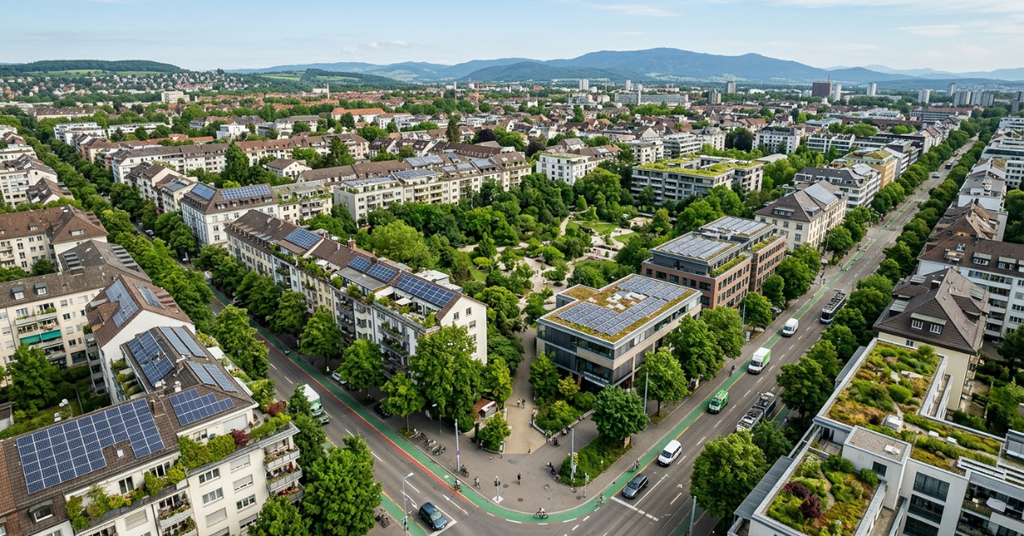
Buildings and transport
Building energy efficiency retrofits, electrified heating and cooling, and expanded public transit, cycling and walking infrastructure are the core levers most sustainable city strategies rely on. Cities that have paired these measures with sustained, multi-year investment have generally seen the clearest emissions and air-quality gains, though results vary widely by starting infrastructure, funding and local political continuity.
Urban resilience and green infrastructure
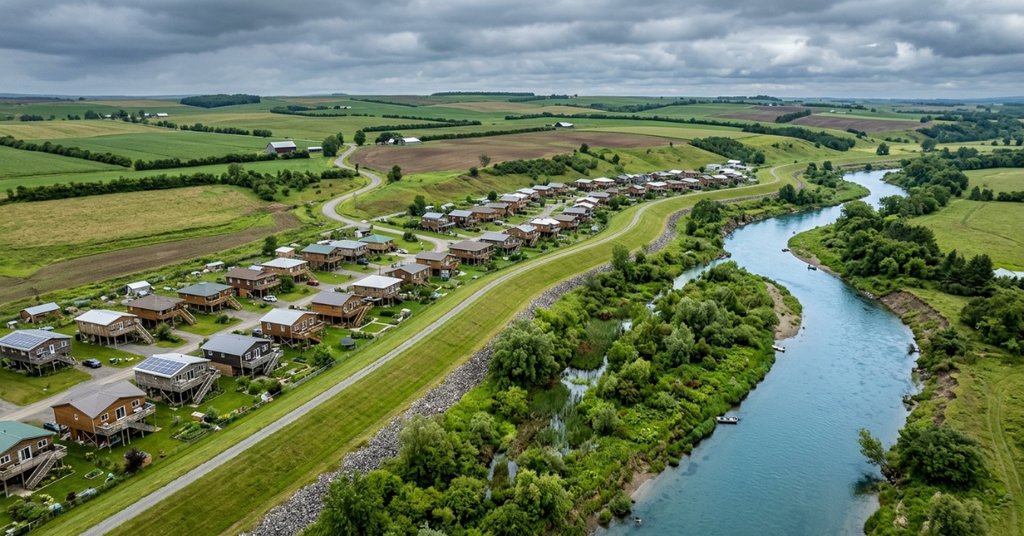
Urban green space, permeable surfaces and updated stormwater systems help cities manage heat and flooding risk as the climate changes, in addition to their role in cutting emissions. Programs that combine this kind of infrastructure planning with public communication tend to get better uptake than technical fixes rolled out without explanation.
| Key takeaway: City-level action can move faster than national policy, but the strongest results come from pairing decarbonization with resilience measures rather than treating them separately. |
Which Climate Solutions Should Be Prioritized?
Not all seven fixes carry equal weight, and treating them as interchangeable understates how climate strategy actually works. A practical rough order, though real-world sequencing depends heavily on a country’s or organization’s starting point, looks like this:
- Rapid emissions reduction and the clean-energy transition (Solutions 1 and 2), the direct mitigation levers that determine how much warming happens in the first place.
- Adaptation for already-exposed communities (Solution 3), protecting people and assets against impacts that are locked in regardless of future mitigation.
- Nature protection and restoration (Solution 5), which can deliver mitigation, adaptation and biodiversity benefits together when appropriately designed and maintained.
- Food and agriculture transformation (Solution 6), a sector-specific opportunity that also touches food security and land use.
- Resilient cities (Solution 7), where dense infrastructure lets a single policy change reach the most people.
- Geospatial intelligence (Solution 4), not a mitigation or adaptation action in itself, but the data infrastructure that makes the other five easier to target, fund and verify.
What Can Organizations Do for Climate Change and Sustainability?
Climate action is not limited to governments. Organizations and individuals can also contribute through measurable changes in energy use, transport, food systems, climate-risk planning, and investment decisions.
Corporate climate action
Companies whose climate commitments hold up to scrutiny generally set emissions targets aligned with a recognized science-based framework, measure supply chain (Scope 3) emissions, which can represent a large share of total corporate footprint, and report progress against third-party verified standards rather than self-reported figures. Thousands of companies globally have already committed to science-based targets through the Science Based Targets initiative, though the gap between announcing a target and delivering audited results remains wide for many of them. Organizations working through that gap can draw on our ESG consulting services.
Individual actions
At the individual level, the actions with the clearest evidence behind them are reducing energy use at home, shifting toward lower-carbon transport where practical, and moving toward a more plant-forward diet. None of these substitute for policy change, but they compound when adopted widely.
Climate justice
Communities that have contributed least to historical emissions often face some of the greatest climate risks. They also have the least access to adaptation finance. This is especially true across the Sahel. Any credible sustainability strategy needs to address this imbalance directly. It should respect Indigenous land rights and direct finance to areas where climate risk is highest, rather than where funding is easiest to deploy.
7 Climate Change and Sustainability Solutions at a Glance
| Solution | Main climate benefit | Key actions | Who should act |
| 1. Renewable energy | Mitigation, displaces fossil power | Expand grid capacity, storage, efficiency standards | Utilities, governments, heavy energy users |
| 2. Emissions reduction | Mitigation, cuts across sectors | Electrify transport and buildings, target hard-to-abate industry | Policymakers, manufacturers |
| 3. Climate adaptation | Resilience, limits harm already locked in | Early warning systems, resilient infrastructure | Governments, disaster management agencies |
| 4. Geospatial intelligence | Enabling, targets and verifies action | Satellite monitoring, AI risk modelling | Planners, NGOs, development finance institutions |
| 5. Nature-based solutions | Mitigation, adaptation and biodiversity | Protect and restore forests, wetlands, oceans | Conservation groups, land managers |
| 6. Sustainable agriculture | Mitigation, food-system emissions | Regenerative practices, cut food waste | Farmers, agribusiness, food companies |
| 7. Sustainable cities | Mitigation and resilience at scale | Building retrofits, transit, green infrastructure | City governments, urban planners |
Key Takeaways
- Mitigation and adaptation have to run in parallel, not in sequence: cutting emissions determines how much warming ultimately happens, but adaptation is what protects the people already exposed to today’s impacts while that transition plays out.
- The newest UNEP data (2025) shows implementation, not ambition, is increasingly the binding constraint: pledges alone have narrowed the projected warming range to 2.3–2.5°C, but only about a third of countries had filed the stronger NDCs due this cycle.
- Climate finance remains the biggest bottleneck across every solution: adaptation finance needs are 12 to 14 times current flows, the 2025 Glasgow adaptation finance target has already been missed, and nature-based solutions attract roughly $1 for every $30 spent on nature-degrading activity.
- Geospatial intelligence does not cut emissions itself, but it changes how efficiently every other solution gets targeted, funded and verified, which is why it functions as an enabling layer rather than a competing solution.
- Climate justice is not a separate track: the communities facing the highest physical risk are consistently the ones with the least access to adaptation finance, which should shape how every one of these seven solutions gets funded.
Conclusion
Climate change and sustainability are not problems the world fails to recognize. The science is clear, the economic risks are growing, and many of the technologies needed for action already exist. The real challenge is speed. Delayed action means deeper emissions cuts later, greater climate risks, higher adaptation costs, and more pressure on ecosystems and communities.
The seven solutions in this article are practical and scalable when supported by effective policies, sustained investment, and better decision-making. Renewable energy, emissions reduction, adaptation, geospatial intelligence, nature protection, sustainable agriculture, and resilient cities must advance together rather than in isolation.
For organizations developing climate strategies, sustainability plans, or climate-risk assessments, geospatial intelligence can strengthen the evidence behind critical decisions. AI Geo Navigators provides spatial intelligence solutions ranging from satellite-based climate monitoring to risk analytics and decision intelligence.
Every year of delay makes climate action harder and more costly. The time to act is now.
FAQs
What is the difference between climate change and sustainability?
Climate change refers to long-term shifts in global temperature and weather patterns driven mainly by greenhouse gas emissions. Sustainability is the broader goal of meeting present needs without compromising future generations’ ability to meet their own. Climate action is the most urgent piece of that broader agenda, because runaway warming threatens the ecological foundations every other sustainability goal depends on.
How can we slow climate change?
Slowing climate change means cutting emissions faster than current pledges allow, primarily by scaling renewable energy, electrifying transport and buildings, cutting methane, and protecting the forests and ecosystems that absorb carbon. No credible plan claims climate change can simply be stopped; the realistic goal is to limit and slow further warming while adapting to the impacts already underway.
What are the biggest solutions to climate change?
The highest-impact solutions are the direct mitigation levers: replacing fossil fuels with renewable energy and cutting emissions across transport, buildings and industry. These are supported by climate adaptation, nature-based solutions, sustainable agriculture, resilient cities, and geospatial intelligence as the data layer that helps target all of the above. No single solution is sufficient on its own; the fastest progress comes from advancing several at once.
What are the seven major climate change and sustainability solutions?
The seven solutions covered here are renewable energy, emissions reduction, climate adaptation, geospatial intelligence, nature-based solutions, sustainable agriculture, and sustainable cities.
What is the difference between climate mitigation and adaptation?
Mitigation means reducing or preventing greenhouse gas emissions, for example by switching to renewable energy. Adaptation means adjusting systems and infrastructure to cope with climate impacts that are already happening or unavoidable, such as flood defenses or early warning systems. Effective climate strategy needs both.
How does GIS help address climate change?
Geographic information systems combine satellite imagery, sensor data and mapping tools to show where climate risks such as flooding, drought or heat stress are concentrated. This doesn’t reduce emissions directly, but it helps governments and organizations target adaptation investment, monitor whether projects are working, and plan more precisely in places where ground data has historically been limited.
Are nature-based solutions effective for climate change?
Yes, when they’re well-designed and properly maintained. Forests, wetlands and healthy soils can absorb meaningful amounts of carbon and deliver biodiversity and water benefits at the same time. Their effectiveness depends heavily on local ecosystem condition, long-term management and permanence, and they work best alongside rapid decarbonization rather than as a replacement for it.
What can businesses do about climate change and sustainability?
Businesses can set emissions targets aligned with recognized science-based frameworks, measure and reduce supply chain emissions, integrate physical climate risk into planning and investment decisions, and report progress transparently against recognized disclosure frameworks rather than relying on self-reported claims.
Sources
UN Environment Programme, Emissions Gap Report 2025: Off Target and Emissions Gap Report 2024
UN Environment Programme, Adaptation Gap Report 2025: Running on Empty
UN Environment Programme, State of Finance for Nature 2026
International Energy Agency, Global Energy Review 2025
Intergovernmental Panel on Climate Change, Special Report on Global Warming of 1.5°C
Swiss Re Institute, The Economics of Climate Change
UN Food and Agriculture Organization, Greenhouse Gas Emissions from Agrifood Systems, 2001–2023
Science Based Targets initiative (SBTi), corporate target commitment data
World Bank, early warning systems and disaster risk research