| Quick answer: Water tanks for rainwater harvesting store collected rain until it is needed, and the right choice depends on three things: material, placement, and capacity. Polyethylene tanks suit most homes, underground tanks suit tight spaces, and capacity should match local rainfall, not a generic estimate. |
Every rainwater harvesting system comes down to one key decision: how to store the water once it leaves the roof. The tank you choose directly affects how much water you can store, how long it remains usable, and how reliable your system is.
Selecting the right water tank for rainwater harvesting depends on three main factors: material, placement, and capacity. If these factors are chosen correctly, your system becomes efficient, cost-effective, and long-lasting. If they are not chosen correctly, even a well-designed setup can fail within a short time.
This guide focuses specifically on water tanks for rainwater harvesting, materials, placement, sizing, and what most buyers get wrong before they purchase. If you are still deciding whether rainwater harvesting is right for your property, our rainwater harvesting guide covers the full picture, including water scarcity context and system types. If you already know your tank choice and need help with the physical setup, our installation guide walks through every step from gutters to overflow pipe.
What makes a good rainwater harvesting tank?
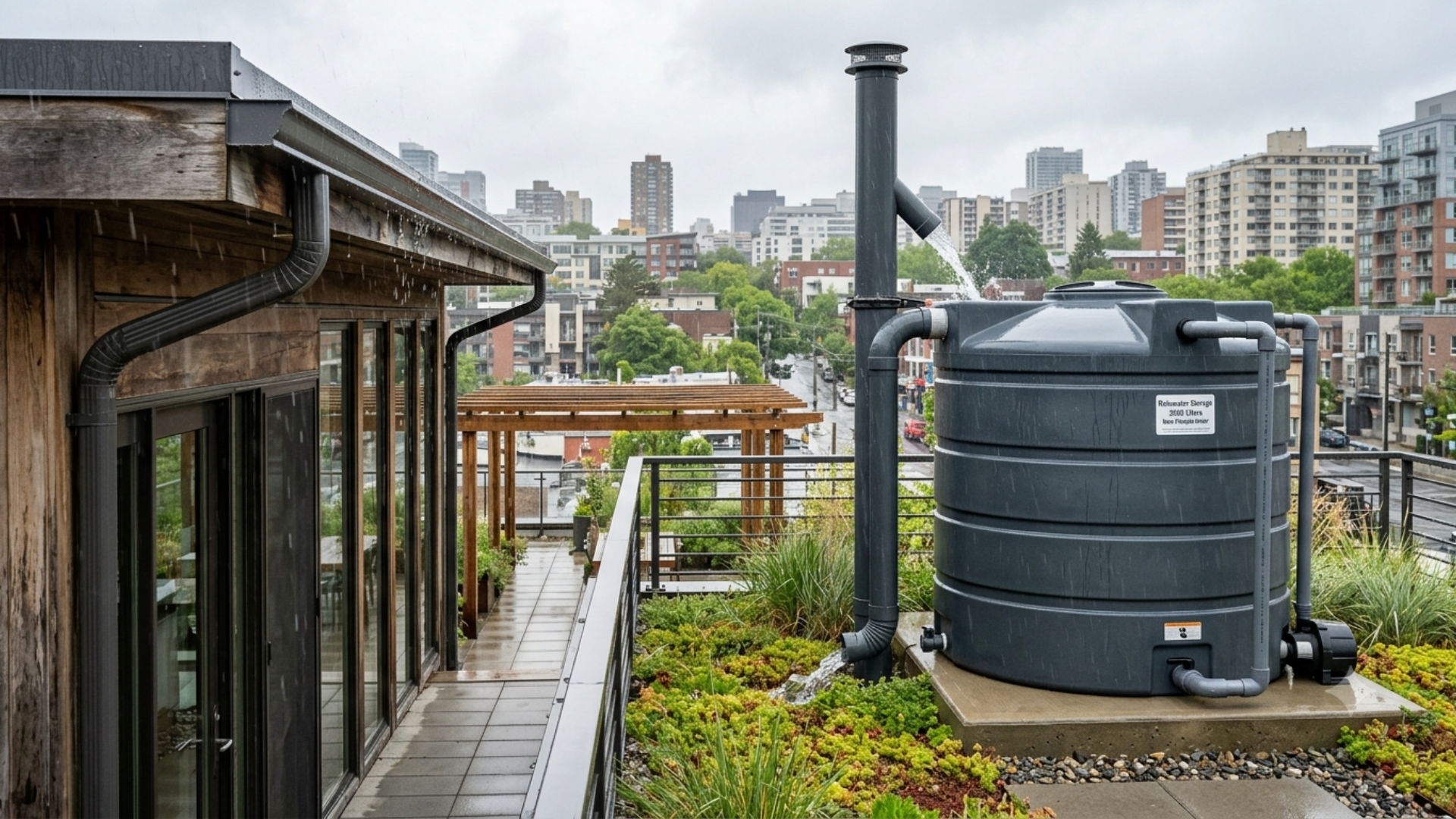
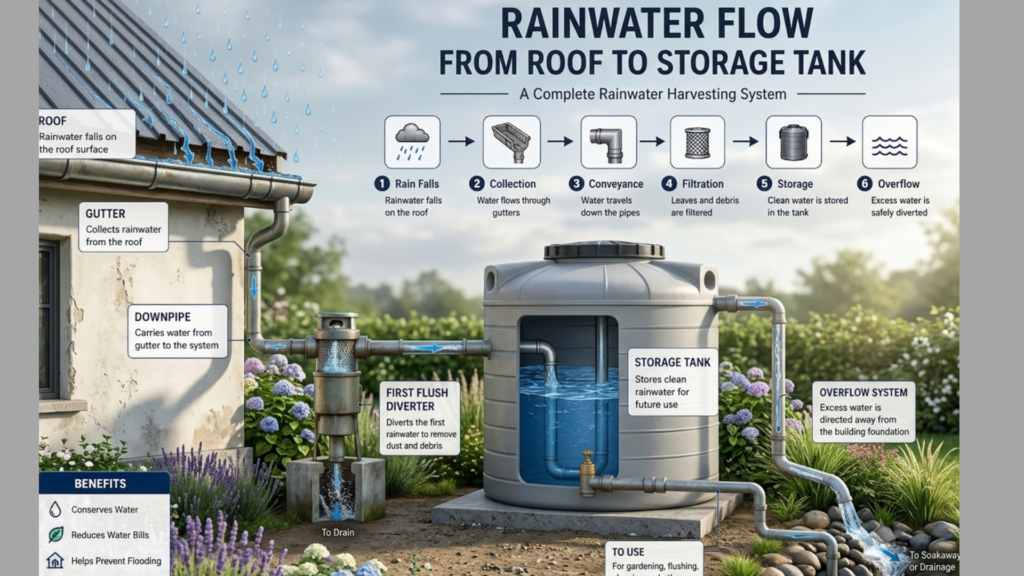
A good tank does three jobs well. Effective water tanks for rainwater harvesting store water safely without leaking or degrading. It blocks light and contamination to prevent algae growth. It also includes a proper overflow outlet, allowing excess water to drain safely away from the building foundation.
Before comparing brands or prices, consider the same three factors that professional installers use. These are security of supply, household water demand, and the intended purpose of the stored water. For example, the water may be used for garden irrigation, toilet flushing, or drinking.
Which tank material should you choose?
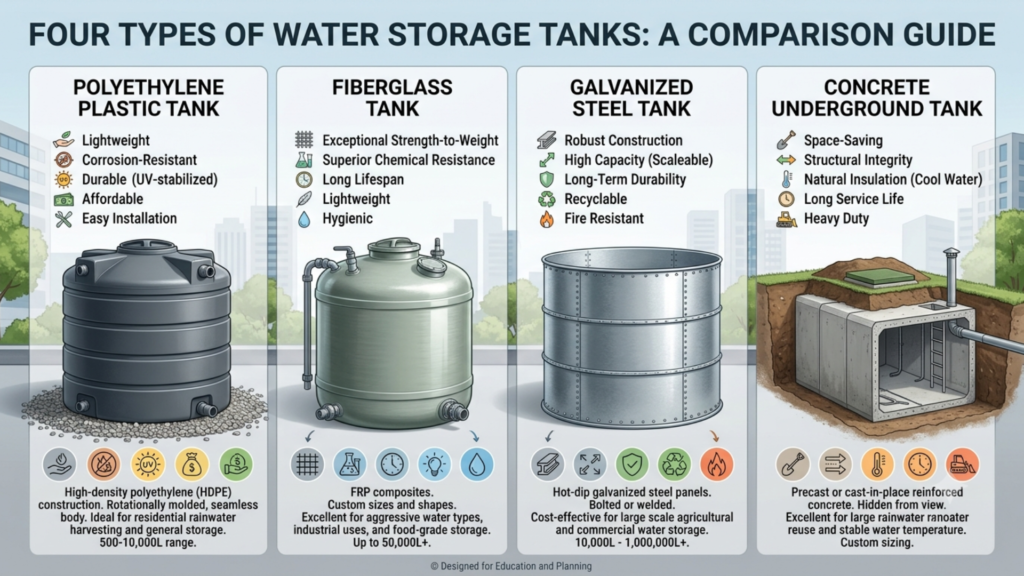
The material of your water tanks for rainwater harvesting affects its cost, lifespan, and overall performance. Here is an honest ranking based on what actually matters for most buyers, not just what manufacturers prefer to highlight.
| Material | Best for | Lifespan | Relative cost |
| Polyethylene (plastic) | Most homes, easy transport | 15 to 20 years | Low |
| Fiberglass | Larger above- or below-ground tanks | 20 plus years | Moderate |
| Galvanized steel | Very large capacity needs | 20 plus years | Moderate to high |
| Concrete | Permanent underground installs | 25 plus years | High |
Why polyethylene wins for most buyers
In a survey of installers run by the American Rainwater Catchment Systems Association, polyethylene water tanks for rainwater harvesting are the most preferred choice for most homeowners. This is mainly because they are lightweight and affordable. They are also easy to find in almost any size. The trade-off is that dark colored plastic tanks absorb heat, so a light or UV-treated finish matters in hot climates.
When metal or concrete makes more sense
Galvanized steel handles the largest volumes, often beyond 20,000 gallons, which makes it the right call for farms or commercial sites. If you are managing water storage specifically for crop irrigation or agricultural use in Pakistan, see our rainwater harvesting for agriculture in Pakistan guide for farm-specific tank and pond considerations
Above-ground or underground, which tank placement fits your site?
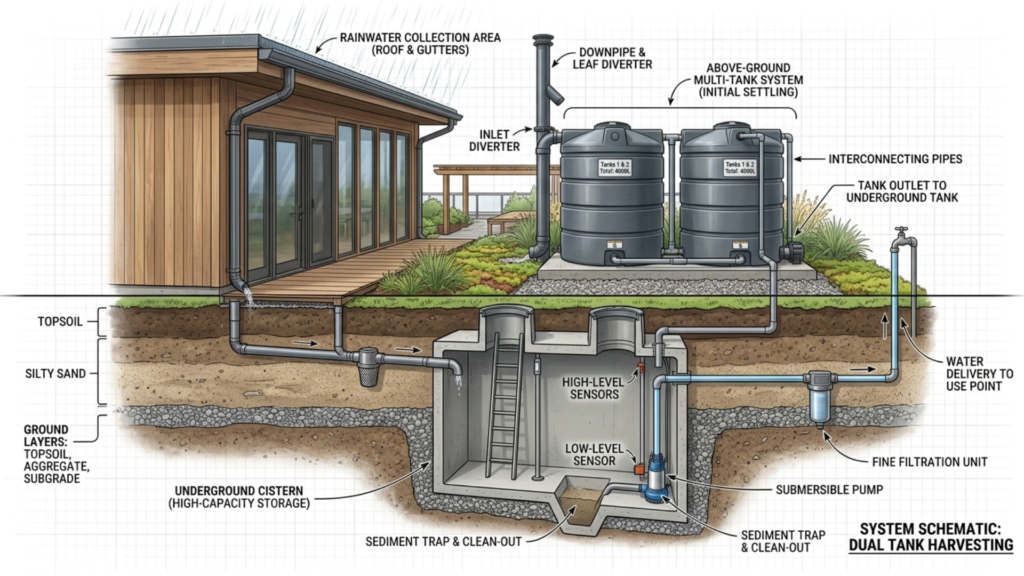
Choosing where to install your water tanks for rainwater harvesting usually comes down to space, climate, and site conditions. And what lies beneath your property, more than personal preference.
• Above-ground tanks cost less to install and are easier to inspect, but take up visible yard space and are more exposed to temperature swings
• Underground tanks save space and stay cooler, which reduces algae growth, but cost more due to excavation
• A high water table can prevent a tank from being buried deep enough, sometimes requiring a more expensive shallow dig design
• Rocky or hard terrain raises underground installation cost significantly, which should be checked before committing to a buried tank
As a result, anyone with a small urban plot often defaults to underground storage, while rural properties with open land usually find above-ground tanks far more cost-effective.
What accessories and fittings does a rainwater tank need?
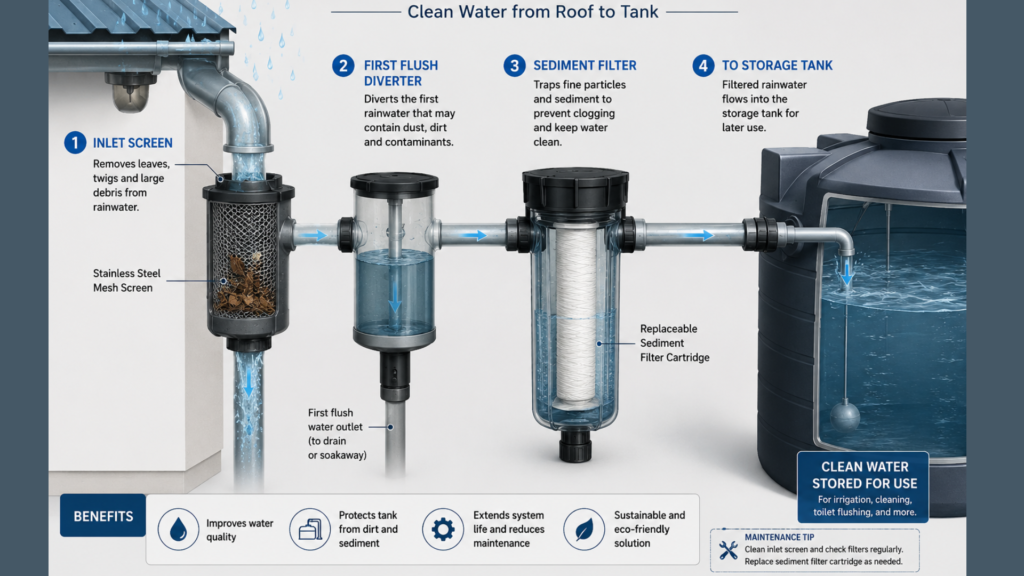
Water tanks for rainwater harvesting cannot function efficiently without the right fittings. Every functioning setup needs five fittings working together, and skipping any one of them shortens the tank’s life or lets in contamination.
• Inlet strainer, fitted where water enters the top of the tank to block leaves and insects
• Outlet valve, usually a ball valve near the bottom connected through a flexible rubber hose to absorb shock and ground movement
• Overflow outlet with a mosquito-proof screen, sized to match your roof area so excess water drains away cleanly during heavy rain
• Vent, which prevents a vacuum from forming inside the tank during a downpour
• Inspection or service port, a wide opening at the top that allows access for cleaning and repairs
According to Texas A&M’s rainwater harvesting guidelines, the outlet should sit at least 4 inches above the tank floor, since drawing water from the very bottom pulls up settled sediment along with it.
If the tank will feed taps, toilets, or irrigation lines under pressure, add a pump with a weatherproof cover. For overflow sizing specifically, installers generally use a 3-inch outlet for roofs under 1,000 square feet and a 4-inch outlet for anything larger, since a wider pipe clears heavy rainfall faster without backing up.
How do you size a rainwater harvesting tank correctly?
Tank size should never be a guess. The starting formula is the same one used for sizing the whole system: roof area multiplied by local rainfall multiplied by a 0.623 conversion factor multiplied by system efficiency.
However, sizing only on yearly rainfall total is a common mistake. A tank also needs enough capacity to bridge the longest expected dry stretch between rain events, not just store the year’s total volume. This is why two homes with identical roofs but different rainfall patterns can need very different tank sizes.
A simple rule of thumb by use case
• Garden watering only: a barrel or small tank, often under 500 litres, is usually enough
• Indoor non-potable use such as toilet flushing: a mid-size tank in the low thousands of litres
• Sole water supply for a household: a larger tank, generally above 30,000 litres, to reduce the risk of running dry
Where and how should you place your tank?
Placement affects both performance and safety, so it deserves the same attention as material choice.
• Set the tank on a level, compacted base such as gravel or a concrete pad to prevent it tilting or cracking once full
• Keep at least some clearance from the building foundation so overflow water cannot pool against the walls
• Position the tank as close to the downpipe as practical, since longer conveyance runs lose pressure and collect more sediment
• Check local building codes before installing a large or underground tank, since many regions require a permit once capacity passes a certain threshold
A full tank is far heavier than it looks. A 1,000-gallon tank holds roughly four metric tons of water, so the base beneath it must be rated to carry that load without settling unevenly over time.
How do you maintain a rainwater harvesting tank?
• Inspect the tank twice a year for cracks, leaks, or signs of algae growth
• Clean inlet and overflow screens every few months to prevent clogging
• Check fittings on metal tanks regularly, since they are more prone to leaking over time than plastic seams
• Repaint or reseal concrete or wood tanks as needed to prevent water loss through the material itself
Clark Tanks recommends a full internal clean every three years at minimum, more often if the water is used for drinking, since sediment builds up at the base even with good screening.
In fact, most tank failures trace back to skipped inspections rather than a flawed material choice, which makes a simple twice-yearly check the single highest-value maintenance habit.
How does AI Geo Navigators help you choose the right tank?
Choosing the right water tanks for rainwater harvesting starts with accurate local rainfall data, not a generic regional average. AI Geo Navigators uses its hazard and precipitation portal to show district-level rainfall intensity, which helps determine whether a smaller tank with frequent refills or a larger tank built for longer dry spells makes more sense for your exact location.
Through its mapping and visualization services, the team can also help commercial or farm-scale projects visualize catchment area against rainfall potential before committing to an expensive large-capacity tank.
For the full step-by-step setup process, see our how to install a rainwater harvesting system guide. For agricultural water storage applications in Pakistan, including check dams, farm ponds, and irrigation tanks, see our rainwater harvesting for agriculture in Pakistan guide. For the broader water scarcity context this fits into, see our rainwater harvesting pillar article
Key takeaways
• Polyethylene suits most households, while steel and concrete suit large-scale or potable water projects
• Above-ground tanks cost less to install; underground tanks save space but cost more
• Tank size should match dry-spell length, not just total annual rainfall
• Most tank failures come from skipped maintenance, not bad material choices
• Local rainfall data, not generic averages, should guide your final tank size
Conclusion
The right water tanks for rainwater harvesting are not the biggest or the most expensive ones. They are the ones that match your roof size, local climate, rainfall pattern, and actual water needs. Choosing the right material, capacity, and placement from the start improves water security, reduces maintenance, and maximizes the value of your system for years to come.
Before making a purchase, confirm your local rainfall pattern and the length of your area’s typical dry spells rather than relying on regional averages. AI Geo Navigators provides accurate rainfall data and mapping insights through its Climate Risk Adaptation and Early Warning System to help you choose the right tank size with confidence, ensuring your rainwater harvesting system performs efficiently over the long term.
FAQs
What is the best material for water tanks for rainwater harvesting?
Polyethylene is the best fit for most households because it is affordable, lightweight, and available in a wide range of sizes. Concrete or steel makes more sense for very large-capacity or potable water needs.
How big should my rainwater harvesting tank be?
Tank size depends on your roof area, local rainfall, and intended use. A garden-only setup may need only a few hundred litres, while a household relying on rainwater as its sole supply often needs tens of thousands of litres.
Should I choose an above-ground or underground tank?
Choose underground if space is limited or you want to keep your yard clear. Choose above-ground if you want lower installation cost and easier access for inspection and maintenance.