1. Introduction
Gilgit-Baltistan, situated in the northernmost region of Pakistan, is characterized by some of the world’s highest mountain ranges, including parts of the Himalayas, Karakoram, and Hindu Kush. The region’s mountainous terrain is home to extensive glaciers, which have historically acted as natural reservoirs, regulating water flow throughout the year. These glaciers feed rivers and streams that support agriculture, livestock rearing, and domestic water supply in valleys such as Hunza, Skardu, Ghizer, Nagar, and Ghanche. The livelihoods of hundreds of thousands of people in Gilgit-Baltistan are directly linked to the availability of glacier-fed water.
However, over the past few decades, climate change has begun to dramatically alter this delicate hydrological balance. Rising temperatures have accelerated glacier retreat, reduced snow accumulation, and caused earlier snowmelt. While total annual water availability may not have declined drastically, the seasonal distribution of water has shifted, creating periods of scarcity, particularly in the spring and early summer when agricultural demand is at its peak. Communities that traditionally relied on predictable meltwater now face shortages, leading to delayed sowing, lower crop yields, and heightened food insecurity.
In addition to climate change, other factors such as population growth, unsustainable water use, and limited water storage infrastructure exacerbate the water crisis. Traditional reservoirs or dams are often infeasible due to rugged terrain, high construction costs, and environmental concerns. This situation calls for innovative, low-cost, locally adaptable, and climate-resilient solutions to address water scarcity while supporting livelihoods.
One such solution is the Ice Stupa, a man-made cone-shaped ice structure designed to store winter water as ice and release it gradually in the spring. Originating in Ladakh, India, Ice Stupas are now gaining attention in other high-altitude regions, including Gilgit-Baltistan. They represent a practical, energy-efficient, and community-driven adaptation strategy that addresses both water scarcity and climate change vulnerability.
By capturing excess winter water and storing it in frozen form, Ice Stupas bridge the seasonal water gap without the need for electricity, complex machinery, or large-scale infrastructure. They also serve as a tool for community engagement, indigenous knowledge integration, and disaster risk reduction, as stable water availability can prevent drought-related crises and agricultural losses.
This article explores the concept, construction, functioning, benefits, challenges, and future potential of Ice Stupas specifically in the context of Gilgit-Baltistan, highlighting their significance as a climate-resilient adaptation measure in high-altitude mountain regions.
2. Climate Change and Water Stress in Gilgit-Baltistan
Gilgit-Baltistan is one of the most environmentally sensitive regions of Pakistan. Its glaciers, river systems, and snow-fed streams have historically supported a fragile but productive high-altitude agricultural economy. Climate change, however, has significantly impacted the region’s hydrology and ecological stability. Rising average temperatures have accelerated glacial retreat across the Karakoram and Himalayan ranges. While the “Karakoram anomaly” means some glaciers in the region are retreating slower than global averages, a majority still show signs of thinning, melting, and volume loss.
The timing of snowmelt and glacier-fed flows is changing, causing a mismatch between water availability and demand. For instance, water is abundant in winter streams but frozen and unusable for irrigation. By contrast, spring and early summer are critical months for sowing wheat, barley, and other staple crops often coincide with water scarcity. Such seasonal discrepancies threaten local food security and agricultural livelihoods, particularly for smallholder farmers who rely entirely on predictable water availability.
In addition to seasonal water stress, the region faces multiple climate-induced hazards. Increased frequency of flash floods, glacial lake outburst floods (GLOFs), landslides, and erosion further exacerbate water management challenges. Traditional irrigation channels, or kuls, are vulnerable to damage during extreme weather events, leading to additional water loss.
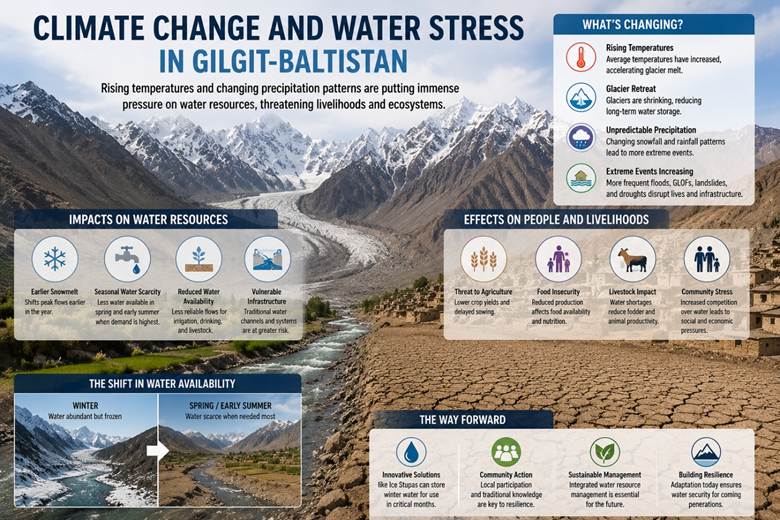
Population growth and expanding settlements in valley floors have also increased water demand. Community increasingly draws from limited streams for domestic use, livestock watering, and crop irrigation. Meanwhile, constructing large-scale reservoirs or dams is challenging due to steep terrain, seismic risk, and high costs. Furthermore, ecological concerns make conventional infrastructure less appealing, as river ecosystems are highly sensitive to human intervention.
Given these challenges, Ice Stupas emerge as an innovative, low-cost, and environmentally friendly solution to climate-induced water stress. By storing winter water as ice, they provide a buffer against seasonal water scarcity, ensuring water availability during spring and early summer. This approach not only supports agriculture but also strengthens community resilience against slow-onset climate risks such as drought, crop failure, and livelihood disruption.
In Gilgit-Baltistan, Ice Stupa adoption can complement existing water management systems. By integrating Ice Stupas with traditional channels, small-scale irrigation systems, and community-based water governance structures, local populations can mitigate the impacts of climate variability while reducing dependency on external interventions. Additionally, footprints align environmental footprint aligns 0with sustainable development and ecological conservation objectives in high-altitude mountain regions.
3. Understanding the Ice Stupa Concept
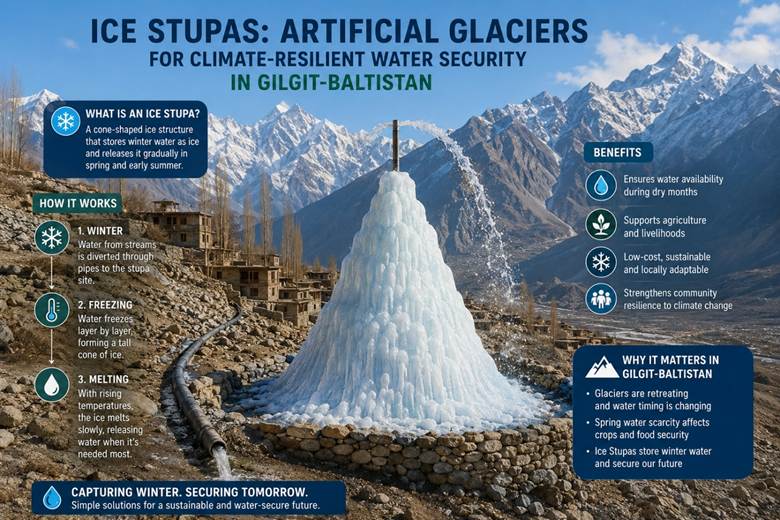
The concept of the Ice Stupa is a brilliant example of combining traditional knowledge, modern engineering, and climate adaptation to address water scarcity in high-altitude regions. Ice Stupas are essentially man-made glaciers, designed to store excess winter water in frozen form and release it gradually during the spring and early summer when natural water availability is limited. Unlike conventional reservoirs, Ice Stupas rely on extremely low winter temperatures to maintain frozen water, making them highly energy-efficient and sustainable.
The term “stupa” comes from the Buddhist architectural structure that features a tall conical or dome-shaped design. The Ice Stupa mimics this shape, which is scientifically efficient for ice retention. The cone structure minimizes surface area exposed to sunlight, slowing down the melting process. Taller ice structures last longer, ensuring water availability throughout the critical pre-monsoon and early summer months.
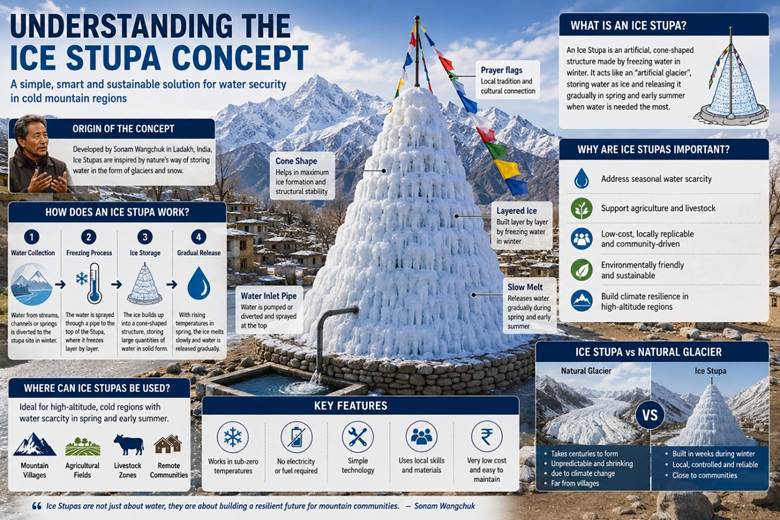
Ice Stupas were first developed in Ladakh, India, by engineer Sonam Wangchuk in 2013. The technology was specifically designed to address water shortages in cold desert regions, where winter water flows from glacial streams remain underutilized. In these regions, agriculture depends heavily on glacier-fed streams, and spring water scarcity poses a major threat to crops. Ice Stupas transform this challenge into an opportunity by capturing winter water and storing it as ice, which gradually melts to irrigate fields.
In the context of Gilgit-Baltistan, the Ice Stupa concept is highly relevant. The region has several glacial streams and rivers flowing through valleys, such as Hunza, Nagar, Ghizer, and Skardu. During winter, these water sources are often inaccessible or frozen, while spring water scarcity affects sowing cycles. By constructing Ice Stupas in strategic locations, communities can harness winter flows, ensuring water availability for early crops like wheat, barley, and vegetables.
An additional benefit of Ice Stupas is their scalability. Structures can be small, serving a single village, or large enough to supply multiple irrigation channels. Moreover, construction does not require electricity or fossil fuels, as water flow is gravity driven. This makes Ice Stupas highly suitable for remote valleys in Gilgit-Baltistan, where access to power and heavy machinery is limited.
Beyond practical water storage, Ice Stupas also have social and environmental benefits. They encourage community participation, as villagers collaborate to plan, construct, and maintain these structures. This strengthens local knowledge-sharing networks and increases resilience to climate change. Environmentally, Ice Stupas have a minimal footprint, unlike dams or reservoirs that disrupt ecosystems. They operate in harmony with natural hydrological cycles, replenishing groundwater and maintaining stream flows.
In conclusion, the Ice Stupa is not just a water storage system; it is a climate adaptation strategy, a community development tool, and an environmentally sustainable solution. In Gilgit-Baltistan, where glaciers are retreating and water scarcity is increasing, Ice Stupas offer a practical, low-cost, and highly effective method to secure water for agriculture and daily life.
4. How Ice Stupas Are Constructed and Function
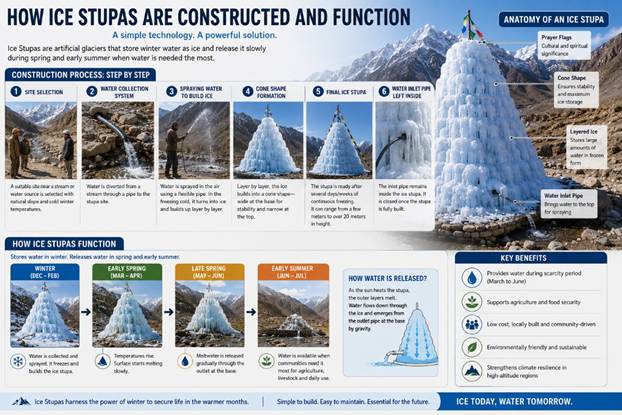
The construction and functioning of an Ice Stupa are based on simple yet highly effective engineering principles, adapted to high-altitude cold regions. Despite its simplicity, the Ice Stupa relies on careful planning, precise site selection, and community engagement to be effective.
4.1 Water Source and Diversion
The first step in building an Ice Stupa is identifying a reliable water source. In Gilgit-Baltistan, glacial streams, winter-fed rivers, or spring channels are ideal. These water sources often remain underutilized in winter due to freezing temperatures. Water is diverted using pipes laid along a gentle slope, which allows gravity to move the water without pumps or electricity. This design ensures energy efficiency, particularly in remote valleys where power access is limited.
4.2 Vertical Spray and Freezing
At the outlet of the pipe, water is sprayed vertically into the air. In sub-zero winter temperatures, this water freezes instantly upon contact with cold air. Layers of ice gradually accumulate, forming a conical structure. The cone shape is scientifically critical; it minimizes surface exposure to sunlight relative to volume, slowing melting and prolonging ice retention.
4.3 Seasonal Growth
Ice Stupas grow continuously throughout the winter. Each new layer of frozen water adds to the overall mass. The height and size of the ice cone can vary depending on water availability, local topography, and community needs. In some Ladakh projects, Ice Stupas have reached heights of 30 meters and stored millions of liters of water. In Gilgit-Baltistan, similar designs can be scaled based on valley size and irrigation requirements.
4.4 Water Release and Irrigation
As temperatures rise in spring, the ice begins to melt slowly. The melting water is directed through channels to fields, gardens, and community storage ponds. This ensures that water is available precisely when crops need it, bridging the gap between winter water abundance and spring scarcity. By releasing water gradually, Ice Stupas prevent wastage and reduce the risk of flooding from sudden glacial melts.
4.5 Community Involvement
One of the strengths of Ice Stupas is that construction and maintenance are community driven. Villagers participate in laying pipes, supervising water flow, and monitoring ice formation. This builds local knowledge and ensures the system remains operational year after year. In Gilgit-Baltistan, where valleys are often remote, this approach reduces dependency on external experts and fosters ownership.
4.6 Technical Considerations
Successful Ice Stupas require careful site selection. They should be located where:
- Water flow is sufficient to sustain ice accumulation
- Winter temperatures remain below freezing for extended periods
- The terrain allows gravity-driven water flow
- Meltwater can be channeled effectively to agricultural lands
Poor planning can result in ice melting too early or insufficient water storage. Therefore, a combination of hydrological assessment, topographical analysis, and local knowledge is essential.
In essence, the Ice Stupa functions as a seasonal water storage system that combines natural freezing processes, simple engineering, and local participation to provide climate-resilient water solutions in high-altitude regions like Gilgit-Baltistan.
5. Importance of the Cone Shape
The cone or pyramid shape of an Ice Stupa is more than an aesthetic choice—it is a scientifically optimized design that maximizes water retention and efficiency. Understanding why this shape works is crucial for planning and constructing Ice Stupas in Gilgit-Baltistan.
5.1 Minimizing Solar Radiation Exposure
One of the primary reasons the cone shape is used is to minimize the surface area exposed to sunlight relative to the volume of ice. In mountainous regions like Gilgit-Baltistan, spring sunlight is intense despite cold ambient temperatures. A flat ice sheet would melt quickly under direct sunlight. A conical structure reduces the amount of ice directly exposed to, prolonging the life of the stored water.
5.2 Enhancing Structural Stability
The conical shape also enhances the structural stability of the Ice Stupa. As the ice grows vertically, the cone ensures that weight is distributed evenly toward the base. This prevents toppling or cracking under the weight of accumulated ice. Taller, narrow structures retain ice longer than wide, flat ones because heat from the surroundings affects the base less than the top.
5.3 Slow, Controlled Melting
The cone shape contributes to gradual water release. The upper layers melt first, feeding the lower ice mass. This process ensures that water is available over several weeks, aligning with the critical agricultural irrigation period in spring. In Gilgit-Baltistan, this gradual release is particularly valuable for crops like wheat, barley, and vegetables, which require sustained water supply.
5.4 Adaptation to Local Conditions
Mountain valleys often experience strong winds, fluctuating temperatures, and uneven sunlight exposure. The conical Ice Stupa reduces the effects of these environmental variables. Its aerodynamic shape minimizes wind erosion of ice and shields lower layers from rapid temperature changes.
5.5 Cultural and Aesthetic Significance
Interestingly, the shape also resonates with local cultural architecture. The resemblance to traditional Buddhist stupas or domed towers makes the technology visually familiar in regions like Gilgit-Baltistan, where many communities have cultural ties with Himalayan Buddhist architecture. This can encourage community acceptance and participation.
5.6 Practical Examples
In Ladakh, Ice Stupas have reached heights of 20–30 meters and stored millions of liters of water. By applying similar designs in valleys of Gilgit-Baltistan, ice structures can be customized according to water availability, terrain, and community needs. Smaller villages may build Ice Stupas of 5–10 meters, while larger irrigation systems may benefit from taller structures.
In conclusion, the cone shape is essential to the functionality and longevity of Ice Stupas. It maximizes ice retention, ensures controlled melting, enhances stability, and aligns with local environmental and cultural contexts. This makes it particularly suitable for mountain regions such as Gilgit-Baltistan, where both climatic and social factors influence the success of adaptation strategies.
6. Benefits of Ice Stupas for Gilgit-Baltistan
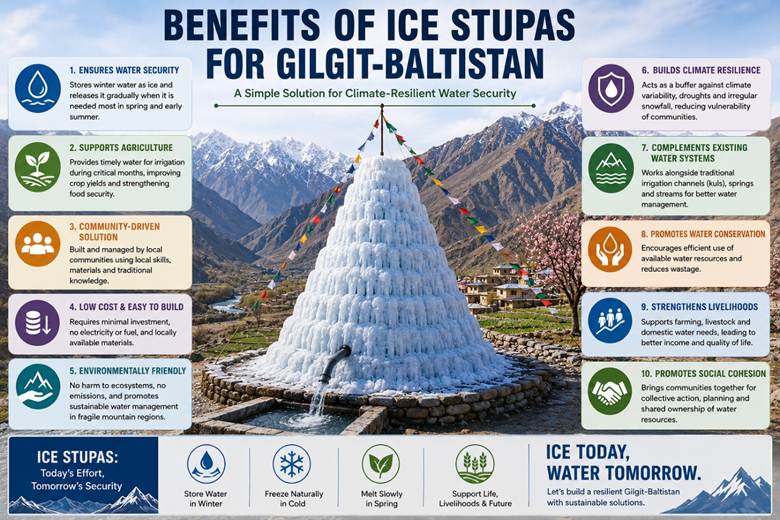
Ice Stupas offer multiple benefits for high-altitude regions, particularly Gilgit-Baltistan, where communities face water scarcity, unpredictable climate patterns, and limited infrastructure. These benefits are multifaceted, spanning water security, agriculture, community resilience, environmental sustainability, and climate adaptation.
6.1 Enhancing Water Security
The primary benefit of Ice Stupas is their role in stabilizing water availability. In Gilgit-Baltistan, winter flows from glacial streams remain largely untapped, while spring irrigation demands are high. Ice Stupas capture winter water and store it in frozen form, releasing it gradually when needed. This ensures that farmers have access to water during sowing and early crop growth stages, reducing the risk of drought and crop failure.
Unlike traditional reservoirs, Ice Stupas do not require complex infrastructure or energy inputs. Gravity-driven flow systems transport water from source streams to Ice Stupa locations, making the technology highly feasible for remote valleys, such as Hunza, Ghizer, and Nagar. The slow melting process further ensures minimal wastage and efficient distribution.
6.2 Supporting Climate-Resilient Agriculture
Access to early-season irrigation allows farmers to sow crops on time, a critical factor for agricultural productivity. Wheat, barley, and vegetables depend on consistent water supply during early growth stages. By providing water during periods of natural scarcity, Ice Stupas increase crop yields and support livelihood stability in mountain communities.
Moreover, Ice Stupas help communities adapt to climate-induced changes in water availability. As glaciers retreat and snowmelt timing shifts, farmers can rely on Ice Stupas as a supplementary water source, bridging the gap created by changing hydrological patterns. This makes technology an integral part of climate-resilient agricultural planning in Gilgit-Baltistan.
6.3 Low-Cost and Sustainable Technology
The construction of Ice Stupas is financially accessible to local communities. Unlike large dams or reservoirs, Ice Stupas require minimal investment in materials, mainly pipes, valves, and water diversion infrastructure. They do not rely on electricity or fuel, which reduces operational costs and ensures sustainability in off-grid areas.
Additionally, Ice Stupas have a low environmental footprint. They do not disrupt river ecosystems, do not require excavation, and utilize natural freezing processes. This aligns with the ecological sensitivity of Gilgit-Baltistan, where rivers and glacial streams are vital for biodiversity and downstream communities.
6.4 Community Empowerment
Ice Stupa construction is inherently community driven. Villagers participate in site selection, pipe laying, and monitoring ice growth. This not only ensures the system’s longevity but also fosters local knowledge, collaboration, and social cohesion. Community gained practical expertise in water management, climate adaptation, and disaster resilience, creating a self-reliant model of resource management.
6.5 Environmental and Climate Benefits
Ice Stupas complement existing ecosystems by storing excess winter water without altering natural flow. By providing a predictable water source, they help reduce over-extraction of streams and maintain groundwater recharge. In the face of climate change, they represent nature-based solutions that combine traditional practices with modern engineering.
In summary, Ice Stupas provide Gilgit-Baltistan communities with a multi-dimensional solution: they secure water for agriculture, empower local populations, support environmental conservation, and strengthen climate adaptation strategies. Their integration into local water management systems can transform high-altitude valleys into resilient and sustainable communities.
7. Ice Stupas as a Disaster Risk Reduction Strategy
Water scarcity is not only an agricultural challenge in Gilgit-Baltistan it is also a slow-onset disaster that threatens livelihoods, food security, and economic stability. Ice Stupas contribute to disaster risk reduction (DRR) by stabilizing water availability and mitigating the impacts of climate variability.
7.1 Reducing Drought Risk
Spring water shortages in Gilgit-Baltistan can lead to delayed sowing, reduced crop yields, and food insecurity. Ice Stupas function as seasonal water reservoirs, storing winter water in ice form and releasing it during critical agricultural periods. This ensures reliable irrigation, reduces crop failure risk, and enhances community resilience to seasonal droughts.
7.2 Strengthening Livelihoods
Mountain communities in Gilgit-Baltistan rely heavily on agriculture and livestock for livelihoods. Water scarcity affects both sectors: crops fail without irrigation, and livestock suffer from reduced forage due to insufficient water for pasture irrigation. Ice Stupas provide a buffer against these livelihood shocks, supporting food security and economic stability.
7.3 Community-Based Risk Management
The construction and maintenance of Ice Stupas involve active community participation, which strengthens local DRR capacity. Villagers learn water management techniques, seasonal planning, and monitoring strategies, enabling them to anticipate and respond to water-related challenges. This community empowerment reduces dependency on external aid during water crises.
7.4 Complementing Existing DRR Systems
Ice Stupas can be integrated with other DRR measures in Gilgit-Baltistan, such as:
- Traditional irrigation channels
- Small-scale water storage ponds
- Flood early warning systems
By complementing existing systems, Ice Stupas enhance the overall resilience of water management infrastructure.
7.5 Long-Term Climate Adaptation
The impact of climate change on glaciers and snowfall patterns is projected to worsen over the coming decades. Ice Stupas provide a long-term adaptation measure, allowing communities to manage seasonal variability, maintain crop production, and reduce vulnerability to climate-induced water stress.
In summary, Ice Stupas are a low-cost, locally driven DRR strategy that addresses slow-onset water crises, enhances agricultural resilience, strengthens community capacity, and complements broader climate adaptation measures in Gilgit-Baltistan.
8. Suitability and Potential in Gilgit-Baltistan
Gilgit-Baltistan’s geography, climate, and community structure make it highly suitable for Ice Stupa implementation. Understanding these factors is essential for successful adoption.
8.1 Climatic Suitability
Ice Stupas require sub-zero winter temperatures to accumulate ice. Most valleys in Gilgit-Baltistan, including Hunza, Skardu, and Ghanche, experience temperatures well below freezing during winter months. These conditions are ideal for water to freeze rapidly into ice, ensuring sufficient storage for spring release.
8.2 Topographical Advantages
The terrain of Gilgit-Baltistan is characterized by steep valleys and flowing glacial streams. Ice Stupas rely on gravity-driven water flow, so elevation differences between water sources and construction sites are advantageous. Many valleys naturally provide the slope needed for water transport without the need for pumps or electricity.
8.3 Community and Cultural Context
Communities in Gilgit-Baltistan have a strong tradition of managing irrigation channels (kuls) collectively. This social structure aligns well with Ice Stupa construction, which requires community involvement in site selection, pipe installation, and monitoring. Furthermore, the conical Ice Stupa shape resonates with regional architecture and religious symbolism, promoting community acceptance.
8.4 Agricultural Relevance
Gilgit-Baltistan’s agriculture relies heavily on glacier-fed water. Ice Stupas ensure water availability during the critical pre-monsoon season, supporting early sowing of staple crops like wheat, barley, and vegetables. This can increase productivity, improve food security, and reduce economic vulnerability.
8.5 Potential for Scaling Up
Ice Stupas can be scaled according to water needs. Small villages may construct modest structures of 5–10 meters in height, sufficient for local irrigation, while larger Ice Stupas can store millions of liters of water to supply multiple villages. GIS mapping, topographic analysis, and community surveys can identify optimal sites, maximizing efficiency and impact.
8.6 Environmental Compatibility
The environmental impact of Ice Stupas is minimal. They do not require river diversion, excavation, or deforestation. By storing winter water as ice, they reduce over-extraction of streams, maintain groundwater levels, and preserve local ecosystems.
In conclusion, Gilgit-Baltistan offers the ideal combination of climate, terrain, community structure, and agricultural need for Ice Stupa adoption. With proper planning and community engagement, these artificial glaciers can provide a transformative solution to water scarcity in high-altitude valleys.
9. Challenges and Limitations
While Ice Stupas provide significant benefits, they also face technical, environmental, and social challenges that must be addressed for successful implementation in Gilgit-Baltistan.
9.1 Climatic Constraints
Ice Stupas rely on prolonged sub-zero temperatures for ice formation. Mild winters or early warming events can prevent adequate ice accumulation or acceleration melting. Valleys with inconsistent winter temperatures may not be suitable for large Ice Stupas.
9.2 Water Source Limitations
Reliable winter water flow is essential. In some smaller or partially frozen streams, water availability may be insufficient to construct an effective Ice Stupa. Seasonal fluctuations in stream flow can affect ice accumulation and subsequent irrigation potential.
9.3 Technical and Design Considerations
The design of Ice Stupas requires careful engineering knowledge. Poorly constructed pipes, spray nozzles, or site selection can lead to structural instability, inefficient ice growth, or early melting. In mountainous terrain, landslides, avalanches, or rockfalls could damage infrastructure.
9.4 Maintenance and Monitoring
Ice Stupas require continuous monitoring during winter to ensure water flows correctly and ice accumulates as planned. In remote valleys, limited access and harsh weather conditions can make maintenance difficult.
9.5 Community Engagement Challenges
Although community involvement is key to success, social dynamics, labor availability, and competing demands can affect participation. Without strong local ownership, Ice Stupas may fail to function optimally.
9.6 Environmental Risks
While minimally, there are potential environmental concerns. Improperly managed meltwater could erode channels or flood fields. Careful planning is needed to ensure controlled water release.
Despite these challenges, most limitations can be mitigated through site assessment, technical guidance, training, and community collaboration. In Gilgit-Baltistan, pilot projects can serve as models, providing lessons for scaling up in other valleys.
10. Future Directions
The future of Ice Stupas in Gilgit-Baltistan is promising, particularly as communities face climate change, glacier retreat, and growing water demands. Several pathways can enhance their effectiveness and scalability.
10.1 Integration with Technology
Modern tools like Geographic Information Systems (GIS), remote sensing, and climate modeling can optimize Ice Stupa placement. By analyzing topography, water sources, solar exposure, and slope, communities can identify ideal sites for maximum water retention. Satellite data can monitor ice accumulation, melting patterns, and potential hazards, improving long-term planning.
10.2 Policy and Institutional Support
Support from local government, NGOs, and climate adaptation programs can provide funding, technical expertise, and training. Policies that encourage community-led adaptation initiatives, like Ice Stupas, can scale up water security solutions across multiple valleys in Gilgit-Baltistan.
10.3 Community Capacity Building
Training programs can educate villagers on construction, maintenance, water management, and monitoring of Ice Stupas. Knowledge sharing across valleys can create networks of communities capable of implementing and sustaining multiple Ice Stupa projects.
10.4 Climate Change Adaptation and DRR
Ice Stupas should be integrated into broader climate adaptation and disaster risk reduction strategies. They can complement traditional irrigation channels, small reservoirs, and flood mitigation structures, building resilience against both slow-onset and sudden climate risks.
10.5 Environmental Sustainability
Future Ice Stupa designs can focus on enhancing groundwater recharge, minimizing runoff, and supporting local ecosystems. Combining Ice Stupas with agroforestry or sustainable agriculture practices can multiply environmental benefits.
10.6 Scaling and Replication
With proper documentation of best practices, Ice Stupas in Gilgit-Baltistan can serve as replicable models for other high-altitude regions in Pakistan, the Himalayas, and Central Asia. Scaling requires coordination, technical standards, and community engagement strategies to ensure long-term success.