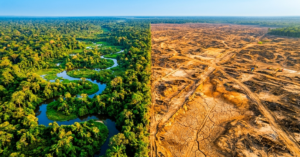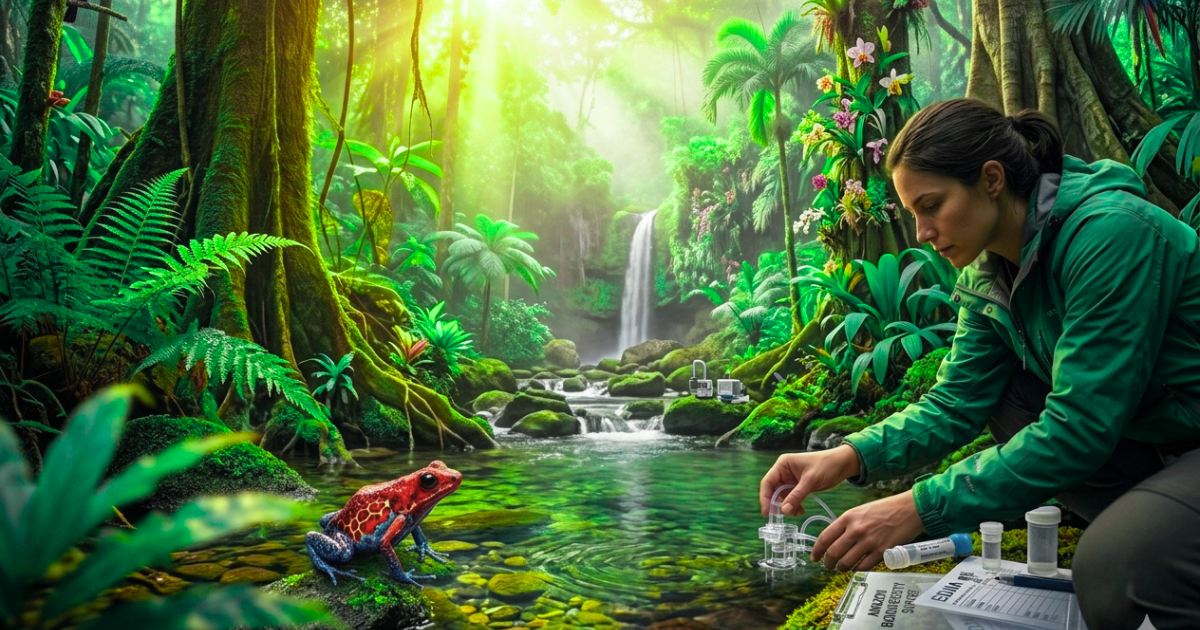
Monitoring of biodiversity is no longer a luxury: it’s a necessity. It is the silent crisis we cannot ignore, and one of the most important responsibilities humans face today. Some species are near to extinct rapidly because forests are shrinking, wetlands are drying up, and coral reefs are turning white and lifeless. The most alarming component? Much of this destruction is taking place quietly, definitely, because we aren’t watching nature carefully enough.
Have you ever notion approximately what happens to an surroundings whilst no one is watching it? The fact is disturbing.
This article introduces a clean, step-by-step technique for how to learn and put into effect powerful biodiversity tracking. It explores how modern-day technological understanding, combined with advanced geospatial technology, is reworking the manner in which we sing, defend, or even experience the natural world.
Why Monitoring of Biodiversity Is More Urgent Than Ever
Here’s the truth: you can not guard what you do not understand. Every species lost is one thread pulled from the material of existence. When sufficient threads are long gone, the complete surroundings collapse, and that disintegration threatens food safety, clean water, remedies, and the air we breathe.
Therefore, building an effective, science-based totally biodiversity monitoring framework is the most vital conservation step any authorities, NGO, or enterprise can take right now.
The Alarming Rate of Species Extinction
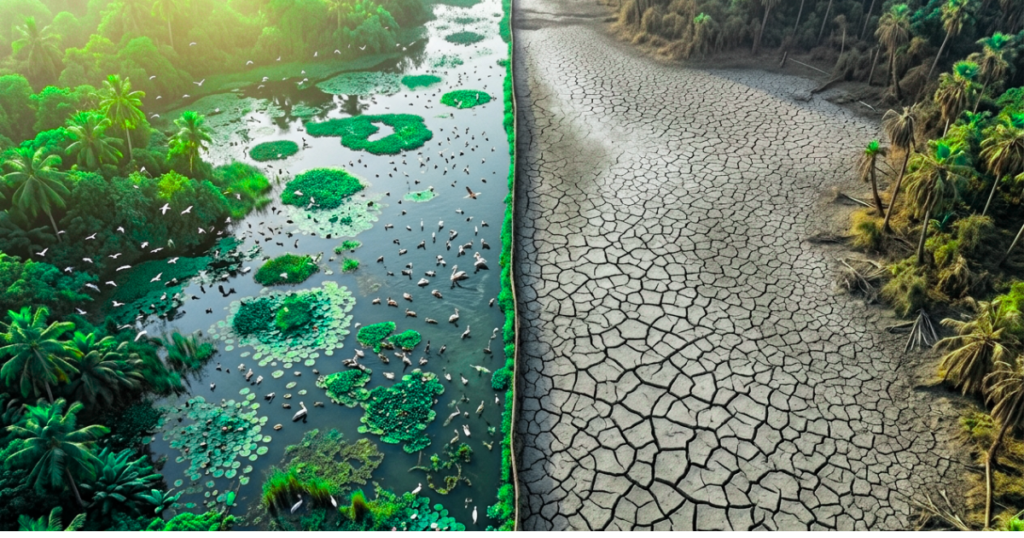
The numbers are staggering. Over one million species currently face extinction, according to the IPBES Global Assessment. The 2024 WWF Living Planet Report recorded an average 73% decline in vertebrate populations since 1970. Furthermore, more than 40% of large-scale mines now operate inside forests, directly threatening irreplaceable biodiversity hotspots.
The Kunming-Montreal Global Biodiversity Framework (KMGBF), adopted at COP15 in 2022, set a historic target: to protect 30% of Earth’s land and oceans by 2030. However, without strong monitoring systems in place, this target remains just a number on paper. Discover how technology is changing that reality.
What Happens to Ecosystems When We Stop Watching?
When monitoring stops, illegal deforestation goes undetected. Invasive species spread unchecked. Endangered animals vanish before anyone notices. In contrast, regions with active monitoring catch habitat destruction early, and that early warning saves ecosystems before the damage becomes permanent.
Think about it: even a small lag in biodiversity monitoring can mean the difference between a recoverable situation and a permanent extinction event. The stakes could not be higher.
What Is a Biodiversity Monitoring Framework?
A biodiversity monitoring framework is a structured, repeatable system for collecting, analyzing, and acting on data about species, habitats, and ecosystems over time. It answers four essential questions: What is there? How much exists? Where is it located? How fast is it changing?
According to IUCN (2024), systematic site-based monitoring is necessary for evidence-based adaptive management in protected areas and other effective area-based conservation measures (OECMs). It also informs managers whether they are meeting their conservation goals.
Most importantly, a strong framework does not just collect data. It connects that data directly to action.
Key Components of a Powerful and Effective Monitoring System
An effective biodiversity monitoring system must include five critical components. Each one builds on the last:
- Baseline data collection — Document what species and habitats exist before any changes occur
- Indicator selection — Choose measurable indicators like species abundance, vegetation cover, and water quality
- Technology integration — Deploy satellite imagery, drones, camera traps, and eDNA tools
- Data management — Store, clean, and share data in open, interoperable formats
- Adaptive management — Feed monitoring results back into updated conservation strategies in real time
Additionally, as noted in PMC (2024), data-driven knowledge is critically important for scientifically informed decision-making, a principle now embedded in the KMGBF itself.
How the Kunming-Montreal Global Biodiversity Framework (KMGBF) Guides Global Action
The KMGBF is the most ambitious global biodiversity agreement in history. It commits 196 countries to 23 actionable targets. These include halting species extinction, restoring 30% of degraded ecosystems, and, most importantly, creating standardized monitoring indicators for the first time.
According to Global Nature Fund (2025), signatory states must now require large companies and financial institutions to monitor, assess, and transparently disclose their risks, dependencies, and impacts on biodiversity. This is a game-changer; biodiversity monitoring is now a legal and financial obligation, not just a scientific exercise.
Proven Tools That Are Transforming Biodiversity Monitoring Today
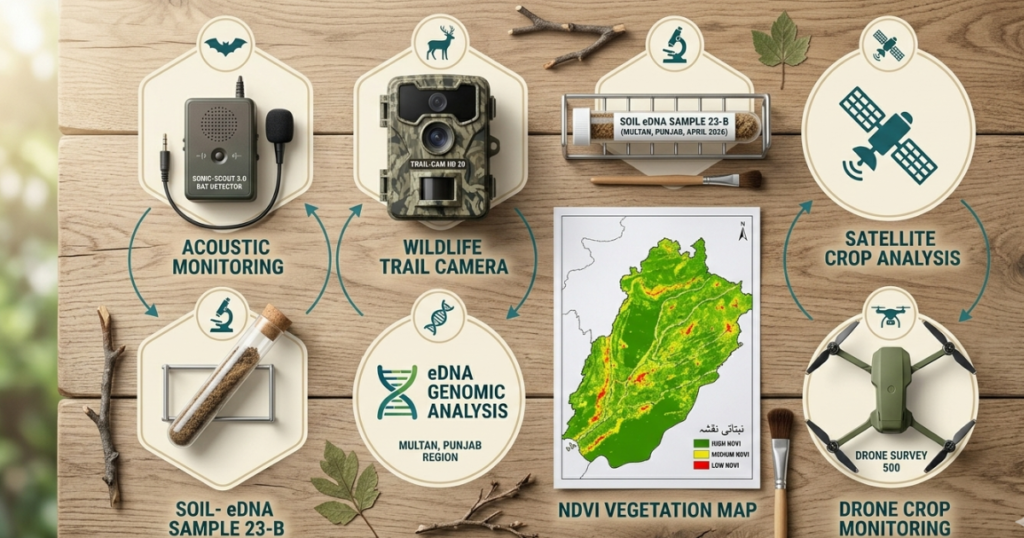
Technology has changed everything. Today, we can monitor entire forest systems from space. We can detect a single species’ DNA in a water sample. We can predict where wildlife corridors will collapse, before they actually do. Let’s explore the most powerful tools available right now.
Remote Sensing & Satellite Imagery
Remote sensing is one of the most groundbreaking tools available for monitoring biodiversity at scale. Satellites capture land cover changes, vegetation health, deforestation rates, and water body shifts, all in near real-time, across millions of hectares simultaneously.
At AI Geo Navigators, the Remote Sensing & Image Analytics service delivers exactly this capability. It enables conservation teams, governments, and NGOs to detect habitat degradation as it happens, not months later when the damage is already done.
Furthermore, learn how 10 powerful remote sensing techniques are changing the world in the AI Geo Navigators’ published blog, a must-read resource for every conservation professional.
NDVI (Normalized Difference Vegetation Index) analysis, for instance, reveals exactly where vegetation is declining. Similarly, thermal infrared imagery tracks wildlife movement patterns and identifies water stress in ecosystems before it becomes critical.
GIS Technology: Map, Analyze, and Protect Habitats With Precision
Geographic Information Systems (GIS) make biodiversity data visual, spatial, and directly actionable. With GIS, you can overlay species distribution maps, deforestation layers, protected area boundaries, and climate projections, all on one intelligent, interactive platform.
The Geospatial Data Production and Mapping, Cartography & Visualization services from AI Geo Navigators are purpose-built for environmental monitoring projects. They help organizations map biodiversity hotspots and track habitat connectivity over time.
In addition, explore how GIS mapping services transform spatial data into better conservation decisions, an insightful article already published on the AI Geo Navigators blog. The Spatial Databases & Web GIS platform further enables real-time sharing of biodiversity data across agencies, solving one of the biggest data-sharing gaps in current monitoring systems.
AI and Predictive Modeling
Artificial intelligence is transforming the entire field of conservation. According to Nature Sustainability (2022), an AI framework called CAPTAIN, based on reinforcement learning, consistently outperforms available state-of-the-art conservation planning software. Under a limited budget, it protects significantly more species from extinction than traditional approaches based on species richness alone.
AI Geo Navigators offers Predictive Modeling & AI Development services that apply machine learning to environmental datasets, enabling forecasts of species decline risk, modeling future habitat loss, and prioritizing conservation areas with proven scientific precision.
Consequently, Risk Analytics & Decision Intelligence tools help policymakers understand which ecosystems face the highest near-term threats, enabling smarter and faster resource allocation before it is too late.
eDNA: The Groundbreaking Science Behind Invisible Species Tracking
Environmental DNA (eDNA) analysis detects species presence from water, soil, or air samples, without ever physically observing the organism. It is especially powerful for aquatic ecosystems, where direct observation is nearly impossible, and for detecting rare or elusive species.
Moreover, as highlighted in Nature Reviews Biodiversity (2025), soil biodiversity has historically been ignored in conservation policies. However, its explicit inclusion in the KMGBF is a breakthrough; all parties to the CBD are now invited to report on soil biodiversity status from 2026 onward.
eDNA combined with GIS mapping creates an unprecedented view of ecosystem health, from the forest floor to the ocean bed.
How Remote Sensing Is Revolutionizing Ecosystem Health Monitoring
Remote sensing goes far beyond simply taking pictures from space. It provides multi-layered environmental intelligence that was previously impossible to gather at scale. Here’s how it works in practice.
Real-time Habitat Change Detection That Saves Forests Before It’s Too Late
Satellite time-series analysis tracks deforestation, wetland drainage, and urban encroachment on protected areas continuously. Automated alerts can be triggered the moment a critical threshold is crossed. Therefore, conservation agencies can respond within days, not the months or years that traditional ground surveys would require.
The Decision Support & Applied GIS Solutions service at AI Geo Navigators integrates these satellite alerts into actionable decision frameworks, connecting space-based data directly to on-the-ground field response in real time.
NDVI Analysis: Your Essential Tool for Vegetation and Biodiversity Health
NDVI values reveal the greenness and photosynthetic health of vegetation. A consistently declining NDVI trend inside a protected forest is an early warning signal. It indicates overgrazing, drought stress, or illegal clearing, often before any visible damage can be observed from the ground.
Combined with species distribution data, NDVI layers become a powerful biodiversity health index. This is precisely the kind of integrated, data-driven analysis that Environmental Sustainability consulting at AI Geo Navigators provides to clients across government, NGO, and corporate sectors.
Build a Strong Biodiversity Protection Framework
Here is a proven, practical framework that any conservation agency, NGO, research institution, or government body can implement. Follow these steps, and you will have a world-class monitoring system in place.
Step 1 — Define Clear, Measurable Conservation Goals
Start with absolute clarity. What exactly are you protecting? For how long? Against which specific threats? Your goals must align with KMGBF targets and your national biodiversity strategy. Without clear goals, even the best monitoring data becomes meaningless noise.
Step 2 — Collect Comprehensive Baseline Species and Habitat Data
You need a solid starting point. Conduct thorough field surveys, use remote sensing for land cover mapping, and gather all available historical species records. As noted by the Canada Biodiversity Observation Network (2024), more than 88% of national biodiversity observations are within 1 km of roads, meaning vast remote regions remain dangerously unmonitored. Filling these gaps requires active deployment of satellite, drone, and eDNA tools in inaccessible areas.
Step 3 — Deploy a Multi-technology Monitoring Network
No single tool is sufficient. Discover how combining multiple technologies creates a complete ecosystem picture:
- Satellite remote sensing — landscape-scale habitat monitoring from space
- Camera traps — continuous large mammal and wildlife tracking
- Acoustic sensors — automated bird, bat, and insect species monitoring
- eDNA sampling — aquatic, soil, and airborne biodiversity detection
- Citizen science apps — widespread, cost-effective species observation
- GIS platforms — integrating and visualizing all data layers in one system
As Frontiers in Climate (2025) confirms, long-term monitoring programs are essential — most ecological responses, including species migration and community succession, unfold over decades. The informational value of biodiversity data increases exponentially with the length of the time series collected.
Step 4 — Analyze, Report, and Adapt Continuously
Data without analysis is a wasted opportunity. Use GIS platforms and AI models to identify trends and anomalies. Report findings to all stakeholders in clear, visual, and accessible formats. Most importantly, continuously feed findings back into management decisions; this adaptive management cycle is the hallmark of every successful biodiversity conservation program.
Explore how GIS Consultancy from AI Geo Navigators can help your organization build this intelligent, adaptive intelligence loop from the ground up.
How AI Geo Navigators Power Biodiversity Monitoring With Geospatial Intelligence
AI Geo Navigators is a climate-intelligence and geospatial firm that converts complex environmental data into clear, actionable intelligence. By integrating artificial intelligence, machine learning, GIS, and remote sensing, the team empowers conservation organizations, governments, researchers, and businesses to answer the most critical question in environmental management: What is happening to our ecosystems right now?
Their comprehensive suite of services covers every aspect of biodiversity monitoring and protection:
- Remote Sensing & Image Analytics — satellite-based habitat and ecosystem monitoring
- Geospatial Data Production — high-accuracy spatial datasets for conservation mapping
- Mapping, Cartography & Visualization — custom biodiversity and habitat maps
- Spatial Databases & Web GIS — real-time data sharing across conservation networks
- Decision Support & Applied GIS Solutions — data-driven conservation action planning
- Predictive Modeling & AI Development — AI-powered species risk forecasting
- Risk Analytics & Decision Intelligence — ecosystem threat assessment and early warning
- Environmental Sustainability — integrated ecosystem health assessment services
- ESG Consulting — KMGBF-aligned biodiversity reporting for businesses
- GIS Consultancy — expert guidance on building monitoring frameworks
Additionally, explore their full suite of AI-powered geospatial products and read more expert insights on their Insights & Blog page.
Life-changing Benefits of a Robust Biodiversity Monitoring Framework
When done right, biodiversity monitoring delivers transformative, measurable benefits for ecosystems, governments, businesses, and communities alike:
- Early detection of habitat loss and species decline, before damage becomes irreversible
- Evidence-based policy that replaces guesswork with real, verified data
- Smarter conservation spending by precisely targeting the most at-risk areas
- Climate change adaptation by continuously tracking ecosystem resilience and stress
- Full legal compliance with KMGBF, EU Biodiversity Strategy 2030, and national laws
- Corporate ESG reporting aligned with TNFD, CSRD, and international sustainability standards
- Community empowerment through citizen science and Indigenous knowledge integration
- Long-term data series that increase exponentially in scientific and policy value over time
Conclusion
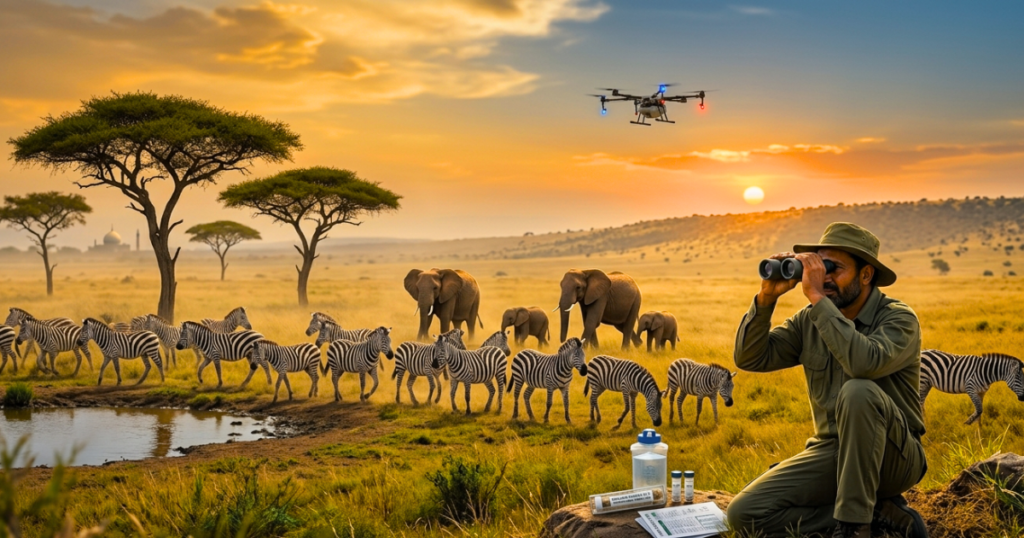
The monitoring of biodiversity is the single most important foundation of every conservation success story. Without it, we are flying completely blind in the face of a planetary ecological crisis.
The good news? The tools exist. The frameworks are in place. The data is becoming more accessible and affordable every year. What we need now is the commitment to act and the technology to act smartly, decisively, and at scale.
Furthermore, whether you are a government body, an international NGO, a field researcher, or a business with growing environmental responsibilities, you can take a powerful, meaningful step today. Map your ecosystems. Monitor them continuously. And protect them using the best available technology and expertise.
FAQs
What is monitoring of biodiversity, and why is it so important?
Monitoring of biodiversity is the systematic, ongoing process of measuring and tracking species populations, habitats, and entire ecosystems over time. It is critically important because it provides the data needed to detect decline early, measure the real success of conservation programs, and guide effective protection strategies before damage becomes permanent and irreversible.
What are the most powerful tools used for biodiversity monitoring?
The main tools include satellite remote sensing, GIS mapping, camera traps, acoustic sensors, environmental DNA (eDNA) analysis, drone surveys, and AI-powered predictive models. Each tool captures a different, complementary layer of biodiversity data.
What is the Kunming-Montreal Global Biodiversity Framework (KMGBF)?
The KMGBF is a landmark international agreement adopted in 2022 at COP15 by 196 countries. It sets 23 specific targets, including protecting 30% of Earth’s land and ocean by 2030, restoring degraded ecosystems, and creating standardized biodiversity monitoring indicators for the very first time. Learn more at the official CBD KMGBF page.
How exactly does remote sensing help in biodiversity monitoring?
Remote sensing uses satellite and aerial imagery to detect changes in land cover, vegetation health (NDVI), deforestation rates, wetland loss, and habitat fragmentation continuously and at a massive scale. It enables large-scale, near-real-time monitoring that field surveys alone cannot achieve. Explore the 10 best remote sensing techniques for conservation.
What is eDNA, and how is it used in modern biodiversity tracking?
Environmental DNA (eDNA) is genetic material shed by living organisms into water, soil, or air. Scientists collect environmental samples and use advanced DNA analysis to identify which species are present — without needing to directly observe or capture any animal. It is especially powerful and cost-effective in aquatic environments and remote habitats.
Can AI genuinely improve biodiversity conservation outcomes?
Absolutely. AI models can rapidly analyze enormous environmental datasets, accurately predict species extinction risk, intelligently prioritize conservation areas, and detect illegal deforestation in near-real time. According to Nature Sustainability, AI-powered frameworks protect significantly more species under limited budgets compared to traditional methods. Discover AI-powered predictive modeling services by AI Geo Navigators.
How can businesses contribute to biodiversity monitoring and reporting?
Under the KMGBF and EU CSRD regulations, businesses are now legally required to monitor, assess, and publicly disclose their biodiversity impacts across their entire value chain. Companies can partner with geospatial specialists like AI Geo Navigators to conduct biodiversity assessments, habitat mapping, and fully ESG-compliant biodiversity reporting aligned with global standards.