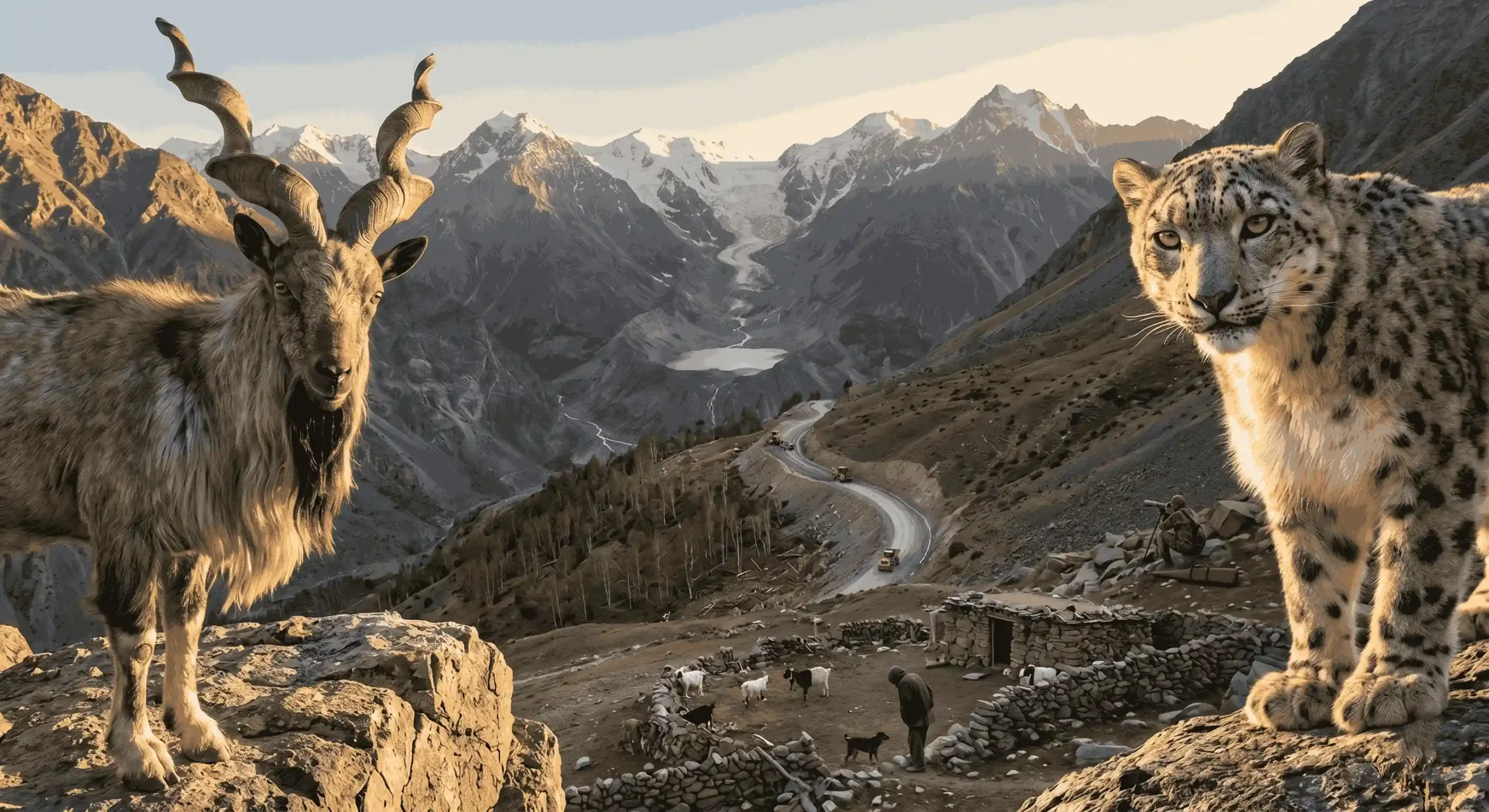
The Karakoram and Hindukush mountains in northern Pakistan are part of the larger Hindu Kush–Karakoram–Himalaya (HKH) region, which is home to important wildlife like the snow leopard (Panthera uncia), Himalayan ibex (Capra sibirica), Marco Polo sheep (Ovis ammon polii), and several types of markhor (Capra falconeri) (WWF‑Pakistan, 2024; Aryal et al., 2021; Bam‑e‑Dunya Network, 2023). These animals are increasingly threatened by habitat loss, new infrastructure, climate change, and human activities. Drawing on recent fieldwork and policy reports, this article highlights the main threats to wildlife in the area and stresses the need for focused conservation efforts.
1. Habitat Loss and Land‑Use Change
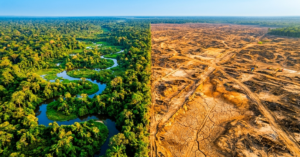
Turning natural habitats into farmland, settlements, and pastures is a major reason for wildlife decline in the Karakoram–Hindukush region (Muhammad et al., 2022; WWF‑Pakistan, 2024). In many valleys of Gilgit‑Baltistan, cutting down trees for fuel and timber and clearing land have reduced native plants, leaving less space for animals like ibex and markhor (Aryal et al., 2021; Muhammad et al., 2022). Overgrazing by livestock also damages alpine pastures, making it harder for wild animals to find food and pushing them closer to villages where conflicts can happen.
Research shows that even in protected areas like Central Karakoram National Park and nearby conservancies, habitat is still being damaged by unregulated tourism, livestock, and collecting fodder and firewood (Aryal et al., 2021; Forest, Wildlife & Environment Department, GB, 2023). These human activities break up habitats that used to be connected, making it harder for animals like the snow leopard to survive across the region.
2. Linear Infrastructure and Habitat Fragmentation
Large infrastructure projects, especially new roads, are now a major threat to wildlife in the Karakoram–Hindukush region. The Karakoram Highway (KKH) and local roads like the Gilgit–Shandur route cut through important snow leopard habitats in Gilgit‑Baltistan, breaking up movement paths and separating animal groups (WWF‑Pakistan, 2024; BEAST Project, 2024). A WWF‑Pakistan study found that these roads make it harder for wildlife to move, lead to more vehicle-animal accidents, and increase conflicts between people and animals, especially for Himalayan ibex that crossroads during their seasonal migrations (WWF‑Pakistan, 2024; BEAST Project, 2024).
The same research shows that while roads and other infrastructure help connect the region and boost the economy, they also turn natural areas into developed or disturbed land, reducing the space available for large carnivores and their prey (WWF‑Pakistan, 2024; BEAST Project, 2024). As more highways, tourist sites, and energy projects are built in the HKH region, these changes add up and break apart wildlife corridors that link parks and conservancies, threatening the health of the whole ecosystem.
3. Climate Change and Altered Specie Range
Climate change is altering temperature and rainfall patterns in the Karakoram-Hindukush where important mountain species can survive. A study using geospatial data and models in Gilgit-Baltistan found that Himalayan ibex and blue sheep will likely lose much of their current suitable habitat as the climate changes especially in the Himalayan and Hindukush ranges (Aryal et al., 2021). The study also showed that annual average rainfall is key factor in habitat stability and changes in rainfall and snowfall are expected to reduce and shift elevation ranges of these species (Aryal et al., 2021).
For snow leopard climate change poses additional risk by shifting their prey to new areas, increasing new avalanches and altering how diseases and parasites spread (Ghaznavi, 2020; Dialogue Earth, 2020). Although the Pamir-Karakoram area of HKH may remain stable for some ungulates, climate change overall is expected to reduce and fragment suitable habitats making conservation planning more difficult.
- Hunting, Poaching and Human-Wildlife Conflict
Killing wildlife for meat, trophies or revenges is still a big problem in the Karakoram-Hindukush region. Surveys in northern Pakistan show that hunting, poaching, and trapping put significant pressure on birds and mammal populations. Birds are shot or trapped for food and trade, while mammals are hunted for trophies or because people see them as threats to livestock (Muhammad et al.,2022).In areas where markhor and ibex live ,illegal hunting and poorly enforced borders make it hard for populations to recover, even when community conservation programs are in place (Aryal et al., 2021) .
Conflicts between people and wildlife are especially serious for large carnivores like snow leopards and wolves, because they sometimes prey on livestock, people may kill them in response. Studies from HKH region show that snow leopards are responsible for attacks on small livestock, and this problem gets worse when grazing areas and carnivore habitats overlap (Aryal et al., 2021).If community conservation programs do not have enough support, such as compensation, insurance and education people may continue to kill these animals which can make it harder for their population to recover.
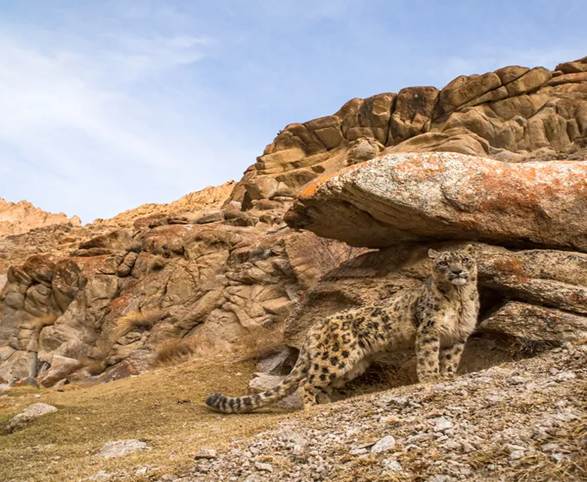
Caption: Snow leopard (Panthera uncia), a flagship and climate-sensitive species of the Hindu Kush–Karakoram region. Source: WWF / Snow Leopard Trust
5. Emerging Threats: Invasive Species and Tourism Pressure
In addition to habitat loss and climate change mountain ecosystems in Karakoram and Hindukush now face new threats from invasive plants and unregulated tourism. Across the wider Himalayan region warmer temperatures and deforestation have helped non-native plants like Crofton weed spread. These plants compete with local species and can change fire patterns and soil chemistry (Intergovernmental Panel on Climate Change, 2019; PLOS ONE, 2021). Most Research on invasive species comes from eastern Himalayas but similar problems are likely in western HKH as new roads and tourism create more ways for these plants to arrive.
In valleys like Hunza and areas of Gilgit-Baltistan increased tourism and new infrastructure such as hotels, trails, and recreation sites have been linked to changes in wildlife behavior increased litter and pollution, and changes in land use in sensitive areas (Bam‑e‑Dunya Network, 2023; WWF‑Pakistan, 2024). Community conservation projects have eased some of these problems but if tourism continues to grow without proper environmental checks and studies on how much the area can handle, it could damage the biodiversity that attracts visitors.
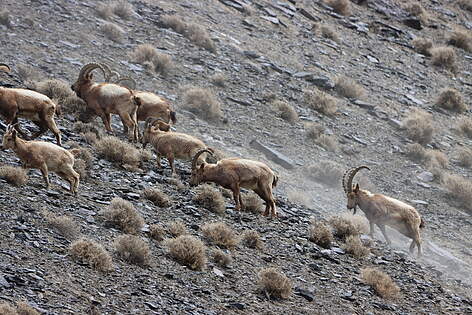
Source: WWF Pakistan
6. Towards an Evidence‑Based Conservation Response
To tackle these threats, a combined approach is needed. This should include managing protected areas, planning for climate resilience, and involving local communities. Recent studies stress the need for stronger cross-border cooperation in the HKH region, such as through the Bam-e-Dunya network, which connects protected areas in Pakistan, Afghanistan, Tajikistan, and China (Bam‑e‑Dunya Network, 2023). Expanding and managing parks like K2–Central Karakoram National Park and nearby conservancies can help protect habitats for snow leopards and their prey and help these species adapt to changes caused by climate shifts (Aryal et al., 2021; Forest, Wildlife & Environment Department, GB, 2023).
Infrastructure planning should also use green principles, such as installing wildlife underpasses and overpasses, and installing speed zones on roads that cross important animal routes (WWF‑Pakistan, 2024; BEAST Project, 2024). Conservation programs that focus on communities such as schemes to prevent livestock loss, provide alternative livelihoods, and raise awareness have helped reduce hunting and revenge killings. These efforts can grow with better support and funding (Aryal et al., 2021; Dialogue Earth, 2020). Without these coordinated, research-based actions, the unique wildlife of the Karakoram and Hindukush will continue to face serious threats, even though the region is important for conservation worldwide.
7. Climate Change Adaptations for Wildlife in Hindukush and Karakoram Regions
In the Hindu Kush–Himalaya (HKH) region, climate change adaptation for wildlife centers on maintaining habitat connectivity, strengthening protected areas, and reducing other stressors. These efforts use both community-based and ecosystem-based methods (ICIMOD, 2024; Gurung et al., 2019; GCA, 2023). This is especially important for cold-adapted animals like snow leopards, ibex, and high-altitude ungulates, which are already facing range and habitat fragmentation due to rising temperatures and shifting rainfall patterns (Aryal et al., 2021; Premlata et al., 2024; Chaudhary et al., 2022).
Following are the adaptation strategies
Expand and Climate-Smart Protected Areas
A major adaptation strategy is to expand, and redesign protected areas to match future climate conditions, rather than just current species locations (Premlata et al., 2024; GCA ,2023). In the HKH studies show that many key habitats and cold-adapted species are outside existing protected areas. Careful land-use planning and the creation of new protected areas along elevation gradients are therefore essential (Premlata et al., 2024; GCA ,2023).For example Pakistan’s Snow Leopard and Ecosystem Program has added thousands of hectares of important snow leopard habitat to the national protected area systems .These areas are selected to remain suitable under future climate scenarios and to support prey species ( Global Snow Leopard and Ecosystem Protection Program;2018;BEAST Project, 2024).
Experts suggest protecting and restoring ecological corridors and connections across the HKH to enable species to move as the climate changes (Chaudhary et al., 2022; Gurung et al., 2019; Ott, 2007). Research on snow leopards and ungulates in the HKH shows that habitat fragmentation and loss of movement routes increase the likelihood of extinction as the climate shifts (Aryal et al., 2021; PLOS ONE, 2021). Because of this, adaptation programs focus on legally protecting “future-use” corridors and “stepping-stone” habitats that connect core protected areas. They also work to restore degraded vegetation and riparian zones, making it easier for species to move across the landscape (Gurung et al., 2019; WWF, 2023).
Protect and Restore Connectivity Corridors
Maintaining and restoring ecological corridors and connectivity across the HKH is widely recommended to allow species to shift ranges in response to climate change (Chaudhary et al., 2022; Gurung et al., 2019; Ott, 2007). Modeling work on snow leopard and ungulate distributions in the HKH indicates that habitat fragmentation and loss of dispersal routes significantly increase extinction risk under climate change (Aryal et al., 2021; PLOS ONE, 2021). Adaptation programs therefore emphasize:
- Designating and legally protecting “future‑use” corridors and “stepping‑stone” habitats that connect core PAs;
- Restoring degraded vegetation and riparian zones to enhance landscape permeability (Gurung et al., 2019; WWF, 2023).
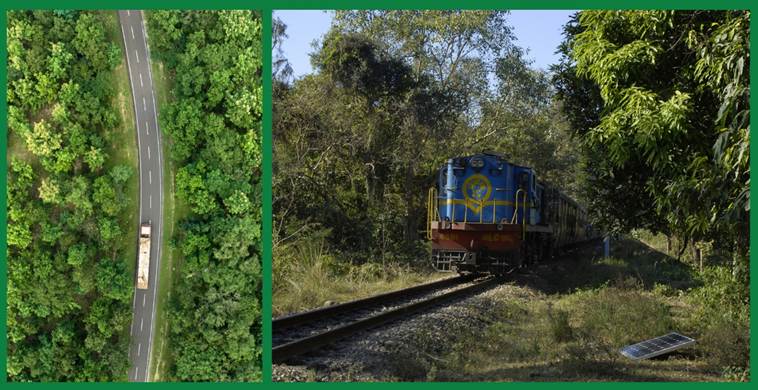
Source: Linear infrastructure such as roads and railway lines running through wildlife habitats can severely hamper wildlife connectivity. © WCT ©Dr. Anish Andheria
Ecosystem-Based Adaptation and Nature-based solutions
Ecosystem-based adaptation (Eba) and nature-based solutions (NBS) are increasingly common in the HKH region because they offer affordable ways to reduce climate risks for people and wildlife (Chaudhary et al., 2022; Mishra et al., 2019). In mountain areas, Eba projects include restoring watersheds, planting trees, and using agroforestry. These actions help stabilize slopes, manage water flow, and protect habitats for animals such as the snow leopard and its prey (Chaudhary et al., 2022; FAO, 2023). Pilot projects in the HKH region show that restoring vegetation and managing spring sheds can improve habitats and reduce the risks of landslides and floods. These steps also help wildlife become more resilient (Chaudhary et al., 2022; WWF, 2023).
8. Case Studies of Successful HKH Wildlife Adaptation Projects
Below are several well-documented case studies of successful wildlife climate adaptation projects in the Hindu Kush–Himalaya (HKH) region.
Pakistan: Snow Leopard and Ecosystem Program (AHM)
The “Conservation and Adaptation in Asia’s High Mountains” (AHM) project, implemented by WWF and partners in Pakistan’s snow leopard range, is one of the most widely cited HKH wildlife‑adaptation case studies (Global Snow Leopard & Ecosystem Protection Program [GSL EP], 2018; WWF, 2018; Snow Leopard Foundation Pakistan, 2024). By integrating climate‑smart rangeland management, predation‑mitigation schemes, and community‑based monitoring, the project simultaneously strengthened habitat resilience and reduced retaliatory killing of snow leopards (GSL EP, 2018; SLF, 2024).
Key outcomes include:
- Improved water management and vegetation restoration in high-altitude rangelands, which increased forage for wild ungulates and, in turn, improved snow leopard habitat quality (SLF, 2024; WWF, 2018);
- Demonstration sites served as models for expanding climate-smart snow leopard landscape management in Pakistan and other HKH countries (WWF, 2018; GSL EP, 2018).
Eastern Nepal: Climate‑Smart Snow Leopard Landscape Planning
In eastern Nepal, the AHM project helped create climate-smart snow leopard landscape management plans for two GSLEP-designated priority landscapes (WWF, 2018; Chaudhary et al., 2022). These plans used species-distribution models, climate projections, and local knowledge to identify current and future suitable habitats, then linked them to land-use and conservation planning (WWF, 2018; ICIMOD, 2019).
Evidence shows that the approach:
- Improved institutional coordination between conservation agencies and local communities
- Help prioritize restoring corridors and sustainable grazing in areas expected to stay suitable for snow leopards and their prey as the climate changes (WWF, 2018; Chaudhary et al., 2022)
Bhutan: High‑Altitude Rangeland Restoration and Pastoral Adaptation
In Bhutan’s high‑altitude rangelands, a joint government–pastoralist initiative has restored degraded pastures through prescribed burning and rotational grazing, practices grounded in traditional knowledge that are now formalized in national operating procedures (Down to Earth, 2026; ICIMOD, 2019). These interventions have improved grassland structure, soil stability, and water retention, thereby increasing forage availability not only for domestic livestock but also for wildlife such as blue sheep and musk deer (Down to Earth, 2026). The case is often cited as a successful nature‑based solution (NbS) that:
- Links climate adaptation, livelihood security, and biodiversity conservation;
- Has expanded through policy support and community involvement, making it a model for other HKH countries (FAO Rangeland Compendium, 2025; ICIMOD, 2019).
Pakistan: Community‑Led Rangeland and Water Management in Gilgit‑Baltistan
The Snow Leopard Foundation Pakistan’s water management work in Gilgit-Baltistan is another strong example of HKH wildlife adaptation (SLF, 2024; WWF, 2018). In degraded sub-alpine scrub areas, local Village Conservation and Development Organizations (VCDOs) built irrigation channels and water systems, improving water access to rangelands and helping vegetation recover (SLF, 2024). This restoration has:
- Stabilized soil and reduced erosion, which helps both livestock and wildlife move more easily;
- Created a more resilient habitat for snow leopards and their prey as rainfall becomes less predictable and glaciers retreat (GSL EP, 2018; SLF, 2024).
Pakistan: Snow Leopard and Ecosystem Programme (AHM)
The “Conservation and Adaptation in Asia’s High Mountains” (AHM) project, implemented by WWF and partners in Pakistan’s snow leopard range, is one of the most widely cited HKH wildlife‑adaptation case studies (Global Snow Leopard & Ecosystem Protection Program [GSL EP], 2018; WWF, 2018; Snow Leopard Foundation Pakistan, 2024). By integrating climate‑smart rangeland management, predation‑mitigation schemes, and community‑based monitoring, the project simultaneously strengthened habitat resilience and reduced retaliatory killing of snow leopards (GSL EP, 2018; SLF, 2024). Key outcomes include:
- Improved water management and vegetation restoration in high‑altitude rangelands, which enhanced forage for wild ungulates and, indirectly, snow leopard habitat quality (SLF, 2024; WWF, 2018);
The use of demonstration sites as models for scaling up climate‑smart snow leopard landscape management across Pakistan and other HKH countries (WWF, 2018; GSL EP, 2018)
Eastern Nepal: Climate‑Smart Snow Leopard Landscape Planning
In eastern Nepal, the AHM project supported the development of climate‑smart snow leopard landscape management plans for two GSLEP‑designated priority landscapes (WWF, 2018; Chaudhary et al., 2022). These plans combined species‑distribution models, climate projections, and local knowledge to identify current and future suitable habitats, then linked them with land‑use and conservation planning (WWF, 2018; ICIMOD, 2019). Evidence shows that the approach:
- Improved institutional coordination between conservation agencies and local communities
- Help prioritize corridor restoration and sustainable grazing schemes in areas projected to remain suitable for snow leopard and its prey under climate change (WWF, 2018; Chaudhary et al., 2022).
Bhutan: High‑Altitude Rangeland Restoration and Pastoral Adaptation
In Bhutan’s high‑altitude rangelands, a joint government–pastoralist initiative has restored degraded pastures through prescribed burning and rotational grazing, practices grounded in traditional knowledge that are now formalized in national operating procedures (Down to Earth, 2026; ICIMOD, 2019). These interventions have improved grassland structure, soil stability, and water retention, thereby increasing forage availability not only for domestic livestock but also for wildlife such as blue sheep and musk deer (Down to Earth, 2026).
The case is often cited as a successful nature‑based solution (NbS) that:
- Links climate adaptation, livelihood security, and biodiversity conservation;
- Has been scaled through policy support and community participation, making it a model for other HKH countries (FAO Rangeland Compendium, 2025; ICIMOD, 2019).
9. Conclusion
Climate change is rapidly changing the ecosystems of the Hindu Kush Himalaya (HKH), making traditional conservation methods less effective. For key species such as the snow leopard, it is now crucial to add climate-focused management and monitoring to support their long-term survival. Combining field surveys with habitat models and climate forecasts helps find safe areas for wildlife now and in the future, so conservation teams can act before populations drop. Keeping track of prey numbers, disease trends, and seasonal shifts also helps set up early warning systems, making it easier to respond quickly.
Reducing threats unrelated to climate change remains important for helping wildlife adapt. Issues like habitat loss, overgrazing, illegal hunting, and new roads or buildings make it harder for animals to deal with climate change. Building wildlife-friendly infrastructure, establishing protected corridors, and carefully planning land use can connect habitats and create safe areas for wildlife, especially in rapidly developing regions like the Karakoram corridor.
Successful adaptation needs strong leadership and teamwork. Because animals like the snow leopard cross national borders, countries need to work together to track wildlife, prevent poaching, and protect habitats. Local communities are also important, since their lives and knowledge are closely connected to the mountains. Supporting conservation led by local people and building partnerships across the region are practical, long-term ways to protect HKH wildlife as the climate changes. In the end, climate adaptation in the HKH should rely on science, including local communities, and be coordinated across the region to protect nature for the future.
References
Adaptation without Borders. (2023). The Hindu Kush Himalaya Assessment: Mountains, climate change, and adaptation. https://adaptationwithoutborders.org/knowledge-base/the-hindu-kush-himalaya-assessment/
Chaudhary, S., Hussain, S., & others. (2022). Climate change vulnerability and adaptation in the Hindu Kush–Himalaya region: A review. Regional Environmental Change, 22(1), 1–17. https://doi.org/10.1007/s10113021018744
Global Snow Leopard & Ecosystem Protection Programme (GSL EP). (2018). Pakistan: Snow Leopard & Ecosystem Programme – Climate‑smart conservation and adaptation. https://globalsnowleopard.org/gef‑undp‑projects/pakistan‑snow‑leopard‑ecosystem‑programme/
International Centre for Integrated Mountain Development (ICIMOD). (2024). Outlook on climate change adaptation in the Hindu Kush Himalaya. WeAdapt. https://weadapt.org/?case‑study=100481
Kotloski, A. (2026). A behavioral lens on the snow leopard (Panthera uncia): Climate‑linked shifts in movement, habitat use, and human interactions. Studia Ecologiae et Bioethicae, 39(1), 15–32. https://doi.org/10.21697/seb.2026.15405
Mishra, A., et al. (2019). Climate change risk perceptions, vulnerability, and adaptation in high‑altitude farming communities of the Hindu Kush Himalaya. Asia‑Pacific Network for Global Change Research Bulletin. https:
Shrestha, A. B., et al. (2012). The recent warming trend in the Hindu Kush–Himalayan region. International Journal of Climatology, 32(12), 1857–1867. https://doi.org/10.1002/joc.2397
Telwala, Y., et al. (2013). Glacial and hydrological changes in the Hindu Kush–Himalaya and their implications for biodiversity. Environmental Management, 52(1), 210–222. https://doi.org/10.1007/s00267‑013‑0062‑9
UNESCO–IHP. (2024). Water, ice, society, and ecosystems in the Hindu Kush Himalaya: An introduction. https://articles.unesco.org/sites/default/files/medias/fichiers/2024/10/HI‑WISE_REPORT_Water_Ice_Society_and_Ecosystems_in_the_HKH.pdf
WWF. (2018). Conservation and adaptation in Asia’s high mountains: Snow leopard landscapes and community‑based management. World Wildlife Fund. https://files.worldwildlife.org/wwfcmsprod/files/Publication/file/10d4bs5t2u_WWF_2018_AHM_Final_Report_2018.02.28_Final.pdf