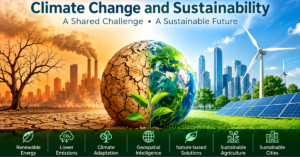
Pakistan is responsible for less than 1% of the global carbon emissions. However, it ranks among the top ten highly climate change affected countries. The 2022 flooding was an event that cost 40 billion dollars. So, the fundamental issue here is how did the banking system in Pakistan react? The State Bank of Pakistan has joined an international network of sustainable banks from as early as 2015, and undertook a review of all banking institutions. The outcome was obvious; they did not use any method of risk assessment of the environment.
Thus, a totally new process had to be designed. The SBP introduced the first-ever Green Banking Guideline in 2017. This marked the first step towards sustainable banking in Pakistan and the practice of handling social and environmental risk in banking. It was a radical departure from traditional banking practice to environmental-friendly practice.
Keywords; Climate finance, Green Banking Guidelines, Environmental and Social Risk Management, Pakistan Green Taxonomy, State Bank of Pakistan
Table of Contents
ToggleEvolution of GBG
SBP Green Banking Guidelines (GBG) 2017
In the guidelines for green banking, three core themes were incorporated: The basic themes incorporated in green banking guidelines were:
- Guidelines on Environmental risk management.
- Facilitating Green Business
- Own Impact Reduction
What is meant by Environmental Risk Management (ENvRM)?
The process of risk management that helps in evaluating, identifying, mitigating and monitoring the environmental risk involved in the operations of a firm is called ENvRM. The ENvRM process is created in such a way to incorporate the risk of future financing due to climate change and environmental changes.
Categories of ENvRM
- Direct Risk: Banks directly affected by the environmental factors
- Indirect Risk: Indirect risks challenges the financial position of a bank due to environmental impacts on the client.
- Reputational Risk: These are the risks associated with a potentially negative publicity due to banks or financial institutions’ own or their clients’ wrong doing.
What was the impact of this for banks?
For banks and other financial institutions, ENvRm can help assess the environmental and climate-related risk of any project before making any investments. So, banks can find and invest in those firms which are truly “green”.
Challenges faced by Banks to implement the GBG
- Banks were unclear and less motivated to implement GBGs
- SBP sanctions limit the refinancing for banks
- Lack of uniform environmental exposure limits across the banks
- Non availability of a quantifiable environmental risk metric
For the 2017 guidelines, there was an increased focus at a macro level on awareness and commitment. Specifically, they advised banks to set up “Green Banking Office” as well as approve a strategy supported by the Board of Directors. It should be noted that the guidelines didn’t have any approach to measure the environmental risks and therefore, the evaluation of an environmental risk was rather arbitrary. However, the concept and voluntary nature of the guidelines are maintained in 2017.
ESRM Implementation Manual (2022)
In November 2022, State Bank of Pakistan (SBP) published Environmental and Social Risk Management (ESRM) Manual. This release was not a new regulation but guidance to the implementation of the “Risk Management” pillar, which was implemented in 2017. One such aspect was the addition of an E&S scope; A change from qualitative risk management to quantitative via an auto-generated risk rating system. In the same way, the manual provided checklists to banks to use at the time of assessing the client before giving a loan “Due Diligence.”
The 2022 Framework
- Formal E&S risk procedures
- Screening methodologies
- Prohibited activity lists
- Due diligence templates
- Sector-specific risk assessment
- Implementation guidance for banks and DFIs
In short, the inclusion of this Environmental and Social Risk Management (ESRM) Manual helped banks and financial institutions in
- Screening procedures
- List of prohibited activities
- Due diligence checklists
- How to classify risk levels
- What documentation to collect
- How to monitor borrowers after disbursement
To conclude, the ESRM Manual would enable banks to determine how they should approach screening of their clients, determine the risk profile, what documentation would need to be gathered, what conditions would warrant enhanced due diligence, and the post-loan monitoring of borrowers. Accordingly, the framework design was based on that of IFC Performance Standards, the Equator Principles, and multilateral development banks, which was a major professionalization step.
Pakistan Green Taxonomy (PGT) 2025
The Pakistan Green Taxonomy was first introduced by the State Bank of Pakistan (SBP) in Circular No. 06 of December 2025. It is one of the most important changes that have been implemented to date. The circular outlines a scientific classification which is accurate for any activity that is either “Green”, “Transition” or “Red”. It eliminates the risk that projects will be labeled ‘green’ solely because they satisfy some of the criteria, but not others, as that could lead to banks considering them ‘green’ when they were not.
Furthermore, it requires banks to be consistent with these definitions when they engage in activities to ensure that the majority of funding is channeled towards climate change mitigation and adaptation. In parallel, it sends out guidance on Climate Stress Testing 2025 to enable banks to estimate potential damages from climate-related disasters.
Objectives & Environmental Goals
The Pakistani green taxonomy sets seven basic environmental objectives:
- Climate Change Mitigation
- Climate Change Adaptation
- Sustainable Use and Protection of Water Resources
- The protection of ecosystems and biodiversity
- Pollution Prevention and Control
- Circular Economy Promotion
- Sustainable Land Management
Key Aspects of PGT 2025
Introduction of classification system of projects/ economic activities; Green, Transition, and Red
A 3 step mandatory test criteria to qualify as green:
- Substantial contribution to climate goals
- Do no significant harm
- Social safeguards: compilation of labor laws and human rights
Targeted Sectors
- Energy
- Manufacturing
- Transport
- Construction
- ICT
- Water and waste management
- Agriculture
- Livestock
Implementation of PGT 2025
The State Bank of Pakistan (SBP) officially appointed six financial organizations to take part in the pilot project aimed at implementing the Pakistan Green Taxonomy (PGT) in 2026. These banks are:
- Habib Bank Limited (HBL): Very well known for its disclosures and implementation of green banking practices is
- United Bank Limited (UBL): SBP technology and innovative finance pilots.
- Bank AL Habib Limited, as an early adopter, has already introduced ESRM into their lending process.
- The Bank of Punjab (BOP): Chosen as the bank for the implementation of digital and innovative solutions in accordance with SBP’s agenda of 2026.
- The National Bank of Pakistan (NBP): A state owned bank to ensure public finances meet the new standards.
- Meezan Bank Limited: One of the Islamic banking institutions selected for testing the alignment of the Green Taxonomy with the Shariah compliant banking system.
The Present Stage (May–November 2026)
The SBP has given itself six months to achieve three main goals for this pilot project. The 6 pilot banks are in the process of;
- Data mapping: their loan portfolios to see how sustainable their current operations are by assigning each loan to the PGT categories (Green, Amber, Red).
- Gap Identification: banks are documenting technical challenges including inability to access accurate carbon emission data from borrowers at local level or cases where the carbon emission “Green” thresholds could be too high in the Pakistani market.
- Refining Templates: SBP is developing the reporting templates and the Web-based Navigation Tool which will subsequently be adopted by all other banks on the basis of the real-time input received from these banks.
What happens when?
Upon completion of the pilot (expected to be completed by November 2026), SBP will Issue Final Regulations: Based on the pilot results, any changes to SH&SFD Circular No. 06 of 2025 will be made. Nationwide Rollout: This will be fully rolled into all banks and Development Finance Institutions (DFIs) across Pakistan by early 2027 for portfolio reporting and green banking disclosures.With the newly acquired credibility of Pakistan’s green requirements and the recent introduction of Pakistan’s green taxonomy, the SBP is creating a dedicated platform to connect green firms aligned with the green taxonomy with foreign investors, hence “Green Fields”.
The Guidelines on Climate Stress Testing 2025 (Annex 1), published by FSD Circular No. 01 of 2025, regulate the climate stress testing that the six pilot banks are now doing.
One example includes
Transition Risk analysis (The “Carbon Tax” scenario)
- The SBP has asked for a forward-looking analysis of transition for bigger institutions, such as the National Bank (NBP) and Habib Bank (HBL), which are classified as Domestic Systemically Important Banks (D-SIBs).
- Carbon Pricing: Banks must simulate a carbon price up to $50 per tCO2e (both domestic and international).
- Based on Interest Coverage Ratios (ICRs) and emission intensities, they identify the corporate borrowers who would be likely to fall into bankruptcy if carbon taxes were to be implemented now.
- These climate shocks need to be integrated into the banks’ annual MSTs.
What is the end result of this?
Strategic Integration: The SBP predicts that this information will be used within the ICAAP of banks; therefore, it is not just about the calculations. If the results show high risk, the bank needs to build up its capital buffer or find ways to reduce the risks (like lowering its engagement with businesses with a higher carbon footprint or flood risk).
How have things really changed?
1. Frequency of Reporting: Now, through the DAP, what was done periodically is done quarterly.
2. Social Inclusion: In the 2022–2025 revisions, social inclusion has been brought in through community health, safety, and labor rights as part of the credit assessment process.
3. Compulsory Action: Although 2017 was considered “best practice,” banks and DFIs are now obligated under the 2025 Taxonomy to align their internal practices with national climate change objectives.
Conclusion
Green banking is a big step in Pakistan’s banking system. SBP in 2017 introduced green business guidelines for a sustainable finance and reduction of environmental footprints.
The 2022 environmental and social risk management was a significant step for banking systems in Pakistan to quantify environmental and social risks- moving from subjective assessment to standardized and enforceable steps.
Pakistan green taxonomy helped identify projects as green, and mandated banks to align their portfolio to these standards to prevent green washing, and most importantly it make sure that the capital could flow to climate mitigation and climate adaptation.