Introduction:
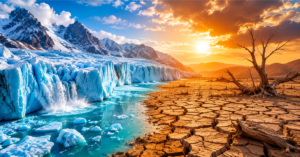
Water is essential for mountain communities in Gilgit Baltistan. The region, fed by glaciers, seasonal snowmelt, and high-altitude streams, is part of the upper Indus Basin, one of South Asia’s most important water sources. But climate change is quickly altering these delicate water systems. Higher temperatures, changes in rainfall, and more unpredictable weather are disrupting the water cycles that have supported local farming and livelihoods for generations. Although scientists have studied glacier retreat and changes in water flow, there has been much less focus on how water is managed and shared as these changes happen. In a place where water security depends on both nature and community institutions, good governance could be the key to future resilience.
According to the Sixth Assessment Report of the Intergovernmental Panel on Climate Change (IPCC AR6, 2021), high mountains in Asia have experienced accelerated warming compared to global average temperature, contributing to widespread glacier retreat and altered snowmelt regimes. Similarly, the comprehensive regional assessment titled “The Hindukush Himalaya Assessment: Mountains, climate change, sustainability and people” (2019) by the International Center for Integrated Mountain Development highlights that even under moderate emission scenarios, significant reductions in glacier volume are projected by the end of the century. These changes are expected to initially increase meltwater flows, followed by long-term declines, posing serious risks to water security across upper Indus Basin.
While much of existing literature focuses on glacier retreat and hydrological change, far less attention has been given to how water is governed and managed in response to these transformations. In Gilgit Baltistan, water distribution relies on a combination of traditional community managed irrigation systems and formal institutional frameworks. As climate pressure increases, the effectiveness of these governance systems becomes a decisive factor in ensuring sustainable water access for agriculture, hydropower, and domestic waste.
This article examines how climate change is reshaping water availability in Gilgit Baltistan and critically explores whether current governance mechanisms are equipped to respond to emerging hydrological risks. By integrating scientific research, regional climate assessments, and policy perspectives, the discussion moves beyond physical water scarcity to address the deeper institutional and governance challenges that will define the region’s climate resilience in coming decades.
Geographic and Climatic Overview of Gilgit Baltistan:
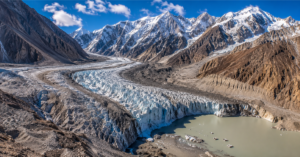
Gilgit Baltistan is in northern Pakistan at the confluence of three major mountain systems, the Karakorum, Himalayas and Hindukush. This unique geographical position makes the region one of the most glaciated areas outside the polar regions. Often referred to as a part of the (Third pole) the broader Hindukush, Karakorum, Himalaya (HKH) region stores vast quantities of freshwater in the form of snow, ice, feeding major river systems across south Asia.
Gilgit Baltistan forms a crucial part of the upper Indus Basin. The Indus River and its tributaries including the Gilgit, Hunza, and Shigar rivers originated from glacier and snow-fed catchments in the mountainous terrain. These high-altitude cryosphere systems regulate downstream water supply, supporting agriculture, hydropower generation, and domestic consumption across Pakistan.
According to the assessment report “The Hindukush Himalaya Assessment: Mountains, climate change, sustainability and people” (2019) by the International Centre for integrated Mountain Development, the HKH region contains approximately 54,000 glaciers, making it one of the largest reserves of ice outside the Arctic and Antarctic. Pakistan alone hosts more glaciers than any other country outside the polar regions, with a significant concentration in Gilgit Baltistan. These glaciers act as natural water reservoirs, releasing meltwater during warmer months and sustaining river flows during dry periods.
Climatically, Gilgit Baltistan experiences high variability due to its complex topography. Precipitation patterns differ significantly across valleys and elevation gradients. Lower valleys tend to be arid to semi-arid, receiving limited rainfall annually, while higher elevations accumulate substantial snowfall during winter months. Research cited in the sixth Assessment Report of Intergovernmental Panel on Climate Change (IPCC AR6, 2021) indicates that high mountains in Asia have experienced accelerated warming over recent decades. Rising temperatures are influencing snow accumulation, glacier mass balance, and the seasonal timing of meltwater discharge.
Hydrologically, the region follows a distinct seasonal regime. River discharge typically peaks during late spring and summer due to glaciers and snowmelt, while winter months experience significantly reduced flows. This seasonal concentration of water availability makes communities highly dependent on predictable melt cycles. However, climatic shifts are increasingly altering the timing and magnitude of runoff, leading to earlier snowmelt, intensified summer flows, and growing uncertainty during late season irrigation periods. The Geographic and climatic characteristics of Gilgit Baltistan therefore create both opportunity and vulnerability. While the region’s glaciers provide a vital freshwater buffer, its reliance on cryosphere processes makes it highly sensitive to temperature rise and climate variability. Understanding this physical foundation is essential before examining how governance systems must evolve to manage emerging water risks in a changing climate.
Climate change impacts on Water Availability
Glacier and Snow Melt: A Changing Balance:
Gilgit Baltistan’s freshwater availability is closely linked to the cryosphere, glaciers and seasonal snow cover which act as natural reservoirs and regulate water flows throughout the year. Recent research shows that snowmelt is the main source of river flow in the Gilgit River basin (GRB) in Pakistan, followed by glacier melt and rainfall. To measure each source’s contribution, researchers used two methods: the Spatial Processes in Hydrology (SPHY) model, which examines hydrological processes over large areas, and the Snowmelt Runoff Model (SRM), which simulates runoff in the GRB from 2001 to 2012. Both models produced promising results in replicating runoff. However, the SRM was slightly less efficient and accurate because it struggled to simulate glacier melt and extreme discharge, especially in July and August when glacier melt is high. SPHY performed better, as it could separate the contributions of glaciers, snow, and rainfall to runoff during the melt season. On average, both models showed that snowmelt accounted for 62% of the runoff, glacier melt for 28%, and rainfall for 10% in this basin.
Over time, water resources in the Gilgit River Basin may decrease, especially meltwater from snow and glaciers, which may not be enough to meet growing demand. This projection can help guide adaptation plans and encourage exploring other ways to manage future water shortages.
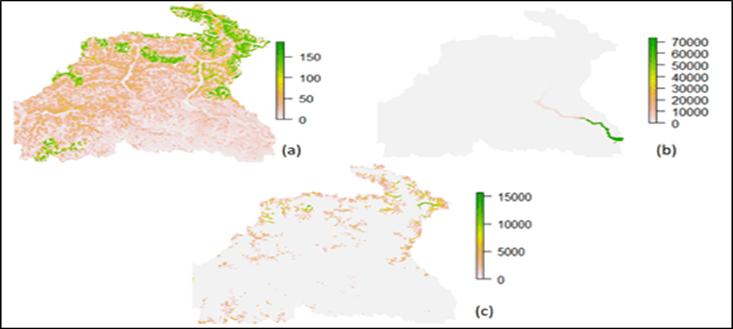
Figure 1 : Routed Runoff simulated by SPHY for the year 2010 at Gilgit River at Gilgit, a) Rain runoff (b) Snow runoff (c) Glacier runoff, All units in (m3/sec) From ICIMOD Report
The research team also examined the potential impact of climate change on future flows under two climate scenarios, Representative Concentration Pathways (RCPs) 4.5 and 8.5. Based on this assessment, our researchers project that the summer flow in GRB will increase by 5.6%–19.8% due to increased temperatures of 0.7–2.6°C during the period 2039-2070.
Recent studies confirm that glaciers in the Hindu Kush–Karakoram–Himalaya (HKH) region, which supply most Gilgit-Baltistan’s rivers, are experiencing dynamic changes. While some glaciers exhibit mass loss, others advance or remain stable due to complex local climate effects; overall, the trend reveals increased variability in water availability. This variability intensifies the challenge of predicting seasonal water supply, a core requirement for effective water governance.
Implications for Water Security:
The study finds that water management facilities in Pakistan lack the capacity to store sufficient water during peak-water seasons and to use it during drought or low-flow periods. According to Sher Muhammad, a remote sensing specialist from Pakistan, “The sensitivity of the water sector was recently highlighted when the storage capacity of the Tarbella, Mangla, and Chashma hydropower reservoirs was compromised due to heavy silt loads, during which dam operations ran at a much-reduced capacity.”
Variability in snow and glacier melt influences both the volume and timing of water availability. Traditional agricultural calendars and water-sharing arrangements rely on predictable seasonal flows. Early or intense water pulses may exceed storage capacity, leading to soil erosion, whereas late-season shortages can harm crops and livestock. Therefore, increasingly unpredictable snowfall and melt dynamics pose a substantial challenge to water security in mountain agricultural systems.
Although glacial meltwater can temporarily increase river discharge, it simultaneously elevates the risk of hydro-meteorological hazards, including flash floods and unstable glacial lakes. These hazards introduce additional vulnerabilities for communities that depend on meltwater for irrigation and domestic use. The interplay between climate-induced changes in river flow and socio-economic reliance on water resources underscores the necessity of comprehensive adaptation planning.
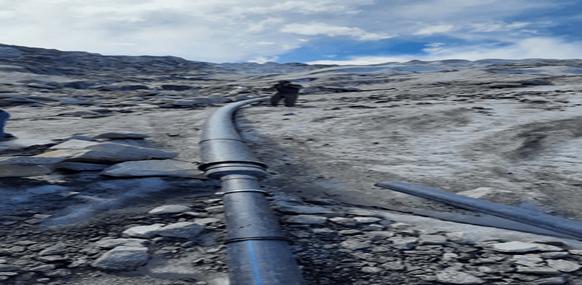
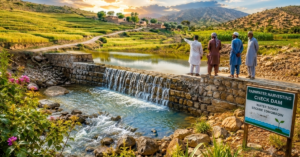
Figure 2: The disruption of glacier-fed irrigation channels is common in Gilgit-Baltistan. Photo by (ICIMOD)
The unpredictable behaviour of snow and glaciers is a serious concern for the community, especially in GB, where almost all farmers rely on water from melting snow and glaciers for irrigation. Glaciers throughout the UIB are shrinking, and the GB region faces the same problem. The khurdopin Glacier Shimshal valley has been moving forward since 2017. Passu Glacier lost 10% of its mass between 1977 to 2014. Since 2018, the Shispher Glacier has been advancing, putting downstream communities at risk, eroding farmland, and disrupting water supplies. At Ghulkin Glacier, small lakes often burst, damaging farmland and parts of Karakoram Highway. (Climate change and water security in the mountains of Pakistan. ICIMOD).
Traditional water Management Systems in Gilgit Baltistan:
People in Gilgit Baltistan have long created local ways to manage water shortages in their tough mountain setting. Farming here depends on irrigation channels that carry meltwater from glaciers and seasonal streams to the fields. These channels are called Kuls, are built and looked after by the community. Local rules govern how water is shared, who maintains the channels, and how farmers resolve disputes.
Meltwater irrigation is vital for Agriculture in this region. In many mountain communities in the Upper Indus Basin, almost 95% of farmers rely on water from snow or glacier melting for their crops and daily needs. Because so many people depend on meltwater, even small changes in its availability can greatly affect the food production in rural life. (ICIMOD)
Much of the arable land in GB sits higher than the main river, so water lifting-technologies could help bring river water to these fields and allow more land to be farmed. Tools like hydraulic ramp pumps and solar pumps can move water uphill. Hydraulic ramp pumps use the force of flowing water and do not need outside energy, while solar pumps run on solar power. Each method needs certain conditions to work well. Solar pumps are best for clean, sediment free water, while hydraulic ramp pumps require a sufficiently steep slope to lift the water.
After field visits and discussions with partners showed these options were practical, ICIMOD tested hydraulic and solar pumps in several villages in GB. These technologies help increase the amount of arable land and boost agricultural production.
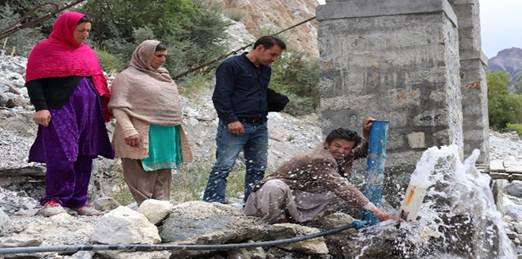
Figure 3 The hydro-ram pump is an energy efficient technology which runs on Zero energy. (ICIMOD)
Traditional irrigation systems have worked well for centuries, but today they face new challenges. Growing populations, shifts in land use, and infrastructure constraints have made water resources scarcer. If governance and adaptation planning do not improve, these systems may struggle to handle future climate changes.
Water Governance Challenges in Gilgit Baltistan:
Traditional water management practices are still important, but strong governance frameworks are now crucial for tackling today’s water challenges in mountain regions. Here, governance means the policies, institutions, and decisions that guide how water resources are shared, managed and protected.
Studies on water governance in mountain areas show that weak institutions often exacerbate climate-related water risks. In many high-altitude areas, such as northern Pakistan, water management faces challenges including divided institutions, insufficient technical skills, and poor coordination between local and national governments. These issues make it difficult to implement long-term plans for sustainable water management.
The study suggests increasing the storage capacity of current reservoirs and building new ones. Since Pakistan relies on agriculture, its irrigation system depends on the water stored in the Indus basin. If climate change causes more seasonal changes in water flow, the current infrastructure may not store enough water for dry periods, making the region more vulnerable. Quick decisions are needed to address this issue.
The study suggests improving hydrological models by collecting field data during regular glacier visits, especially during the early and late ablation periods. Better monitoring and model performance will lead to stronger results that can guide sustainable water management policies such as climate change.
Climate change is making it harder to predict water flows in the Indus Basin. With more unpredictable rainfall and changing meltwater, planners and policymakers struggle to predict how much water will be available. Because of this, it is more important than ever to adopt adaptive governance that integrates climate data, hydrological monitoring, and local knowledge.
Climate Adaptation strategies for Mountain Water Systems:
As climate pressures intensify, it is crucial to develop adaptation strategies that enhance water resilience in mountain regions. Recent studies highlight the need to combine environmental monitoring, institutional changes, and community involvement when creating solutions for these areas.
The main approach is to improve monitoring systems for glaciers, snow, and river flow. Reliable data on these changes helps policymakers predict seasonal water supplies and plan how to share water. Better hydrological models and satellite tracking also help leaders make smarter choices in areas that rely on glaciers.
Expanding water storage and improving irrigation efficiency are also important steps. Since meltwater is available mostly at certain times of year, collecting extra water during peak melt can help keep supplies steady during dry periods later. Building reservoirs, creating small storage ponds, and using better irrigation methods can make a big difference for farmers who rely on this water.
Community-based adaptation is also important. In many mountain areas, people have long used local knowledge to manage water. Combining these traditional practices with modern climate science can help build stronger systems that fit both the environment and local needs.
To adapt effectively, local communities, researchers, and government institutions need to work together. Without this kind of teamwork, technology by itself will not solve the complex water governance problems in glacier-dependent areas.
Outlook for Water Security in Gilgit Baltistan:
Water availability in Gilgit-Baltistan will be shaped by changes to glaciers and seasonal snow. As temperatures go up, scientists expect more meltwater at first. However, as glaciers get smaller, water supplies could eventually decrease. This trend, called “peak water,” means that places with more meltwaters now might face shortages later in the century.
Research shows that glaciers in the Hindu Kush, Karakoram, and Himalaya regions could lose much of their ice if warming continues. This loss may reduce water supplies for millions of people who rely on the Indus Basin.
Changing snow patterns could also shift when seasonal runoff occurs. If snow melts earlier and less snow accumulates in winter, it can upset irrigation plans and farming cycles that depend on steady water flows.
Given these risks, improving water governance and climate adaptation strategies is key to achieving sustainable water management in the region. Policies that combine climate science, community input, and stronger infrastructure can help protect water resources for the future.
Policy Recommendations for Climate Resilient Water Governance:
Addressing water challenges in Gilgit-Baltistan requires more than monitoring glacier retreat. Sustainable solutions depend on scientific knowledge, stronger institutions, and community-driven management. As meltwater becomes harder to predict, policymakers need to focus on building resilience in both natural resources and governance.
Improving hydrological monitoring is essential. We need to better track water systems and combine this information with climate data. Accurate data on glacier mass, snow cover, and river flow make it easier to predict water supplies. With improved monitoring tools and satellite images, authorities can notice changes in melt patterns earlier and plan accordingly. Research on mountain water systems highlights that strong data infrastructure is crucial for managing water in glacier-dependent regions as the climate changes (Trends in Climate Adaptation Solutions for Mountain Regions, 2024).
Expanding water storage and improving irrigation efficiency are important policy goals. Since most of the region’s water comes during short summer melt periods, effective storage systems are needed to prevent seasonal shortages. Building small reservoirs, upgrading irrigation channels, and using modern water-saving technologies can help communities adapt to changes in meltwater supply. Studies of glacier-fed irrigation systems show that better storage and distribution can greatly improve water security for mountain farmers (ICIMOD, Importance of Glaciers for Water Availability in Pakistan).
Improving coordination and governance frameworks is important. In many mountain regions, water management is split between different departments and levels of government. This separation can make climate adaptation strategies less effective. Studies on mountain water governance show that integrated water resource management, which brings together local institutions, government agencies, and scientific organizations, is essential for addressing new water challenges (International Development Research study on glacier-dependent irrigation systems).
Community participation must remain at the heart of future water policies. People in Gilgit-Baltistan have a deep understanding of seasonal water flows, glacier patterns, and irrigation management. Combining their experience with modern scientific research can help create adaptation strategies that work better and are more accepted by the community. Local water management models have supported agriculture in the region for generations, so these approaches should be built up, not replaced.
Conclusion:
Water in Gilgit-Baltistan depends heavily on the region’s glaciers, snow, and mountain climate. In the past, these natural systems stored water, kept rivers flowing, and supported farming, energy, and daily life in the Upper Indus Basin. Now, climate change is disrupting the balance that has long controlled water supplies here.
Warmer temperatures and shifting rainfall are changing how snow and ice melt, making water supplies less predictable and harder to manage. Although melting glaciers might boost river flows for a while, experts warn that ongoing glacier loss could make water supplies less reliable in the future. Because of this, it is important to reconsider how water is managed in places that depend on glaciers.
Traditional irrigation and community water management have worked well for centuries. Still, these methods might not be enough to handle the challenges brought by climate change. To use water, it is important to improve coordination among institutions, invest in monitoring, upgrade storage systems, and integrate scientific research with local knowledge.
The future of water security in Gilgit-Baltistan relies on the health of its glaciers and good water management. If policymakers and communities use flexible, inclusive methods, they can protect mountain water resources and help the region adapt to climate change for future generations.