Introduction
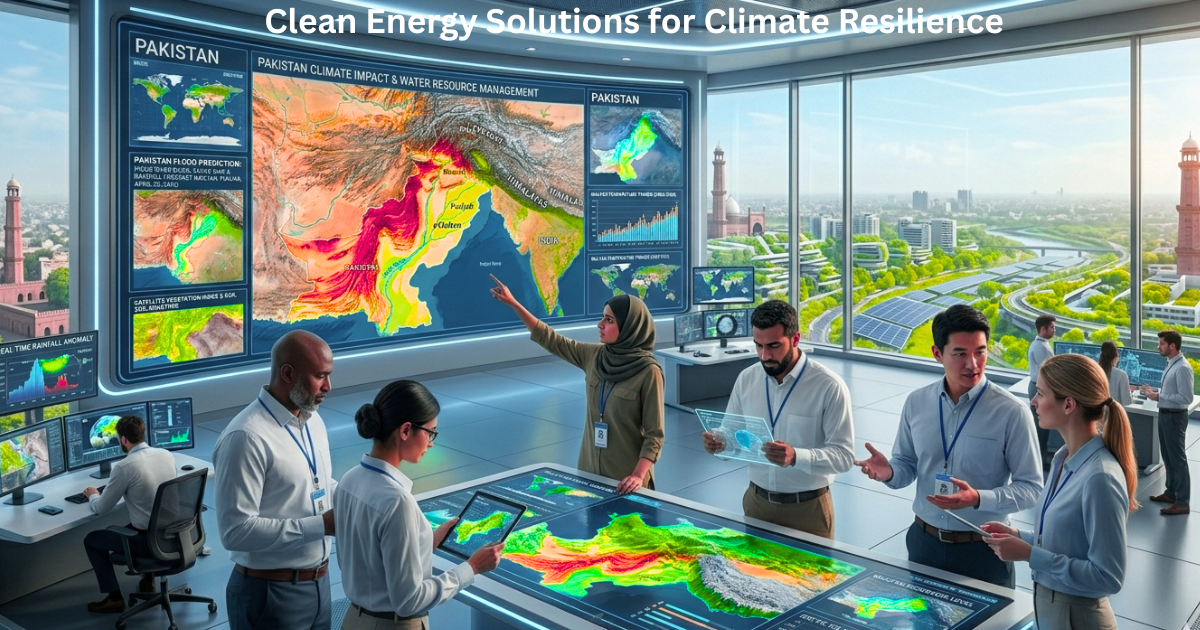
Clean energy solutions for climate resilience are not only a choice anymore, but they are necessary for survival in the century. Our planet is breaking records that are not desirable. The year 2024 was the year on record. We have already crossed seven of nine planetary boundaries. And till 2050, it is expected that climate change could cause over 14.5 million additional deaths worldwide. They are not distant warnings. Rainfall, water shortages, forest fires, and extreme temperatures are already transforming our cities, agriculture, and economy, and South Asia is also included in these changes.
The good news? We don’t need to just wait and hope for governments to act alone. Clean energy is one of the best tools available today for communities, businesses, and leaders to build a safer, more resilient future. In this article, we’ll explain to you how renewable energy, smart grids, and AI-powered climate intelligence work together to protect people from the growing impacts of climate change.
Why Clean Energy Is the Backbone of Climate Resilience
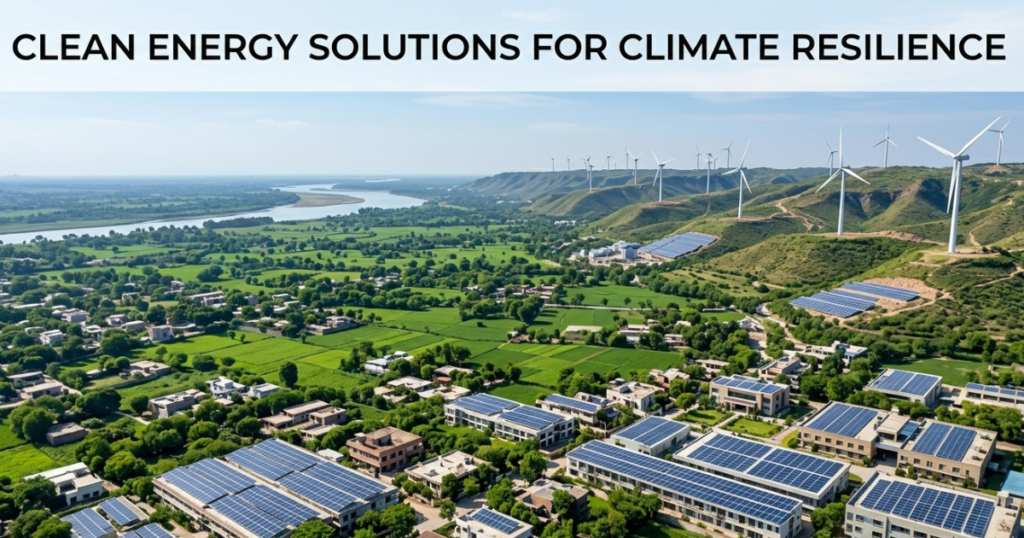
Climate resilience refers to the ability of any community, ecosystem, or economy to cope and bounce back after exposure to any form of climate shocks, such as floods, drought, heatwaves, and violent storms.
No other factor drives resilience better than clean energy, and there are many reasons for that, but here are the top three.
.
It Reduces Dependence on Fragile Fossil Fuel Systems
The fossil fuel system is deeply vulnerable to climate disorder. A flood can shut down a coal plant. A heatwave can reduce the efficiency of gas turbines. A supply chain disturbance can increase energy prices overnight.
Even if the primary grid fails, solar power from rooftops, wind turbines from hills, and community-level grids fueled by water currents from neighboring rivers could operate. Energy sovereignty would be restored. They put energy control back once more.
It Directly Cuts the Emissions Driving Climate Change
Every kilowatt-hour from a solar panel replaces one that would otherwise come from burning coal or gas. This directly reduces the greenhouse gas emissions that are making climate change worse. In 2025, clean energy investments reached a staggering $2.2 trillion globally, surpassing fossil fuel funding for the first time in history.
It Powers Other Adaptation Solutions
This is the most underappreciated connection. Clean energy does not just reduce emissions, it powers adaptation tools. Solar energy runs early-warning systems. Wind energy powers desalination plants in drought-prone regions. Mini-grids keep hospitals running after cyclones. Without reliable clean energy, adaptation itself becomes impossible.
The Most Powerful Clean Energy Solutions for Climate Resilience
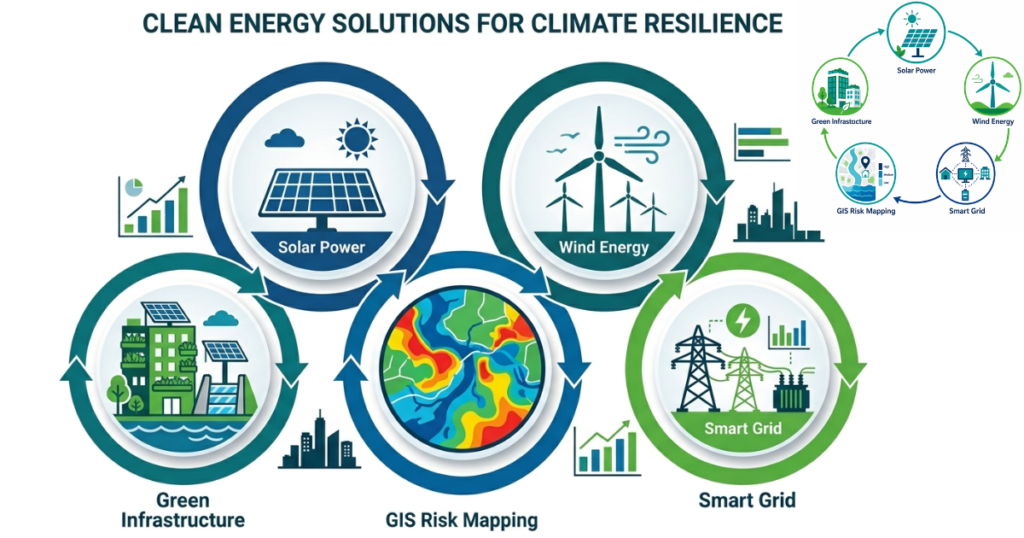
1. Solar Power, The World’s Most Democratic Energy Source
Solar photovoltaic (PV) technology has become the fastest-growing energy source in history. Costs have dropped by over 90% in the past decade. Today, solar is cheaper than coal in most parts of the world.
For climate resilience, solar offers unique advantages:
- Rooftop solar keeps homes and hospitals energized after grid failures caused by storms
- Agrivoltaics, placing solar panels above crops, reduces water evaporation, protects plants from extreme heat, and generates power simultaneously. This is being actively tested in Kenya, Tanzania, and South Asia.
- Floating solar on reservoirs reduces water evaporation in drought-prone areas while generating clean power.
In Pakistan, solar energy is particularly promising. The country receives among the highest solar irradiation in the world. Explore AI Geo Navigators’ Remote Sensing & Image Analytics services to map solar potential in your region with satellite-level precision.
2. Wind Energy, Reliable Power for Resilient Communities
Wind power is one of the most cost-effective forms of electricity generation today. Coastal and highland regions of Pakistan, including Sindh and Balochistan, hold enormous untapped wind energy potential.
For communities facing climate disruption, distributed wind turbines provide a reliable backup when centralized grids fail. Small-scale wind farms can be paired with battery storage to create micro-grids that serve entire villages.
3. Off-Grid and Distributed Energy Systems
This is one of the most important but neglected energy sources of renewable energy.
The power grid is dangerously weak during natural disasters. The moment there is flooding, the electricity transmission lines fail. If there is a cyclone, the substation fails. The result? Whole districts plunge into darkness, just when they need energy the most.
The answer to this lies in off-grid, decentralized energy generation systems. A solar-based mini-grid system in a village will be independent of the power grid, failing 200 kilometers away. It powers the water pumps. It helps keep health clinics functioning. It helps sustain communications.
For instance, in the Rangamati Hills of Bangladesh, a solar-powered tube well was established within a decentralized energy generation initiative and helped communities survive a serious drought period.
AI Geo Navigators’ Spatial Databases & Web GIS solutions help governments and NGOs identify the most vulnerable communities and plan optimal mini-grid placement using real geospatial data.
4. Smart Grids and Energy Storage
A smart grid is a power network that uses digital technology to monitor, manage, and respond to energy demand in real time. Combined with battery storage, smart grids dramatically improve resilience.
Here is why this matters for climate adaptation:
- Smart grids can automatically reroute power away from flood-affected areas
- Battery storage keeps energy available during extended outages after extreme weather events
- AI-powered demand response systems reduce peak load stress during heatwaves
- Grid modernization consistently improves resilience against extreme weather
In 2025, grid modernization efforts reduced transmission losses and improved weather resilience across multiple major markets. The technology is proven. The question now is deployment speed.
5. Modular Geothermal Energy
People often don’t think about geothermal energy for some reason, but that shouldn’t be the case.
Unlike solar and wind energy, geothermal energy is not affected by the weather; therefore, you can count on it for clean energy 24/7. Today, there are various types of geothermal systems available that can be factory-made with modular & portable features and installed wherever there is a place.
An example is a pilot project in Nevada that generated over 3.5 megawatts ( MW ) of endless electricity from a closed-loop system; this indicates that geothermal technology is scalable and will support all types of critical infrastructure in the event of prolonged blackouts due to extreme weather conditions.
6. Green Buildings and Energy-Efficient Infrastructure
Building accounts for almost 40% of worldwide energy use, so designing energy-efficient buildings has an enormous impact on reducing greenhouse gases while increasing the community’s resilience as well
Green building design includes:
- Passive cooling, reducing dependence on energy-intensive air conditioning during heatwaves
- Rainwater harvesting systems integrated with energy-efficient pumps
- Net-zero energy buildings that generate as much energy as they consume
- Climate-resilient construction materials that are climate-resistant and can withstand severe weather
The FORTIFIED Home™ program in the US provides certification for the construction of hurricane-resistant homes and serves as a model for other energy-efficient homes that have been built to meet this standard by providing insurance rebates and state grant programs to incentivize buildings designed using energy efficiency and resiliency features
How AI and GIS Are Transforming Clean Energy Deployment for Climate Resilience
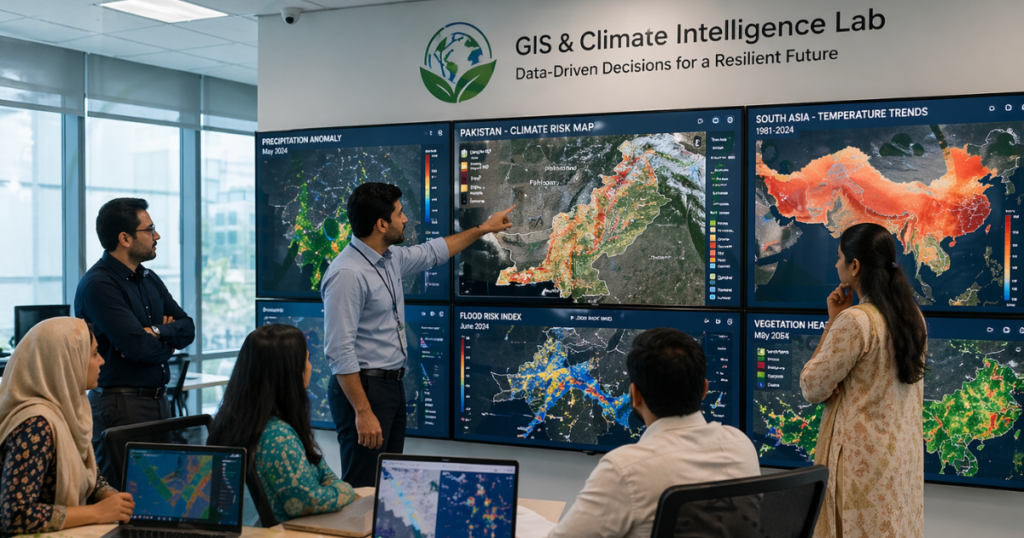
This is the gap that most articles completely miss.
Clean energy deployment without spatial intelligence is like building a flood barrier in the wrong place. You need to know where the risks are, who is most vulnerable, and where energy infrastructure will have the greatest impact on resilience.
That is exactly where AI-powered geospatial intelligence comes in.
AI-Powered Climate Risk Mapping
AI Geo Navigators’ Risk Analytics & Decision Intelligence services combine satellite imagery, climate models, and machine learning to produce granular risk maps. These maps show:
- Which areas face the highest flood, drought, or wildfire risk
- Where energy infrastructure is most likely to fail during extreme weather
- Which communities have the least resilience capacity and need off-grid solutions most urgently
Governments and development organizations use these maps to prioritize clean energy investments where they matter most.
Remote Sensing for Real-Time Environmental Monitoring
Satellite-based remote sensing monitors land-use change, crop health, water availability, and atmospheric conditions in near real time. This data is essential for:
- Identifying areas experiencing accelerating desertification (where solar-based land restoration can help)
- Monitoring crop stress during droughts (where agrivoltaics or solar-powered irrigation can intervene)
- Tracking urban heat islands (where green roofs and solar integration can reduce temperatures)
Explore AI Geo Navigators’ Geospatial Data Production capabilities to understand how this data is collected, processed, and applied.
Predictive Modeling for Energy System Resilience
AI Geo Navigators’ Predictive Modeling & AI Development services enable energy planners to simulate how extreme weather events will affect energy systems, before those events occur. This allows utilities and governments to:
- Pre-position emergency energy resources
- Design grid topologies that are inherently more resilient
- Model the return on investment of different clean energy deployment strategies
The Shocking ROI of Clean Energy for Climate Resilience
Here is a fact that most people do not know: investing in climate resilience is enormously profitable.
Consider these verified figures:
- Every $1 invested in climate adaptation generates $12 in economic benefit (Standard Chartered analysis, 10 emerging markets)
- The US Chamber of Commerce found that every $1 spent on resilience saves $13 in damage and cleanup costs
- World Resources Institute analysis of 320 adaptation investments across 12 countries found that every $1 yields over $10.50 in benefits over 10 years.
- Global clean energy investment reached $2.2 trillion in 2025, the first year it surpassed fossil fuel funding.
- The investment opportunity for climate adaptation solutions is projected to grow from $2 trillion today to $9 trillion by 2050
These are not optimistic projections. They are documented returns from real investments already made. The economic case for clean energy and climate resilience is stronger than the case against it.
Clean Energy for Climate Resilience in South Asia and Pakistan
South Asia is one of the regions most vulnerable to climate change in the world. Pakistan, in particular, faces:
- Devastating annual monsoon floods (2022 floods submerged one-third of the country)
- Accelerating glacial melt in the Himalayas and Karakoram range
- Severe water scarcity in Balochistan and parts of Punjab
- Extreme heat events exceeding 50°C in Sindh and southern Punjab
- Rapid, unplanned urban expansion in Karachi, Lahore, and Islamabad
Consequently, Pakistan has one of the world’s highest needs for clean energy solutions that simultaneously reduce emissions and build resilience.
However, the country also has extraordinary clean energy advantages:
- Among the highest solar irradiation globally
- Significant wind corridors in Sindh
- Massive hydropower potential in the north
- A young, tech-savvy population ready to adopt new solutions
AI Geo Navigators — Pakistan’s leading climate-intelligence and geospatial firm– is already working to bridge this gap. By combining AI, GIS, and remote sensing, the team delivers actionable intelligence to help communities, governments, and businesses make smarter clean energy and climate adaptation decisions.
Contact AI Geo Navigators today to explore how geospatial intelligence can support your clean energy and climate resilience goals.
Practical Steps to Build Clean Energy Resilience, For Communities, Businesses, and Governments
For Communities
- Assess your local climate risk using GIS-based risk maps before investing in infrastructure.
- Install rooftop solar with battery backup to maintain power during grid outages.
- Support community mini-grid projects to reduce dependence on centralized infrastructure
- Adopt water-smart energy systems, solar-powered pumps, drip irrigation with clean energy.
For Businesses
- Conduct a climate risk assessment of your supply chain and infrastructure
- Switch to on-site renewable energy to reduce exposure to energy price volatility
- Integrate ESG reporting that tracks both energy transition and climate resilience metrics
- Partner with geospatial intelligence providers to model climate risk across operations
Explore AI Geo Navigators’ ESG Consulting Services to align your business with climate resilience standards.
For Governments and Policymakers
- Mandate climate risk disclosure for all major energy and infrastructure projects
- Create incentives for distributed renewable energy, feed-in tariffs, tax credits, and grants.
- Integrate climate risk mapping into all urban planning and energy policy decisions.
- Fund community-level adaptation programs that pair clean energy access with resilience training
AI Geo Navigators’ Decision Support & Applied GIS Solutions provide the spatial intelligence governments need to make these decisions effectively.
Nature-Based Clean Energy Solutions, The Triple Dividend
Nature-based solutions offer what experts call a “triple dividend” for climate resilience:
- They avoid losses from climate impacts
- They generate economic gains
- They deliver social and environmental benefits
When combined with clean energy, nature-based solutions become even more powerful:
- Agrivoltaics grow food, generate power, and reduce water consumption simultaneously
- Afforestation with solar integration restores degraded land while powering local communities
- Wetland restoration reduces flood risk while creating carbon sinks that offset emissions from the energy sector
- Mangrove restoration alongside coastal wind energy provides both storm protection and clean power
In China’s Gobi Desert, large-scale solar arrays are simultaneously generating clean power and reversing desertification, creating microclimates that support native vegetation and restore biodiversity.
This integrated approach to clean energy and nature is the frontier of climate resilience strategy in 2025.
Conclusion
The reality is the climate emergency is upon us; however, solutions are at hand.
Clean energy solutions are available and provide effective and immediate alternatives for climate adaptation or resilience to our crises; for example, the deployment of solar energy, wind power, smart grids, micro grids, and geospatial intelligence using artificial intelligence.
The returns on investment from these clean energy solutions will be exceptional; the technologies are mature, and the need for clean energy is urgent.
As a result, there is something you can do; no matter if you are a community leader, business owner, non-governmental organization, or government official, you can make a difference by taking action, first understanding your climate risk and then utilizing clean energy to protect your most precious resources.
Discover how AI Geo Navigators can help you map climate risk and deploy clean energy solutions, using cutting-edge GIS, remote sensing, and AI-powered climate intelligence.
FAQs
What are clean energy solutions for climate resilience?
Renewable energy technologies, such as wind, solar, hydropower, and geothermal, along with smart grid systems and AI-enabled monitoring tools, serve as clean energy solutions to enhance climate resiliency for communities, businesses, and governments. They also help reduce greenhouse gases and help reinforce the infrastructure so that people can rely on it, even if extreme weather conditions occur.
How does solar energy help with climate adaptation?
Solar energy helps with climate adaptation in multiple ways. It provides reliable power during grid outages caused by storms and floods. Agrivoltaic systems protect crops from extreme heat while generating electricity. Solar-powered water pumps ensure access to water during droughts. Off-grid solar systems keep hospitals and emergency services operational after climate disasters, precisely when reliable power is most critical.
What is the ROI of investing in clean energy for climate resilience?
The return on investment is significant. Research indicates that for every dollar ($1) invested into creating climate resiliency, there will be an estimated economic benefit between ten dollars ($10) and thirteen dollars ($13) due to avoiding costs from damages, job creation, and increased productivity. Investing in clean energy will have additional returns due to decreasing energy costs, improving energy security, and reducing future infrastructure replacement costs after extreme weather events.
How is AI used in clean energy and climate resilience?
Artificial Intelligence’s Role in Identifying Climate Risks and Optimizing Clean Energy Deployment via Satellite Imagery, Climate Models, and Infrastructure Data. AI predictive modeling can show us how energy systems will react to extreme weather patterns. Machine learning algorithms process remote sensing data to monitor crop health, track desertification, map flood zones, and guide smart grid management for maximum resilience.
What clean energy solutions are best for Pakistan?
Pakistan has exceptional solar irradiation, significant wind corridors in Sindh, and major hydropower potential in the north. For climate resilience, the most impactful solutions include: rooftop solar with battery storage for urban and peri-urban areas; solar-powered mini-grids for rural and remote communities; wind energy development in coastal Sindh; and AI-GIS-powered climate risk mapping to guide investment priorities across flood-prone, drought-affected, and heat-stressed regions.
What is the difference between climate mitigation and climate adaptation?
Climate mitigation refers to actions that reduce or prevent greenhouse gas emissions, such as switching from coal to solar power. Climate adaptation refers to actions that help communities cope with climate impacts that are already happening or unavoidable, such as building flood barriers or installing drought-resistant crops. Clean energy is unique because it achieves both: it mitigates climate change by cutting emissions while also enabling adaptation by providing resilient, decentralized energy infrastructure.
How can geospatial data improve clean energy planning for climate resilience?
Geospatial data, collected through satellite remote sensing, drone surveys, and IoT sensors, provides the spatial intelligence needed to deploy clean energy where it has the greatest resilience impact. GIS maps show which communities face the highest climate risk, where energy infrastructure is most vulnerable, and where distributed renewable energy will deliver the greatest benefit. Without this spatial intelligence, clean energy investments risk being placed in the wrong locations or failing to reach the most vulnerable populations.