Introduction:
Climate change has emerged as one of the defining challenges of the twenty-first century. Rising global temperatures, intensifying storms, prolonged droughts, accelerating sea-level rise, and widespread ecosystem degradation are no longer distant threats; they are living realities for millions of people worldwide (IPPC,2022).
In response, societies have traditionally employed heavy solutions such as dams, seawalls, drainage systems, and air conditioning infrastructure. While these approaches have delivered short-term protection in many cases, they are often expensive. Energy-intensive and environmentally disruptive. Increasingly, researchers and policymakers are recognizing that long-term climate resilience cannot be achieved by working against natural systems. Instead, it requires working with them.
Nature-based solutions are a new way to address climate change by focusing on protecting and working with ecosystems rather than controlling or replacing them. These solutions aim to protect, restore, and manage natural areas so they continue to provide important benefits to people and the environment. Forests, wetlands, mangroves, grasslands, rivers, and coastal areas already help regulate the climate, store carbon, manage water, and support wildlife. Nature-based solutions build on these natural roles while also meeting social and economic needs.
NBS are particularly significant in the current climate context due to their capacity to deliver multiple benefits concurrently. For example, a restored wetland can reduce flood risk, improve water quality, sequester carbon, support wildlife, and enhance local livelihoods. This multifunctionality distinguishes nature-based solutions from conventional interventions that typically address only a single issue. As climate change, biodiversity loss, and social inequality increasingly intersect, integrated approaches such as NBS are receiving growing global attention.
Besides helping the environment, nature-based solutions are also known for being cost-effective and lasting a long time. Unlike traditional infrastructure, which can wear out and need constant repairs, healthy ecosystems often get stronger over time. They can adapt and recover, offering flexible protection as the climate changes. This makes nature-based solutions a good choice for dealing with future challenges.
Defining Nature-Based Solutions
A nature-based solution is any action that protects, restores, or manages natural systems to help solve environmental problems and benefit both people and nature. The International Union for Conservation of Nature says NBS are actions that protect, manage, and restore natural or changed ecosystems to effectively and flexibly address society’s challenges (IUCN,2020).
The World Resources Institute points out that NBS use natural processes like filtering water, storing carbon, providing shade, and stabilizing soil. These actions bring additional benefits, such as improved human health and greater biodiversity (World Resource Institute,2021).
Diverse Applications Across Global Challenges
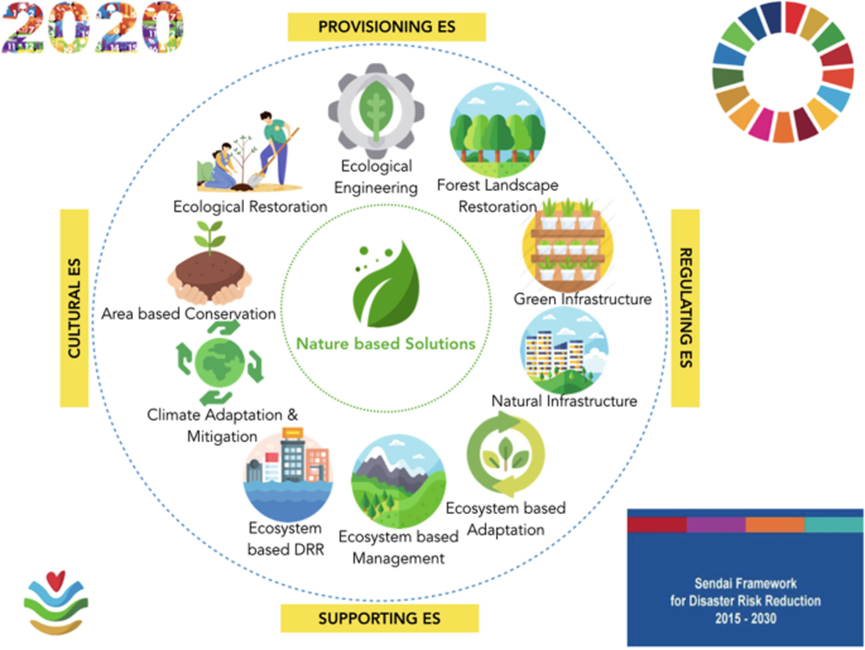
NBS are highly flexible and can be used to address many problems, such as adapting to and mitigating climate change, managing disasters, managing water resources, improving food security, and making cities more sustainable.
Climate Change Mitigation and Adaptation
NBS employs a dual strategy to address climate change. To mitigate, they enhance carbon sequestration through reforestation, afforestation, and the restoration of coastal ecosystems such as mangroves and salt marshes, which serve as significant carbon sinks (IPCC,2022). For adaptation, NBS reduce vulnerability to climate impacts, including extreme weather events, sea-level rise, and heatwaves. Examples include restoring coastal wetlands to protect against storm surges and erosion and developing urban green spaces to mitigate the urban heat island effect. Systematic evidence mapping indicates that NBS interventions are effective in addressing the impacts of climate change and hydrometeorological hazards on people, although most of the evidence comes from high-income countries (Chausson et al.,2020).
Disaster Risk Reduction
NBS are increasingly recognized as sustainable alternatives to traditional engineering solutions for disaster risk reduction. Floodplains and natural wetlands, for example, can attenuate flood peaks by providing substantial hydrologic storage, thereby reducing the impact of heavy rainfall events (World Bank, 2021). In coastal regions, mangroves and coral reefs function as natural barriers, dissipating wave energy and protecting shorelines from erosion and storm damage. This approach is especially important in areas such as the Mediterranean basin, which faces severe coastal degradation and heightened storms and flood risks (Dhyani et al.,2024). Quantifying the effectiveness of NBS in reducing risks from hydrometeorological hazards remains an active area of research, with European examples demonstrating their efficacy.
Urban Sustainability and Green Infrastructure
In cities, NBS are important for making communities stronger and improving people’s lives. Green infrastructure, a key part of urban NBS, involves creating networks of natural and semi-natural spaces (Kabisch at al.,2017). Examples include green roofs, parks, permeable sidewalks, and restored riverbanks. These features help manage stormwater, clean the air, lower city temperatures, and provide recreational spaces. Studies from 2016 to 2022 show that NBS can help solve many city problems (Zhang et al.,2025).
Areas with social housing, which often face more environmental issues, can especially benefit from these solutions. (Urban cooling and energy-saving effects of nature-based solutions across types and scales, 2025)
Challenges and Implementations of Nature-Based Solutions
Despite the recognized potential and numerous benefits of NBS, widespread implementation faces significant challenges. A primary barrier is ambiguity in definitions and practical applications, resulting from the integration of multiple scientific disciplines and delays in establishing clear standards (IUCN,2020).
One of the critical barriers to effective NBS deployment is the institutional capacity and governance frameworks. Studies consistently highlight institutional barriers as a primary reason for the observed implementation gap, particularly in large international projects (Martin et al.,2020). These barriers often include a lack of coordination across government sectors, insufficient policy integration, and limited financial mechanisms tailored to NBS.
Financial challenges also hinder NBS implementation. Although NBS can be cost-effective over the long term, initial investment costs may exceed those of traditional grey infrastructure, and existing funding streams are often not structured to support integrated approaches. Innovative financial mechanisms and improved methods for quantifying and monetizing the multiple benefits of NBS are needed to attract investment (UNEP,2022).
The success of NBS frequently depends on stakeholder acceptance and involvement. Projects may encounter resistance and fail to achieve intended outcomes if local communities are not engaged during planning and implementation or if their traditional knowledge and perspectives are overlooked.
From a scientific and technical perspective, there is a recognized need for more robust evidence on the long-term effectiveness and performance of various NBS under different environmental conditions. (Martín et al., 2021) Research is evolving from a primary focus on the scientific basis of NBS to a focus on the practical challenges of implementation and scaling up. There is also a gap in understanding how landscape dimensions influence NBS effectiveness, requiring a more integrated perspective on the relationship between NBS and the broader landscape.
Another challenge involves potential tradeoffs. Although NBS are intended to provide multiple benefits, careful planning is necessary to avoid unintended negative consequences. For example, using a non-native “hyperaccumulator” plant for soil remediation may pose risks of invasiveness and harm to local biodiversity, as ecologists have highlighted.
Pathway For Enhanced Implementation
Addressing these challenges and ensuring accurate adoption of NBS are essential. First, more precise and standardized definitions and guidelines are needed to ensure consistent application and evaluation across contexts. The International Union for Conservation of Nature provides globally recognized standards that are increasingly used to assess NBS programs.
Strengthening governance and policy frameworks is also essential. This involves integrating NBS into spatial planning and policy instruments for climate change adaptation, ensuring that NBS are incorporated as integral components of broader development strategies. For example, the European Union has positioned itself as a leader in promoting NBS through strategies such as the EU Biodiversity Strategy for 2030, which relies on NBS to restore ecosystem integrity and enhance climate resilience.
Financial innovation is paramount. This includes developing robust economic models that fully account for the ecosystem services and co-benefits provided by NBS, thereby increasing their attractiveness to investors and policymakers. Examples include Payment for Ecosystem Services schemes, in which beneficiaries of clean water or flood protection compensate land managers for implementing NBS that deliver these services.
Engaging stakeholders and fostering public awareness and acceptance are critical for successful implementation. This requires effective communication about the benefits of NBS and inclusive, participatory processes involving local communities, indigenous populations, and private-sector actors. Nature-based enterprises are emerging as essential actors in delivering NBS, underscoring the private sector’s role in scaling up solutions.
Role of Natural-Based Solutions in Urban Areas
Urban NBS are crucial for improving urban air quality. Green infrastructure, including urban forests and parks, acts as a natural air filter, trapping particulate matter and absorbing gaseous pollutants like nitrogen dioxide, sulfur dioxide, and ozone. For example, studies in Southern Ontario, Canada, have shown that green infrastructure can significantly reduce tropospheric nitrogen dioxide concentrations, contributing to atmospheric cleansing and public health improvements (Nowak et al.,2014). This function is particularly vital in highly urbanized and industrialized cities such as Liguan City in the Philippines, which faces environmental challenges, including air pollution exacerbated by the climate crisis.
NBS are also essential for sustainable urban water management, particularly in reducing flood risk and improving water quality. As urban areas expand, natural drainage systems are replaced by impervious surfaces, increasing stormwater runoff and overwhelming conventional drainage infrastructure, which leads to urban flooding. NBS such as permeable pavements, rain gardens, bioswales, and restored urban wetlands capture, infiltrate, and filter stormwater runoff, thereby reducing the volume and velocity of water entering drainage systems (EPA 2020). This approach not only mitigates flood impacts but also recharges groundwater and filters pollutants from stormwater.
Furthermore, urban NBS contribute significantly to biodiversity conservation and ecological connectivity within cities. By creating and restoring green spaces, urban NBS provides habitats for various species, supports local flora and fauna, and enhances ecological resilience. Green corridors and interconnected green spaces can facilitate species movement, counteract habitat fragmentation, and promote urban biodiversity, which is a core tenet of NBS.
NBS in urban areas also significantly enhance human well-being and quality of life. Urban green spaces provide opportunities for recreation, physical activity, and social interaction, all of which are vital for mental and physical health. Exposure to nature is associated with reduced stress, improved cognitive function, and enhanced mood (WHO,2016). Citizen perceptions in the Barcelona metropolitan area, for example, highlight how NBS improve local climate resilience and quality of life by providing multifunctional landscapes. These socioeconomic benefits also include the creation of green jobs and more resilient urban infrastructure, offering long-term economic advantages (Raymond et al.,2017).
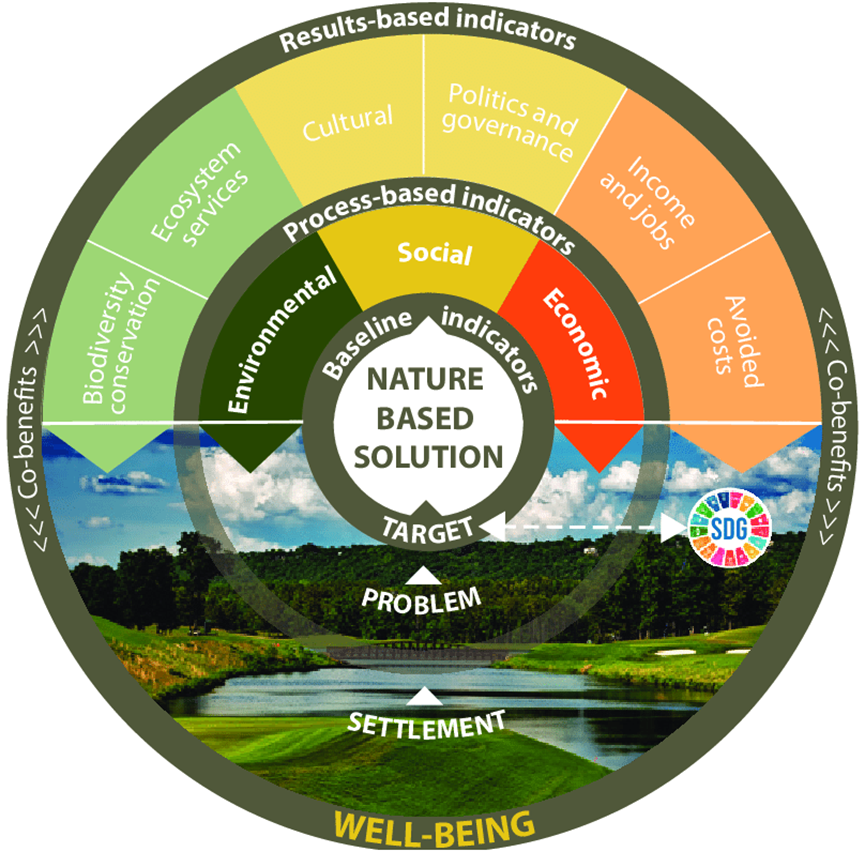
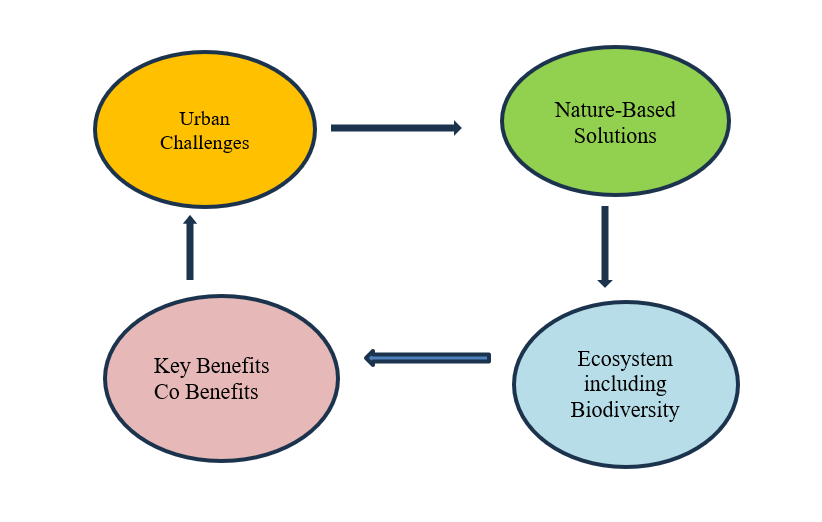
To illustrate the interconnectedness of these benefits, the following figure from Remme et al. (2024) shows a framework clarifying the relationship between NBS and ecosystem services in urban systems, highlighting how NBS are designed to enhance the flow of multiple ecosystem services to address urban challenges.
Benefits of Nature-Based Solutions
Environmental benefits
The environmental benefits of nature-based solutions are substantial and well-documented. NBS can provide up to one-third of the climate mitigation required to meet Paris Agreement goals through carbon sequestration in forests, wetlands, and soils (Griscom et al.,2017). They also enhance biodiversity by creating and restoring habitats, thereby supporting ecosystem resilience in the face of climate change.
Social Benefits
Nature-based solutions enhance community resilience by reducing vulnerability to climate hazards such as flooding, extreme heat, and drought.
Access to green spaces and nature, as noted before, improves mental and physical health and reduces stress.
Economic Benefits
Nature-based solutions often represent cost-effective alternatives to traditional infrastructure. The global value of ecosystem services provided by NBS is estimated at $170 billion annually. (Costanza et al., 1997, pp. 253-260) When properly designed and maintained, NBS can be more affordable than grey infrastructure while delivering additional benefits that conventional infrastructure cannot provide.
Nature-based solutions create employment opportunities in restoration, maintenance, and management, generating green jobs that support local economies. They can also reduce energy costs through natural cooling and insulation and avoid the high maintenance and replacement costs associated with aging concrete infrastructure.
Case Studies Demonstrating the Effectiveness of Nature-Based Solutions
Real-world examples illustrate how nature-based solutions work effectively across diverse geographic and socioeconomic contexts. In Bangladesh, the restoration of mangrove forests along the Sundarbans Coastline has proven transformative. These Green walls protect vulnerable communities from storms and cyclones such as Cyclone Amphan in 2020 by dissipating wave energy and reducing erosion. (Mishra et al., 2021)
In Nairobi, Kenya, the Karura Forest restoration turned a degraded urban woodland into a thriving green lung. Community-led efforts planted native trees, restored wetlands, and created trails, cutting urban heat by up to 4°C, improving air quality, and providing recreational spaces for over one million residents. (Loice & Chebii, 2025)
Closer to home in Pakistan, the Billion Tree Tsunami project in Khyber Pakhtunkhwa exemplifies NBS at scale. Planting native species across degraded lands has restored the watershed, reduced soil erosion, combated desertification, and sequestered carbon while creating 100000 green jobs. (Billion Tree Tsunami Afforestation Project KP, 2023) In flood-prone areas like Jhelum, similar reforestation efforts against monsoon deluges, providing NBS, can deliver resilient, cost-effective protection tailored to local ecosystems. (Nature-based Solutions | WWF, n.d.)
These cases highlight a common thread: nature-based solutions succeed when they integrate local knowledge, secure funding, and measure multiple outcomes, including carbon storage and community empowerment.
Conclusion
Nature-based solutions offer proven, multifaceted pathways to climate resilience, delivering environmental protection, social equity, and economic gains that grey infrastructure cannot match.
As the IUCN’s updated Global Standard was launched in October 2025, Scaling NBS requires clear guidelines, strong safeguards, and inclusive governance to ensure long-term success.
In Pakistan, examples such as Recharge Pakistan and Ten Billion Tree Tsunami show that NBS can transform flood-prone landscapes into resilient ecosystems, protecting communities while creating jobs.
Embracing NBS is essential to a sustainable, resilient future. Prioritizing their integration into policy and practice is imperative.